QUANTUM ALGORITHM
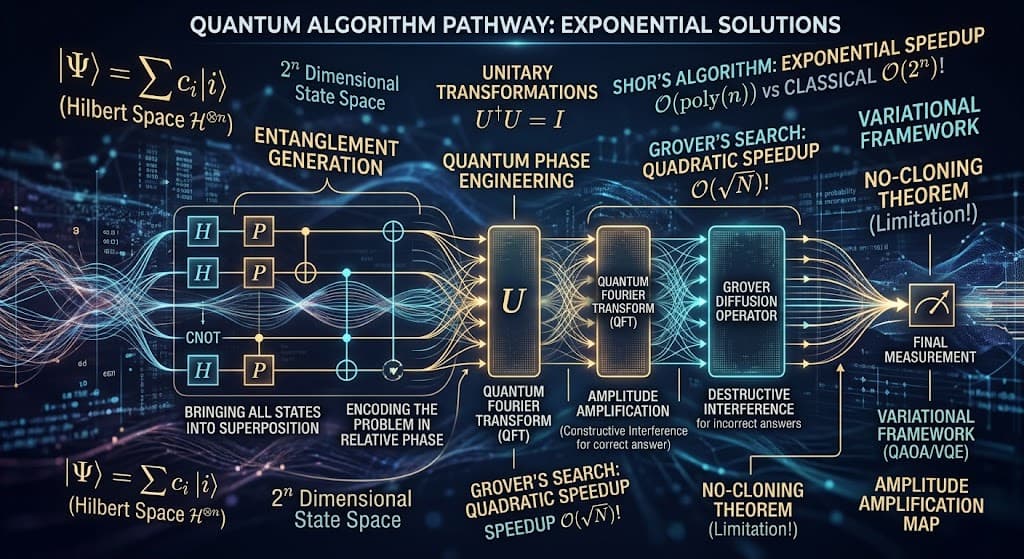
Quantum algorithms are computational procedures designed to exploit the principles of quantum mechanics to solve specific problems more efficiently than classical algorithms. By manipulating qubits through quantum gates and measurements, these algorithms can take advantage of quantum phenomena such as superposition, entanglement, and interference to perform computations in fundamentally different ways. However, quantum algorithms do not provide an advantage for every problem; their effectiveness depends on the nature of the task and the availability of suitable quantum hardware. Several well-known quantum algorithms demonstrate the potential of this approach. Shor’s algorithm can factor large integers exponentially faster than the best-known classical algorithms, with important implications for public-key cryptography. Grover’s algorithm provides a quadratic speedup for unstructured search problems. The Quantum Approximate Optimization Algorithm (QAOA) explores approximate solutions to certain optimization problems, while quantum phase estimation plays a central role in many quantum simulations. Together, these algorithms form a foundation for exploring applications in cryptography, optimization, chemistry, materials science, and other fields, although practical advantages remain dependent on error rates, hardware capabilities, and computational resources.