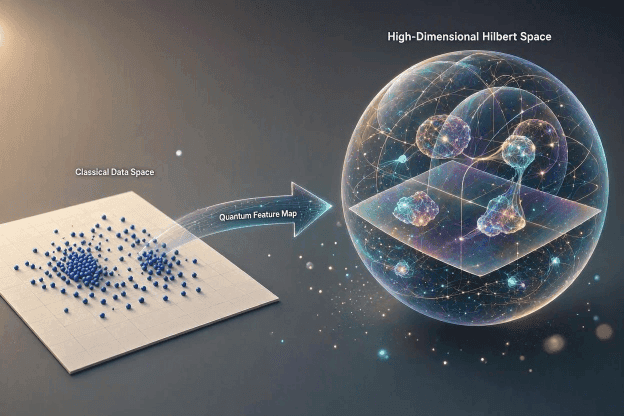
Quantum Artificial Intelligence
Quantum Artificial Intelligence (Quantum AI) is an interdisciplinary field at the intersection of artificial intelligence, machine learning, and quantum science and technology. It explores how the principles of quantum mechanics can be used to develop new approaches to data processing, learning, and solving computational problems. This field encompasses two main approaches: Quantum Machine Learning (QML), which uses quantum algorithms and systems to perform machine learning tasks, and the application of artificial intelligence techniques to analyze, control, and optimize quantum systems. The first approach investigates concepts such as superposition, entanglement, and quantum circuits in the design of algorithms for classification, clustering, data analysis, and pattern recognition. The goal of Quantum AI is to develop methods that combine the capabilities of artificial intelligence and quantum computing to address specific computational problems. Potential applications include complex data analysis, optimization, simulation of physical and chemical systems, materials discovery, and the development of machine learning models. However, this field is still under active research and development, facing challenges such as hardware errors, limitations in the number and quality of qubits, data-loading costs, and the difficulty of demonstrating advantages over classical methods. Therefore, although Quantum AI has considerable scientific and technological potential, its practical advantages over classical artificial intelligence have not yet been conclusively established for many applications.