quantum sensing
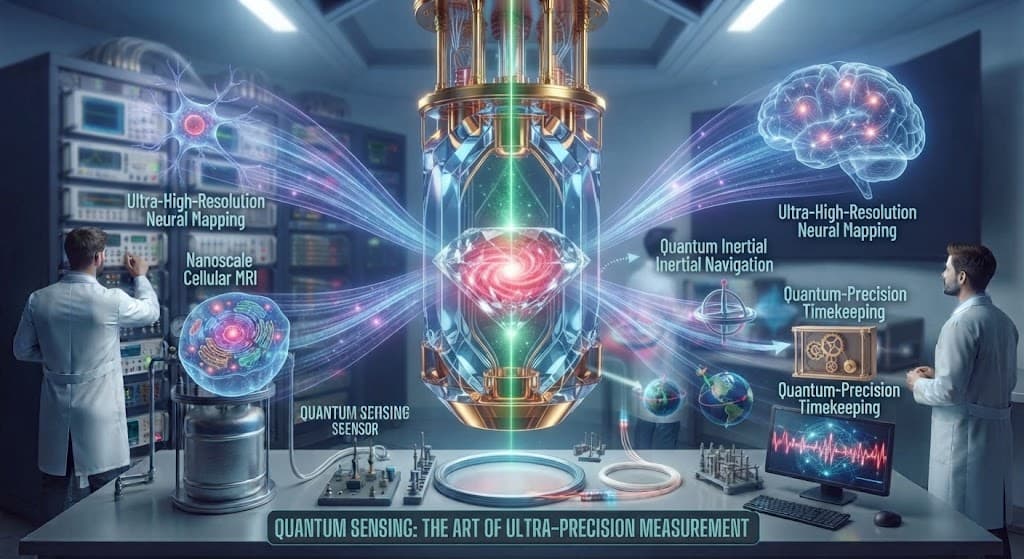
Quantum Sensing is a field of quantum technology that uses the principles of quantum mechanics, including superposition, entanglement, and the sensitivity of quantum states to environmental changes, to measure physical quantities with high precision. By employing systems such as atoms, ions, photons, and defects in solid-state materials, quantum sensing enables the measurement of quantities such as magnetic and electric fields, time, acceleration, rotation, temperature, and gravity. For example, atomic clocks use atomic energy transitions to measure time with extremely high precision, while quantum magnetometers can detect very subtle variations in magnetic fields. Quantum sensing has a wide range of applications in fundamental science, medicine, navigation, geology, and environmental monitoring. Examples include magnetic imaging of brain and heart activity, the development of precise navigation systems for situations in which access to GPS is limited, the detection of subsurface geological changes, and the improvement of precision measurements in laboratories. However, the performance of quantum sensing systems depends on factors such as environmental noise, equipment stability, operating conditions, and calibration methods. Although quantum sensing can improve measurement precision or sensitivity in certain applications, its advantages over classical sensing methods depend on the type of sensor, the measurement conditions, and the intended application.