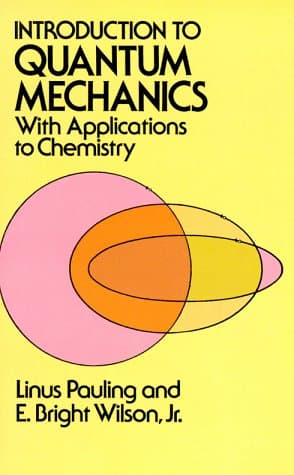
Introduction to Quantum Mechanics with Applications to Chemistry
Author: Linus Pauling, E. Bright Wilson, Jr
Introduction to Quantum Mechanics with Applications to Chemistry, written by Linus Pauling and E. Bright Wilson, is a classic textbook that introduces the principles of quantum mechanics with particular emphasis on their applications to chemical and molecular systems. Originally published in 1935, the book was designed for chemistry students, experimental physicists, and beginning students of theoretical physics. The book begins with an overview of classical mechanics and the early quantum theory before developing the foundations of wave mechanics and the Schrödinger equation. Its main topics include wave functions, the hydrogen atom, perturbation theory, variational methods, electron spin, the Pauli exclusion principle, many-electron atoms, and the rotational and vibrational properties of molecules. It also discusses the application of quantum mechanics to the structures of simple and complex molecules. A central contribution of this work is its systematic connection between quantum theory and chemical phenomena. It demonstrates how quantum-mechanical principles can be used to understand atomic and molecular structures, chemical bonding, intermolecular interactions, and molecular properties. Although it predates many modern developments in quantum chemistry, it remains historically and educationally valuable as a foundational text connecting quantum mechanics with chemistry.
Read the introduction- Pages
- 468
- Language
- انگلیسی
- Reading level
- Intermediate
About the book
Introduction to Quantum Mechanics with Applications to Chemistry, written by Linus Pauling and E. Bright Wilson, is a classic textbook that introduces the principles of quantum mechanics with particular emphasis on their applications to chemical and molecular systems. Originally published in 1935, the book was designed for chemistry students, experimental physicists, and beginning students of theoretical physics.
The book begins with an overview of classical mechanics and the early quantum theory before developing the foundations of wave mechanics and the Schrödinger equation. Its main topics include wave functions, the hydrogen atom, perturbation theory, variational methods, electron spin, the Pauli exclusion principle, many-electron atoms, and the rotational and vibrational properties of molecules. It also discusses the application of quantum mechanics to the structures of simple and complex molecules.
A central contribution of this work is its systematic connection between quantum theory and chemical phenomena. It demonstrates how quantum-mechanical principles can be used to understand atomic and molecular structures, chemical bonding, intermolecular interactions, and molecular properties. Although it predates many modern developments in quantum chemistry, it remains historically and educationally valuable as a foundational text connecting quantum mechanics with chemistry.
How this book helps
Quantum Chemistry: Applying quantum mechanics to analyze the electronic structures of atoms and molecules and understand chemical bonding.
Atomic and Molecular Structure: Studying energy levels, electron distributions, and the properties of atoms and molecules.
Molecular Spectroscopy: Analyzing energy levels and quantum transitions associated with molecular rotation, vibration, and radiation interactions.
Physical Chemistry: Understanding the quantum foundations of the physical and chemical properties of materials and molecular systems.
Chemical Bonding: Investigating electronic structures and the role of the Pauli exclusion principle in molecular formation.
Computational Chemistry and Approximation Methods: Applying perturbation theory and variational methods to analyze complex quantum systems.
Atomic and Molecular Physics: Studying many-electron atoms, electron spin, and quantum interactions.
What you will learn
Explain the foundations of quantum mechanics and its historical development from the old quantum theory to wave mechanics.
Apply the Schrödinger equation to standard atomic and molecular problems.
Analyze wave functions and the energy structure of the hydrogen atom.
Explain the role of electron spin and the Pauli exclusion principle in many-electron atoms.
Investigate the quantum structures and properties of simple and complex molecules.
Understand the quantum foundations of molecular rotation and vibration and their relationship to molecular spectra.
Apply approximation methods such as perturbation theory and the variational method to quantum problems.
Understand the relationship between quantum mechanics, physical chemistry, and molecular structure.
Contributors
- Author
- Linus Pauling, E. Bright Wilson, Jr
Publication and reading details
- Publisher
- McGraw-Hill Book Company
- Published
- 1935
- Language
- انگلیسی
- Pages
- 468
- Edition
- 2
- Format
- Text
- Reading level
- Intermediate
- Category
- Quantum Chemistry
Book identifiers
- ISBN
- 9780486648712