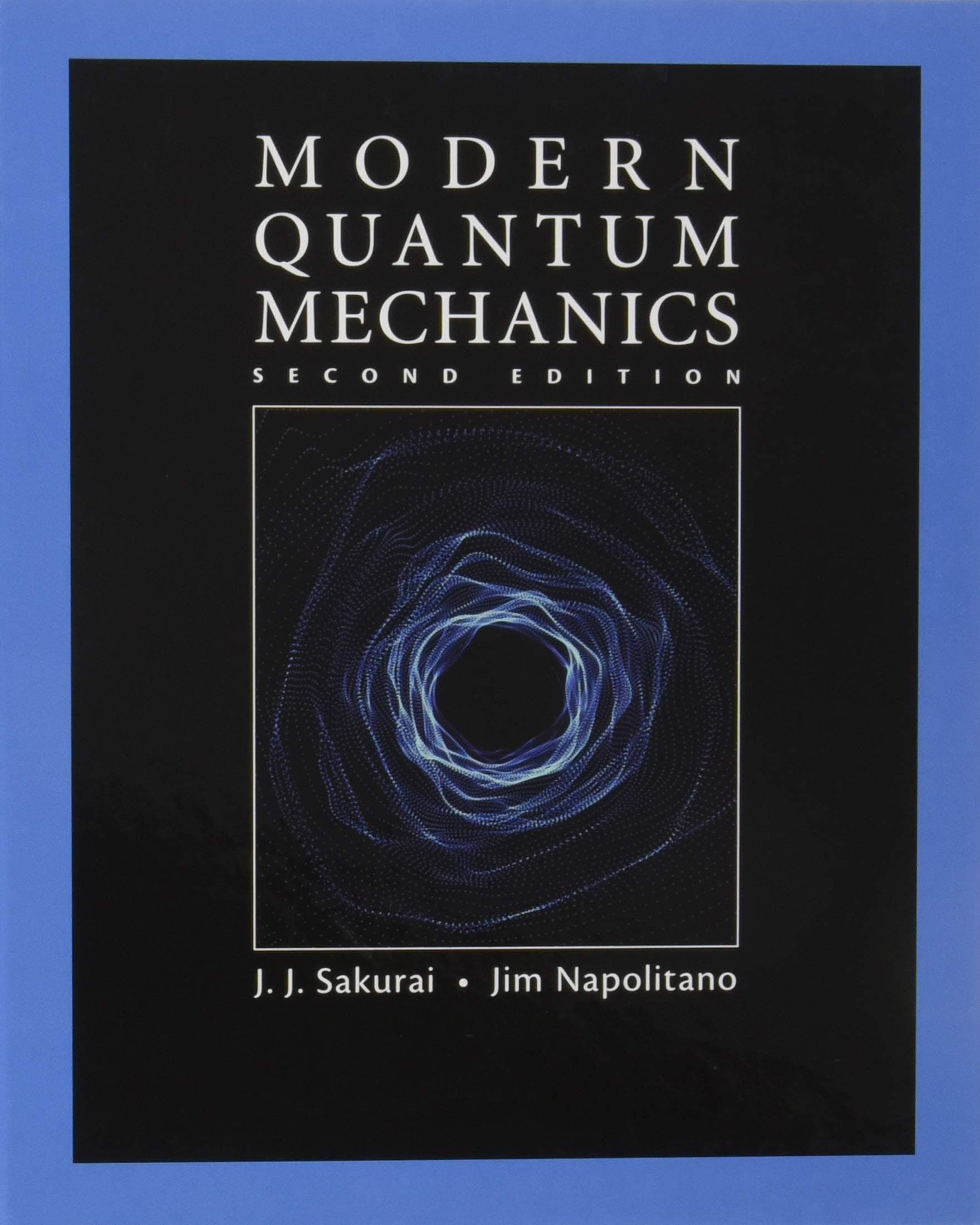
Modern Quantum Mechanics
Author: J. J. Sakurai
Modern Quantum Mechanics is a classic and widely respected textbook for advanced undergraduate and graduate-level study of quantum mechanics. J. J. Sakurai presents the fundamental principles of quantum theory through a modern, mathematically rigorous approach that emphasizes the underlying structure of the theory rather than following a purely historical sequence. The book introduces key concepts such as the Stern–Gerlach experiment, quantum state vectors, Dirac bra–ket notation, operators, matrix representations, measurements, and observables. It then develops the principles of quantum dynamics, including time evolution and the relationship between the Schrödinger and Heisenberg pictures. The book also provides a detailed treatment of angular momentum and spin, symmetry principles and conservation laws, approximation methods, perturbation theory, scattering theory, identical particles, and relativistic quantum mechanics. Revised editions prepared by Jim Napolitano retain Sakurai’s original approach while updating and extending the material. They also discuss important topics such as Feynman path integrals, quantum correlation measurements, and Bell’s inequality. Through its combination of mathematical formalism and physical interpretation, the book provides a strong theoretical foundation for advanced studies in theoretical physics and related areas of quantum science.
Read the introduction- Pages
- 550
- Reading level
- Advanced
About the book
Modern Quantum Mechanics is a classic and widely respected textbook for advanced undergraduate and graduate-level study of quantum mechanics. J. J. Sakurai presents the fundamental principles of quantum theory through a modern, mathematically rigorous approach that emphasizes the underlying structure of the theory rather than following a purely historical sequence. The book introduces key concepts such as the Stern–Gerlach experiment, quantum state vectors, Dirac bra–ket notation, operators, matrix representations, measurements, and observables. It then develops the principles of quantum dynamics, including time evolution and the relationship between the Schrödinger and Heisenberg pictures.
The book also provides a detailed treatment of angular momentum and spin, symmetry principles and conservation laws, approximation methods, perturbation theory, scattering theory, identical particles, and relativistic quantum mechanics. Revised editions prepared by Jim Napolitano retain Sakurai’s original approach while updating and extending the material. They also discuss important topics such as Feynman path integrals, quantum correlation measurements, and Bell’s inequality. Through its combination of mathematical formalism and physical interpretation, the book provides a strong theoretical foundation for advanced studies in theoretical physics and related areas of quantum science.
How this book helps
Advanced study and teaching of quantum mechanics at the senior undergraduate and graduate levels.
Mathematical analysis of quantum states, operators, measurements, and time evolution.
Investigation of angular momentum, spin, symmetries, and conservation laws.
Application of perturbation theory and approximation methods to quantum systems.
Theoretical preparation for research in particle physics, quantum field theory, and quantum information science.
Supporting foundational research related to quantum systems, quantum computing, and quantum technologies.
What you will learn
Developing a rigorous understanding of the operator formulation of quantum mechanics and Dirac notation.
Understanding the relationships among quantum states, observables, measurements, and time evolution.
Analyzing the role of symmetries and conservation laws in quantum systems.
Applying time-independent and time-dependent perturbation theory to appropriate quantum problems.
Understanding angular momentum, spin, and angular-momentum addition rules.
Gaining familiarity with scattering theory, identical particles, and relativistic quantum mechanics.
Building the theoretical background required for further study of advanced quantum physics and quantum field theory.
Contributors
- Author
- J. J. Sakurai
- Editor
- Jim Napolitano
Publication and reading details
- Publisher
- Cambridge University Press
- Published
- 1985-2020
- Pages
- 550
- Edition
- 3
- Format
- Text
- Reading level
- Advanced
- Category
- Quantum Mechanics
Book identifiers
- ISBN
- ۹۷۸۱۱۰8422413