Principles of Quantum Mechanics
Author: Ramamurti Shankar
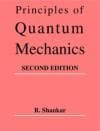
Principles of Quantum Mechanics by Ramamurti Shankar is a comprehensive and mathematically oriented textbook that develops the foundations of quantum mechanics in a systematic manner. The book begins with a self-contained mathematical introduction and a review of classical mechanics, establishing the conceptual and mathematical background required to understand quantum theory. It then develops the fundamental postulates of quantum mechanics, including the description of quantum states, operators, measurements, and time evolution. A major strength of the book is its detailed treatment of the mathematical structure underlying quantum theory and its connection to physical phenomena. Core topics include the harmonic oscillator, Heisenberg uncertainty relations, systems with multiple degrees of freedom, symmetries, angular momentum, the hydrogen atom, spin, and the addition of angular momenta. The text also introduces important approximation techniques, including the variational method, the WKB approximation, and time-independent and time-dependent perturbation theory. The advanced chapters cover scattering theory, the Dirac equation, and the path integral formulation of quantum mechanics. The second edition includes a substantially revised mathematical introduction, a discussion of time-reversal invariance, and expanded coverage of path integrals and their applications. Supported by extensive exercises and references, the book serves as a rigorous textbook for advanced undergraduate and graduate students studying theoretical quantum mechanics.
Read the introduction- Pages
- 676
- Language
- انگلیسی
- Reading level
- Beginner
About the book
Principles of Quantum Mechanics by Ramamurti Shankar is a comprehensive and mathematically oriented textbook that develops the foundations of quantum mechanics in a systematic manner. The book begins with a self-contained mathematical introduction and a review of classical mechanics, establishing the conceptual and mathematical background required to understand quantum theory. It then develops the fundamental postulates of quantum mechanics, including the description of quantum states, operators, measurements, and time evolution.
A major strength of the book is its detailed treatment of the mathematical structure underlying quantum theory and its connection to physical phenomena. Core topics include the harmonic oscillator, Heisenberg uncertainty relations, systems with multiple degrees of freedom, symmetries, angular momentum, the hydrogen atom, spin, and the addition of angular momenta. The text also introduces important approximation techniques, including the variational method, the WKB approximation, and time-independent and time-dependent perturbation theory.
The advanced chapters cover scattering theory, the Dirac equation, and the path integral formulation of quantum mechanics. The second edition includes a substantially revised mathematical introduction, a discussion of time-reversal invariance, and expanded coverage of path integrals and their applications. Supported by extensive exercises and references, the book serves as a rigorous textbook for advanced undergraduate and graduate students studying theoretical quantum mechanics.
How this book helps
Quantum Mechanics Education and Research
Atomic and Molecular Physics
Theoretical Physics
Approximation Methods in Quantum Mechanics
Relativistic Quantum Mechanics
Quantum Scattering Theory
Path Integral Formulation of Quantum Theory
What you will learn
Understand the mathematical foundations of quantum mechanics, including state spaces, vectors, and operators.
Explain the postulates of quantum mechanics and their physical implications.
Analyze quantum measurements and time evolution.
Solve quantum mechanical problems involving harmonic oscillators, hydrogen atoms, and spin.
Examine the role of symmetries and conservation laws in quantum systems.
Apply variational, WKB, and perturbation methods to approximate quantum problems.
Understand the fundamentals of scattering theory and the Dirac equation.
Explain and use the path integral formulation of quantum mechanics.
Contributors
- Author
- Ramamurti Shankar
Publication and reading details
- Publisher
- Plenum Press / Springer
- Published
- 1980
- Language
- انگلیسی
- Pages
- 676
- Edition
- 2
- Format
- Text
- Reading level
- Beginner
- Category
- Quantum Mechanics
Book identifiers
- ISBN
- 978-0-306-44790-7