Bell’s Theorem and the CHSH Inequality One of the strangest features of quantum mechanics is quantum entanglement. When two particles are entangled, measurements on them can reveal correlations that defy our classical intuition. This raises a fundamental question.
Are these strange correlations genuinely quantum, or did the particles have their properties all along, with us simply unaware of them?
This question was at the heart of the famous EPR argument. In 1935, Albert Einstein, Boris Podolsky, and Nathan Rosen argued that quantum mechanics might give an incomplete description of reality and that hidden variables might determine the particles’ true state.
Nearly three decades later, the Irish physicist John Bell showed how to turn this philosophical debate into a question that could be tested experimentally. The result is what we now call Bell’s theorem and Bell inequalities.
What Exactly Is the Question?
Suppose we prepare two entangled particles and send them in different directions, one to an experimenter named Alice and the other to an experimenter named Bob. Alice and Bob are far apart, and each performs a measurement on their own particle (Figure 1).
They record their measurement outcomes and later compare them. The question is whether a classical theory can explain the correlations between their results.
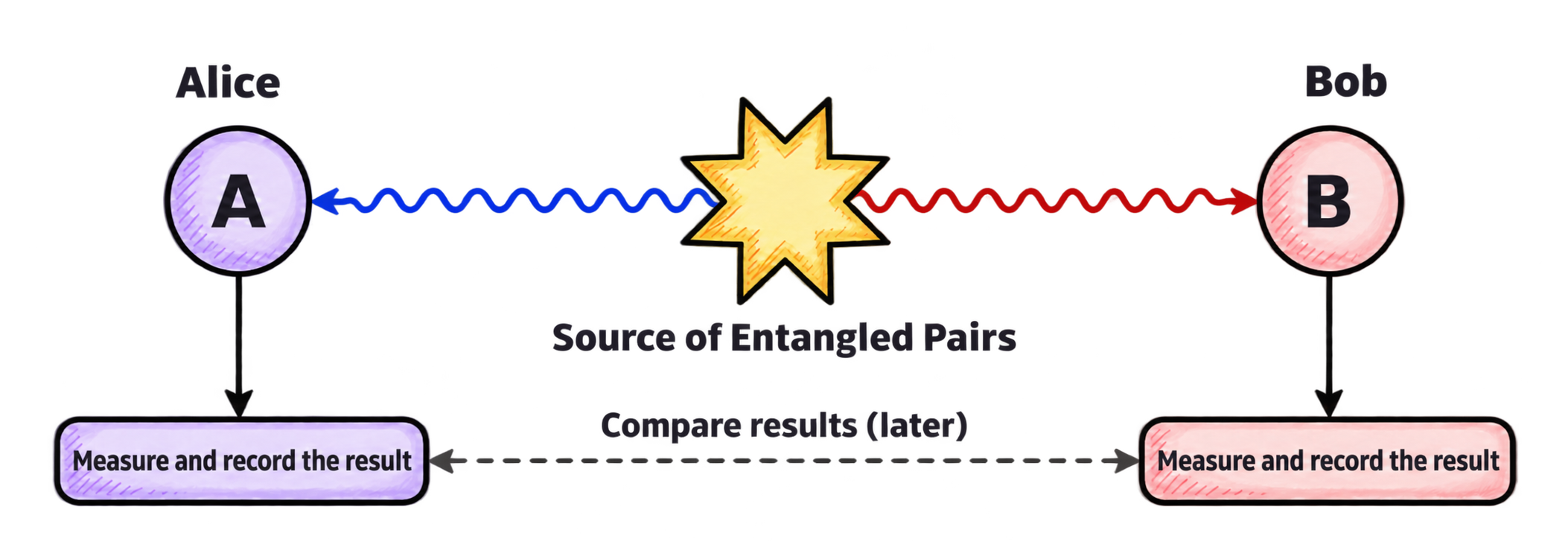
Figure 1. The basic setup of a Bell experiment. A source sends one particle from an entangled pair to Alice and the other to Bob. Each makes a measurement, and they compare their results later.
The Idea of Hidden Variables
To understand Bell’s idea, let us begin with a classical explanation. Imagine two balls, one red and one blue. We put them in separate boxes and send the boxes to two distant locations. When Alice opens her box and sees the red ball, she immediately knows that Bob’s ball is blue.
The explanation is simple: each ball had its color from the start.
Some physicists initially thought that quantum particles might behave in much the same way. The particles might carry hidden variables that determine the outcome of a measurement in advance. In this picture, quantum mechanics provides only partial information about the particle’s true state.
Two Key Assumptions: Realism and Locality
This kind of explanation is often presented in terms of two assumptions.
Realism. The system’s physical properties have definite values before measurement, even if we do not know those values. In the deterministic picture described here, the particle already has an answer for each possible measurement.
Locality. The outcome of a measurement at one location cannot be immediately influenced by the choice of measurement at a distant location. This assumption is closely related to the speed-of-light limit on information transfer in special relativity. Together, these assumptions describe the kind of local hidden-variable models considered here. Bell showed that such models cannot reproduce all the predictions of quantum mechanics.
Bell’s Main Idea
Bell’s insight was that if particles carry local hidden variables, and if the measurement settings are chosen independently of those variables, the correlations between measurement outcomes cannot exceed a certain limit. We call this mathematical constraint a Bell inequality.
Quantum mechanics predicts that some entangled states violate this limit. The two approaches therefore make different predictions, and an experiment can test which prediction agrees with nature (Figure 2).
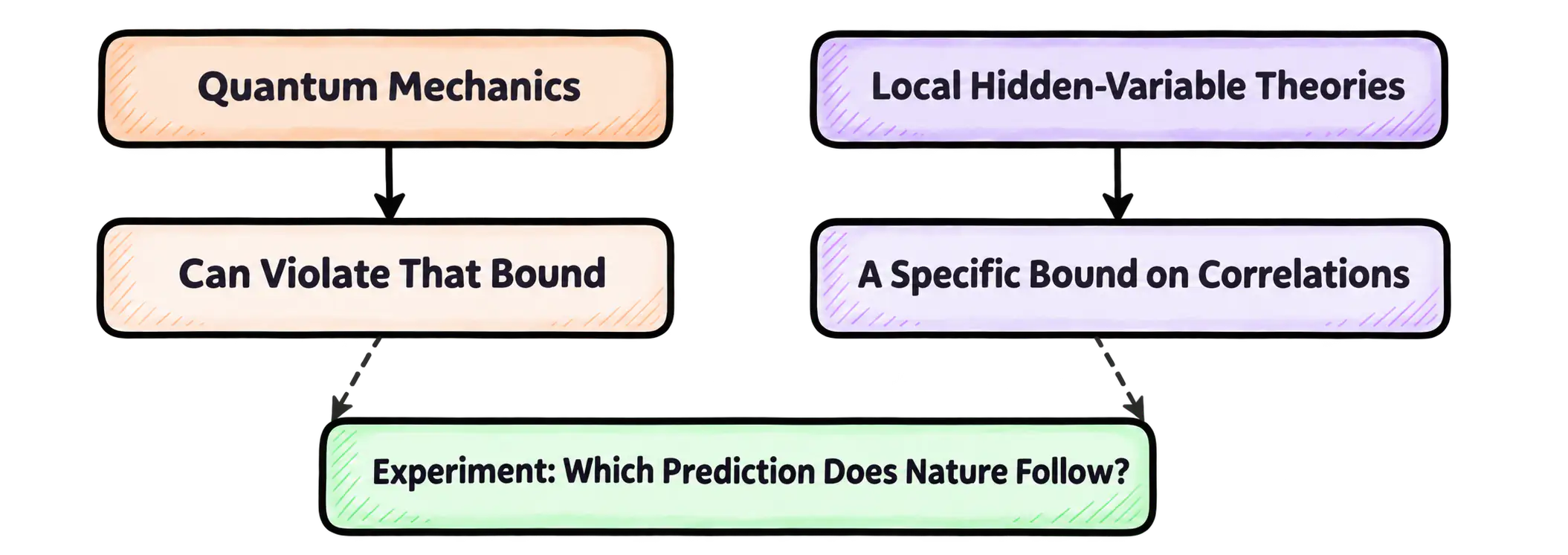
Figure 2. Two theories make different predictions, and an experiment can distinguish between them.
The CHSH Inequality: A Common Form of Bell Test
One of the best-known Bell inequalities is the CHSH inequality, named after John F. Clauser, Michael A. Horne, Abner Shimony, and Richard A. Holt.
Suppose Alice can choose between two measurement settings, and , and Bob can choose between and . Each measurement yields one of two outcomes, or .
We define the correlation between Alice’s and Bob’s outcomes for settings and as In other words, we multiply the two outcomes in each run with those settings and average the products. If the outcomes always have the same sign, . If they always have opposite signs, . If the outcomes agree just as often as they disagree, .
We now define a quantity by
The CHSH inequality states that
This is one of the central equations in Bell’s theorem. It means that a local hidden-variable model satisfying the assumptions above can give a value of no greater than .
What Does Quantum Mechanics Predict?
Quantum mechanics predicts that, with a suitable entangled state and suitable measurement settings, we can reach
which exceeds . Quantum mechanics therefore allows values in the range
In this range, the predictions of quantum mechanics differ from those of local hidden-variable models.
The Difference in a Single Picture
Figure 3 shows on an axis. Local hidden-variable models allow values up to , while quantum mechanics allows values up to . An experimental violation of the bound rules out the local hidden-variable models covered by the inequality.
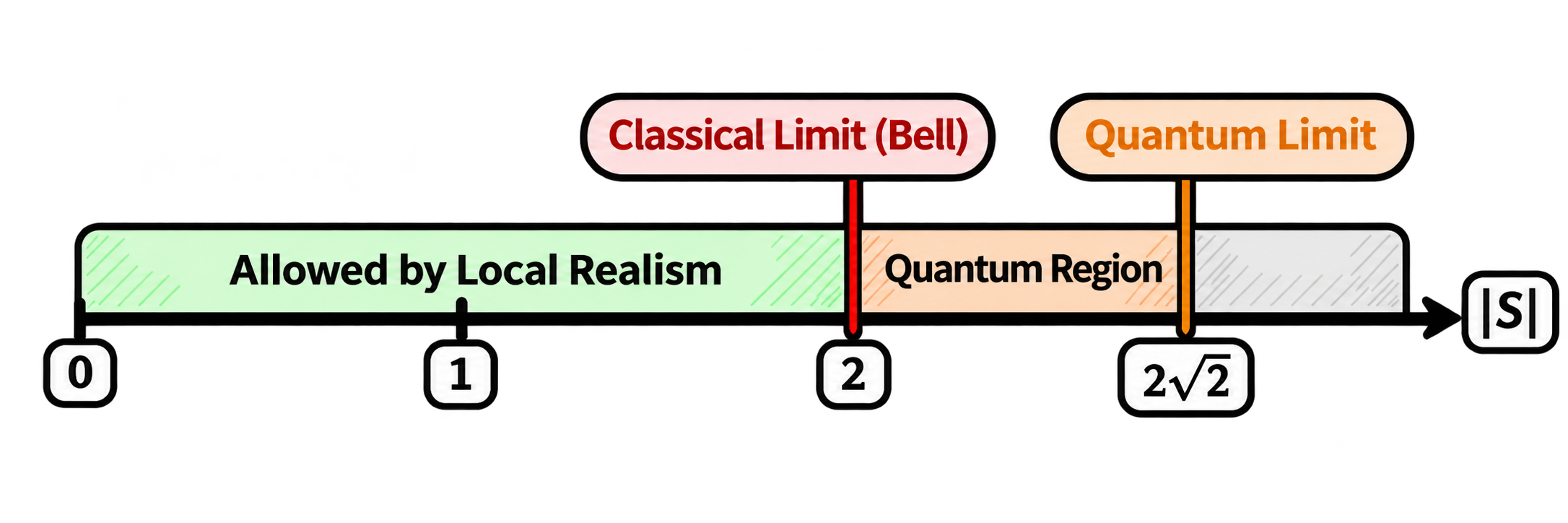
Figure 3. The axis shows possible values of . The green region is compatible with local hidden-variable models. The orange region is accessible to quantum mechanics and lies outside the local hidden-variable bound.
Why Is This Result So Important?
At first glance, this may seem like a purely mathematical difference, but its implications run much deeper. Suppose we accept both of the following statements.
The particles carry predetermined answers for all possible measurement settings.
Alice’s choice of measurement setting cannot immediately affect the outcome of Bob’s distant measurement.
Bell showed that this picture cannot account for all the predictions of quantum mechanics. The analogy with the red and blue balls, whose colors were fixed from the start, is therefore insufficient to explain entanglement. Bell experiments show that quantum correlations go beyond what this kind of explanation can account for.
An Example with Entangled Photons
Consider a source that produces pairs of entangled photons. One photon travels to Alice and the other to Bob. Each experimenter has a polarization analyzer that can be set to different angles (Figure 4).
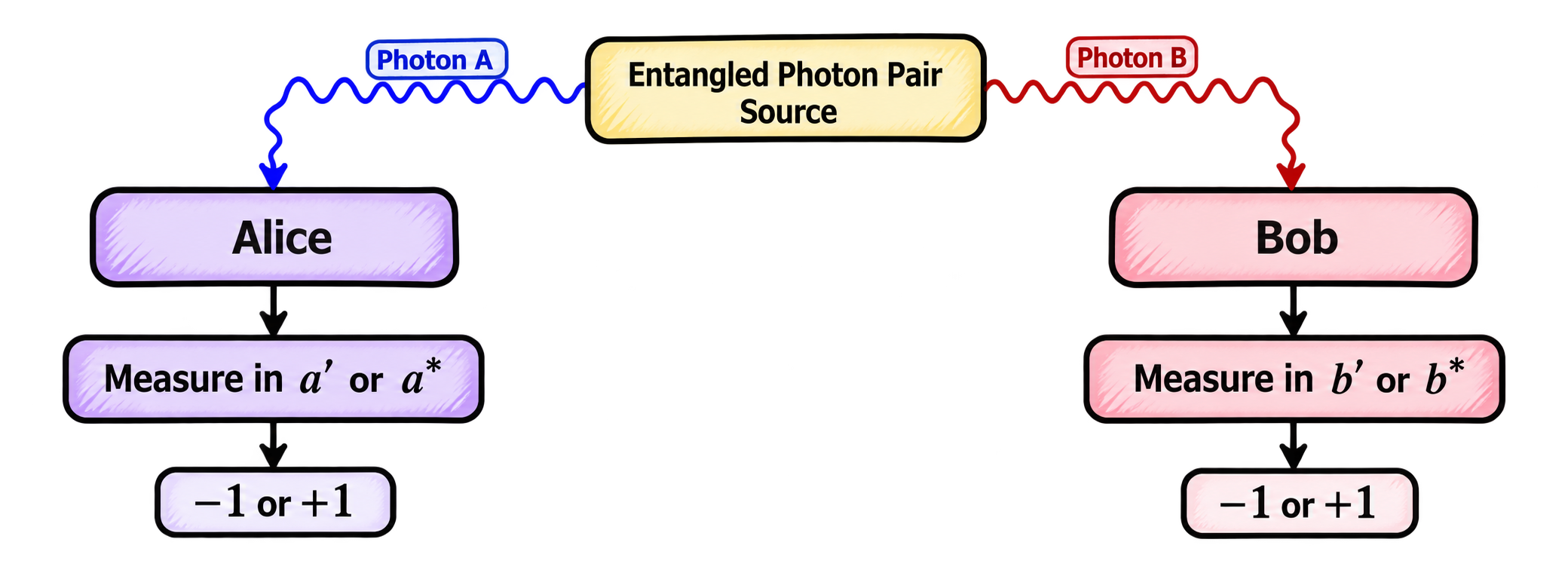
Figure 4. A Bell test with photons. On each trial, Alice and Bob each choose one of two angles for their polarization analyzer and record an outcome of or .
On each trial, Alice and Bob each choose one of their settings. After many trials, they combine their data and calculate . If , the CHSH inequality is violated.
Why Do We Need Different Measurement Settings?
If Alice and Bob each use the same fixed setting on every trial, they cannot carry out a CHSH test. Alice must be able to choose between and , and Bob between and . They then estimate the four correlations
and substitute them into the CHSH expression:
If , the Bell inequality is violated.
Why Can Quantum Mechanics Reach ?
To see where this value comes from, let us use a well-known entangled state:
For photons in this state, the labels and represent horizontal and vertical polarization, respectively. If Alice sets her polarization analyzer to angleand Bob sets his to angle, quantum mechanics predicts
Let Alice’s angles be and , and Bob’s angles be and . The first three correlations in the CHSH expression are then equal to , and the last is equal to . Substituting these values gives
The value is the maximum that quantum mechanics allows for . It is known as the Tsirelson bound.
is the bound for local hidden-variable models, often called the classical bound.
is the quantum bound, also called the Tsirelson bound.
is the range of CHSH violations attainable in quantum mechanics.
Have Experiments Actually Violated Bell Inequalities?
Yes. Scientists have tested Bell inequalities in a variety of experiments since the 1970s. Early experiments used entangled photons, and advances in technology made increasingly precise tests possible.
One of the main challenges was addressing experimental loopholes<sup>10</sup>. For example, if some particles go undetected, the detected particles may fail to represent the full set of trials. The test also depends on choosing the measurement settings with sufficient randomness and independence. Researchers designed more precise experiments to close these loopholes.
In 2015, independent teams in Delft, Vienna, and Boulder reported experiments that closed the major loopholes simultaneously. The results agreed with the predictions of quantum mechanics. The 2022 Nobel Prize in Physics went to Alain Aspect, John F. Clauser, and Anton Zeilinger for pioneering experiments with entangled photons that demonstrated violations of Bell inequalities and helped lay the foundations of quantum information science.
Does Bell’s Theorem Say That the World Is Nonlocal?
Popular accounts sometimes put it this way:
Bell’s theorem proved that the world is nonlocal.
The theorem makes a more precise claim. A local hidden-variable theory satisfying Bell’s assumptions cannot reproduce all the predictions of quantum mechanics.
The no-signaling principle still holds, so entanglement cannot be used to send a message of one’s choosing faster than light. Violating a Bell inequality reveals a property of the correlations between measurements. Sending a message would require control over what the other party observes locally.
What Did Bell Rule Out?
Bell’s theorem establishes a specific limit on how we can explain quantum correlations. Under the assumptions of a Bell test, the following three claims cannot all hold at the same time:
Hidden variables account for the measurement outcomes.
- Locality holds in the sense used in Bell’s framework.
- The model reproduces all quantum predictions about the correlations between entangled particles.
A deeper theory that reproduces the predictions of quantum mechanics must therefore give up at least one of the assumptions behind this classical picture. This is one reason Bell’s theorem is so important to the foundations of physics.
How Are Entanglement, EPR, and Bell Connected?
Figure 5 brings the story together in a simple sequence.
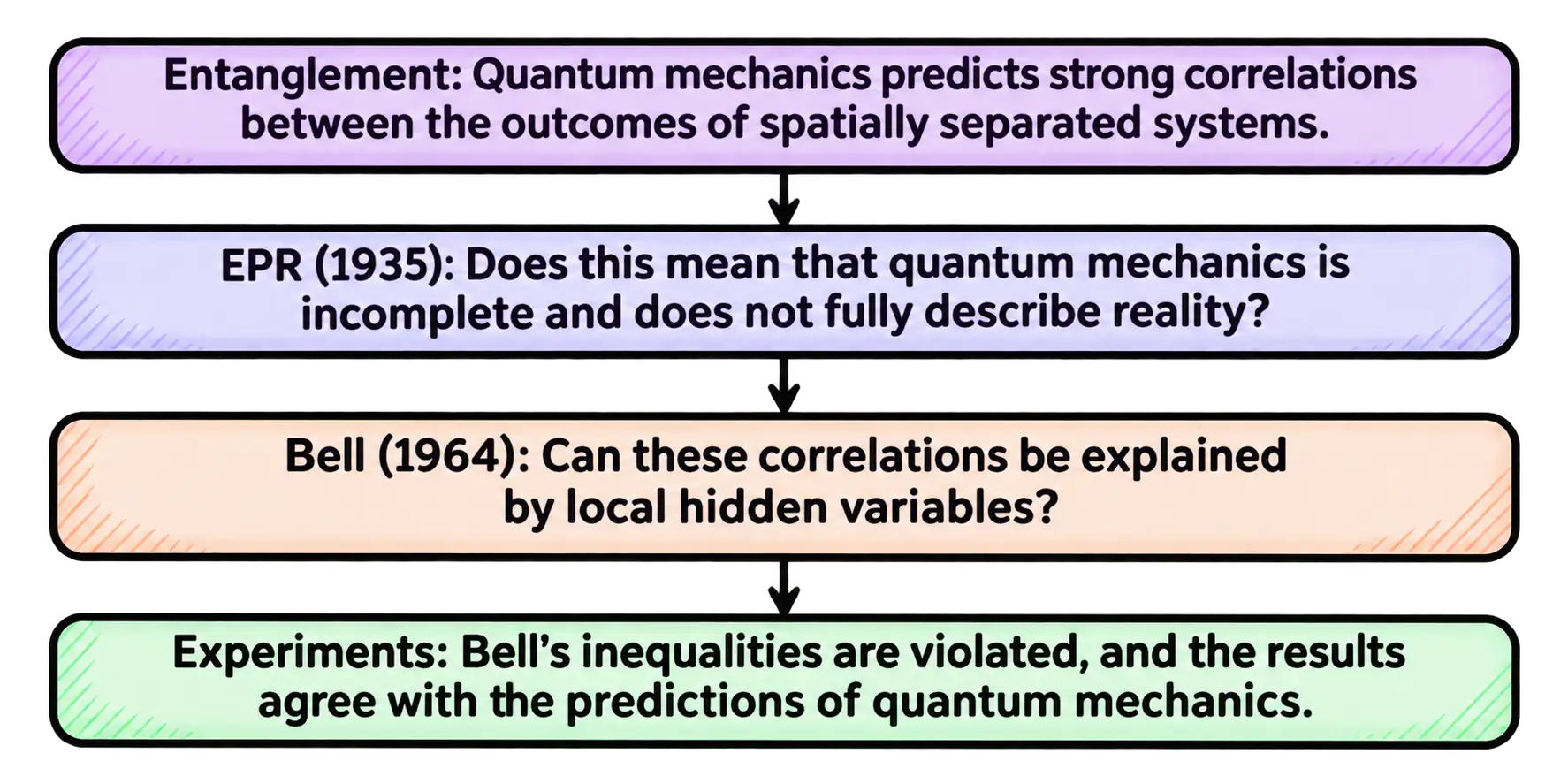
Figure 5. From entanglement to experiment. A series of ideas turned a philosophical question into an experimental test.
This is one of the most striking stories in the history of modern physics.
Why Bell’s Theorem Matters for Quantum Technologies
Bell’s theorem grew out of a foundational question, and today nonlocal correlations and Bell tests also matter in quantum technology. Some protocols, for example, use violations of Bell inequalities to certify quantum correlations. This idea has applications in areas such as
quantum communication,
reliable random number generation,
quantum cryptography,
quantum networks, and
testing and validating quantum systems.
What began as a question about the nature of reality has become part of quantum information science.
Conclusion: What Exactly Did Bell Tell Us?
Two entangled particles can exhibit correlations that exceed the limit allowed by local hidden-variable models. In the CHSH formulation, that limit is . Quantum mechanics allows to reach , and a suitable state and choice of measurement settings attain that value.
Bell experiments have observed violations of Bell inequalities. The results cannot be explained by the simple picture in which particles carry a set of predetermined answers while satisfying Bell’s locality and measurement-independence assumptions.
Perhaps the most striking result is that Bell’s theorem turned what once seemed to be a philosophical debate about reality into a question that could be settled by a physics experiment. Entanglement shows that nature can exhibit correlations that defy classical intuition. Bell’s theorem gives us a way to quantify and test that difference.
In the next article, we can take a closer look at what EPR actually argued and why Einstein described the kind of distant influence that concerned him as “spooky action at a distance.”
References
A. Einstein, B. Podolsky, and N. Rosen. “Can Quantum-Mechanical Description of Physical Reality Be Considered Complete?” Physical Review 47, 777 (1935).
J. S. Bell. “On the Einstein Podolsky Rosen Paradox.” Physics Physique Fizika 1, 195 (1964).