Imagine separating two particles and taking one to one side of the world and the other to the opposite side. Could they still somehow remain connected? This strange question lies at the heart of one of the most famous papers in the history of physics: the 1935 EPR paper. In this article, we will see what that paper argued, why it troubled Einstein, and how it ultimately led to modern experiments and technologies.
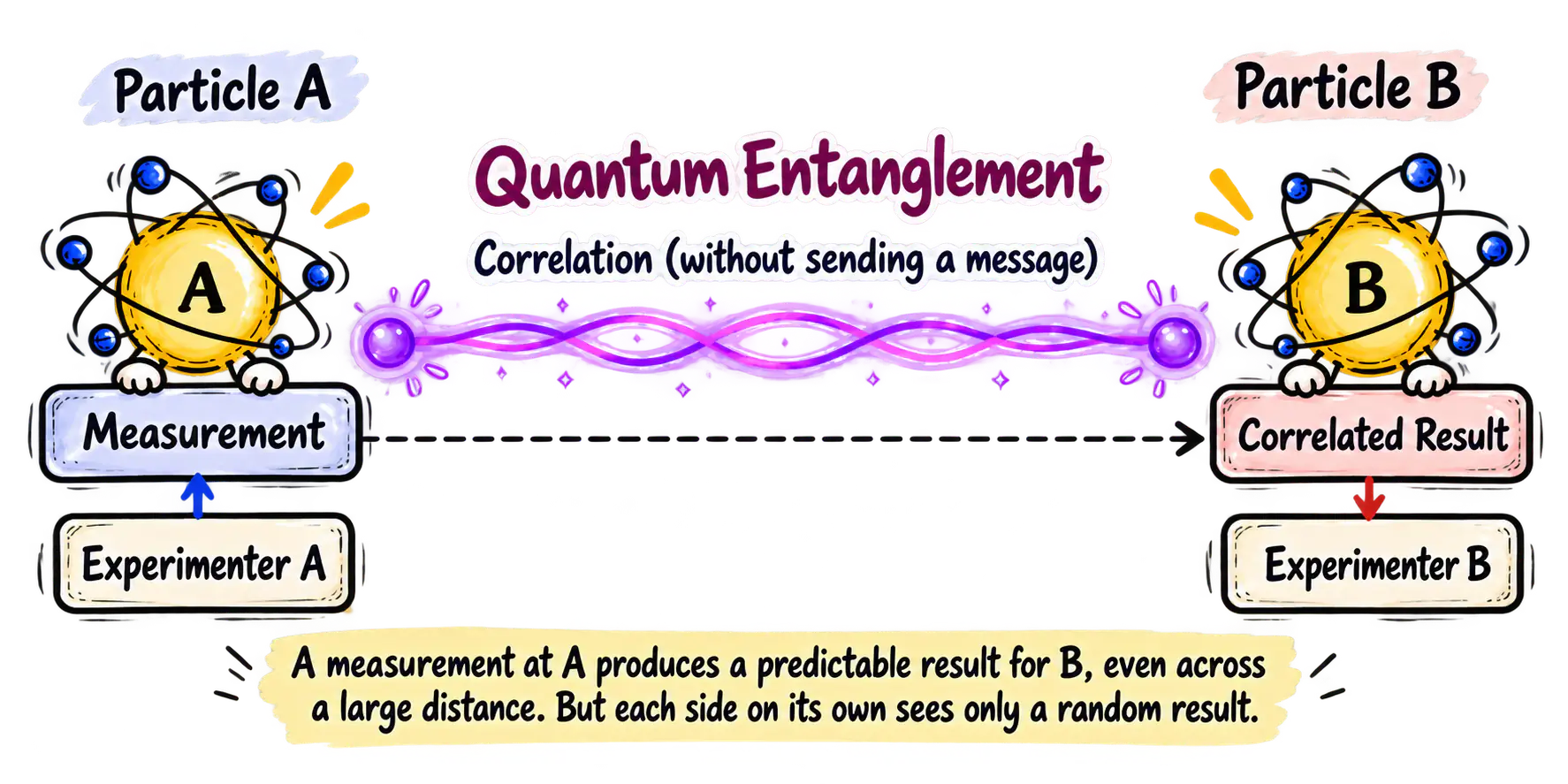
Figure 1: The basic picture of entanglement: two widely separated particles and two experimenters. The coordination between the results becomes apparent only when they are later compared; no signal is transmitted faster than light.
Entanglement: When Two Particles Still Form a Single System
Sometimes two particles, even after being separated, display coordinated behavior: if we measure one of them, we can predict the outcome of a measurement on the other, no matter how far apart they are. This phenomenon is called entanglement (Figure 1). The EPR paper placed this very phenomenon at the center of a major debate: what does quantum mechanics tell us about reality, and is its description complete?
The Birth of the EPR Debate (1935)
In May 1935, Albert Einstein, together with his two younger colleagues Boris Podolsky and Nathan Rosen, published a four-page paper in Physical Review. The title itself was a question: Can Quantum-Mechanical Description of Physical Reality Be Considered Complete? The paper later became known by the initials of its authors, EPR. It is also sometimes called the EPR paradox, although there is no logical contradiction involved; its main claim was that quantum mechanics might be missing something.
The basic idea is simple. Two particles are produced from a common source and then move apart, perhaps so far apart that one is on Earth and the other is in another galaxy. According to quantum mechanics, as long as no measurement has been made, only the state of the pair as a whole can be described. Neither particle carries a separate pre-existing label specifying exactly what its state is.
The Main Question: The Completeness of a Theory
What is interesting is that EPR did not dispute the predictions of quantum mechanics. They accepted that the theory worked correctly. Their question was whether the theory described all of physical reality, or whether some part of that reality had been left out.
To make the discussion precise, they proposed two definitions:
Condition of completeness: A theory is complete if every element of physical reality has a corresponding element in the theory.
Criterion of reality: If, without in any way disturbing a system, we can predict with certainty the value of a physical quantity, then that quantity corresponds to an element of reality.
The second criterion agrees quite naturally with common sense: if we can say exactly where something is without touching it, then it really is there.
A Simple Example: Before and After Measurement
To make the EPR idea more intuitive, let us begin with spin. Spin is an intrinsic property of a particle that can be thought of roughly as a kind of rotational direction, with the important difference that it can take only certain allowed values. For example, along the-axis it may be either up ↑ or down ↓.
Two particles can be prepared in a state known as the singlet state, in which the total spin of the pair is zero. The consequence is that if you measure the spin of particle A along some direction and obtain, for example,, then the spin of particle B along the same direction will necessarily be ↓. In simple terms, the spins of the two particles are always opposite.
The subtle point is this: before the measurement, quantum mechanics does not say that A is definitely up and B is definitely down. It says only that the pair is in a superposition in which both possibilities are present: A up and B down, and A down and B up. But once A is measured, the result for B along that same direction becomes certain, even if B is kilometers away.
EPR themselves formulated their argument in terms of position and momentum rather than spin. The spin version was introduced later by David Bohm and is usually used first because it is easier to understand.
The EPR Thought Experiment: Position and Momentum
Now let us turn to the original EPR argument. Consider two particles that have interacted for some time and then move apart in opposite directions. Particle 1 reaches Alice and particle 2 reaches Bob. EPR showed that quantum mechanics allows the two particles to occupy a state in which both their relative position and their total momentum are known exactly.
These two quantities can be specified precisely at the same time, and the uncertainty principle does not forbid this. Alice now has two choices:
- If she measures the position of particle 1, she can immediately and with certainty infer where particle 2 is:.
- If she measures the momentum of particle 1, she can immediately and with certainty infer the momentum of particle 2:.
The two particles may be kilometers apart. It therefore seems natural to assume that whatever Alice does to particle 1 cannot affect particle 2. This assumption is called locality.
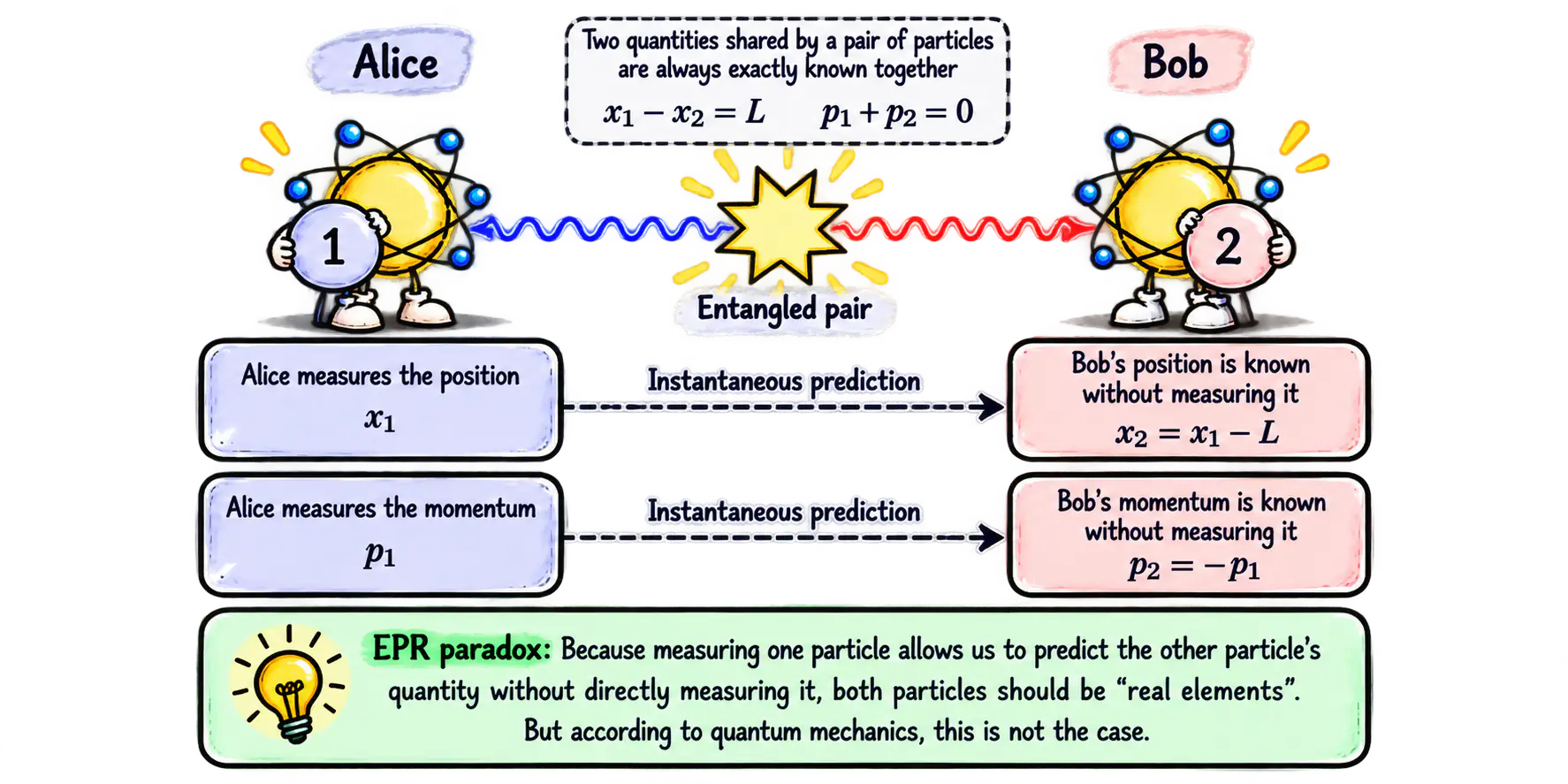
Figure 2: The EPR thought experiment; by measuring either the position or the momentum of particle 1, Alice can predict the corresponding quantity for particle 2 without touching particle 2.
The EPR Argument
From here, the EPR reasoning proceeds step by step:
Alice can predict the position of particle 2 without interacting with it. Therefore, according to the criterion of reality, the position of particle 2 is an element of reality.
By the same reasoning, the momentum of particle 2 is also an element of reality.
Particle 2 cannot know which measurement Alice will choose to perform. Therefore, it must possess both quantities simultaneously.
But according to the Heisenberg uncertainty principle, quantum mechanics allows no state in which both the position and momentum of a single particle have simultaneously definite values.
From the EPR point of view, only two possibilities remain: either quantum mechanics is incomplete, or Alice’s measurement instantaneously affects a distant particle. EPR regarded the second possibility as unacceptable and therefore concluded that quantum mechanics was not complete.
Einstein’s Concern: “Spooky Action at a Distance”
Einstein believed that things in the world possess real and definite properties whether or not we measure them. The idea that a measurement performed in one place could instantaneously determine the state of something elsewhere seemed unacceptable to him. Years later, in a 1947 letter to Max Born, he referred to this phenomenon as “spooky action at a distance.”
It is important, however, to be fair: the central concern of EPR was not that a signal could be transmitted faster than light. Their concern was the possible incompleteness of the quantum description and whether the world could be understood in a local and realist way. Even so, if we accept that quantum mechanics is the whole story and that nothing is hidden behind it, then we must accept correlations that do not fit comfortably with everyday intuition.
The solution Einstein preferred involved hidden variables: perhaps particles carry definite values from the beginning, values that quantum mechanics simply does not reveal. Decades later, however, it became clear that if such hidden variables are local, experiments rule out this possibility as well.
The Reactions
Niels Bohr responded a few months later in the same journal and under the same title. From Bohr’s point of view, one cannot speak about the reality of a physical quantity independently of the experimental arrangement used to measure it. Therefore, the EPR criterion of reality, however reasonable it may appear, does not work in the quantum world.
That same year, Erwin Schrödinger coined the term entanglement for this strange form of correlation and regarded it as a central feature of quantum mechanics. Schrödinger’s famous cat also emerged from the same set of debates.
Einstein himself was not entirely satisfied with the final wording of the EPR paper, which had been written by Podolsky. In a letter to Schrödinger, he complained that the main point had been buried beneath excessive erudition.
Nature’s Answer: Bell Tests
For nearly thirty years, the EPR debate seemed largely philosophical, as though no experiment could settle it. Then, in 1964, John Bell showed that it could.
Bell proved that if the “local and realist” picture—the kind of picture Einstein had in mind—were correct, then the correlations between the results obtained by the two observers could never exceed a certain bound. These bounds are known as Bell inequalities. Quantum mechanics, however, predicts that entangled particles can violate those limits.
From the 1970s onward, physicists such as John Clauser, Alain Aspect, and Anton Zeilinger carried out these experiments, and time after time the results agreed with quantum predictions. In 2015, loophole-free experiments in Delft and several other laboratories removed the remaining major doubts, and in 2022 the Nobel Prize in Physics was awarded to those three scientists.
The message of these experiments is clear: nature exhibits correlations that cannot be explained by a simple combination of local hidden variables and locality.
Does Entanglement Mean Faster-Than-Light Communication?
No. This is one of the most common misconceptions about entanglement. It is true that the results on the two sides are correlated, but each individual measurement result, considered on its own, is completely random. Alice has no way to send a message to Bob merely by choosing what or how to measure. This fact is known as the no-signaling principle.
The correlation between the results becomes visible only when Alice and Bob later compare their data using an ordinary communication channel, such as a telephone or the internet. Those channels do not operate faster than light. Entanglement therefore does not conflict with special relativity, which forbids the transmission of information faster than light.
The Legacy of EPR in Quantum Technologies
The EPR debate did not remain confined to philosophy. The same entanglement that troubled Einstein is now one of the most important resources in quantum technology:
Quantum computing: Entanglement between qubits is one of the main resources behind the power of many quantum algorithms.
Quantum communication: In quantum key distribution (QKD), and particularly in the E91 protocol, communication security is tied to the violation of Bell inequalities.
Quantum teleportation: With the help of entanglement and an ordinary classical communication channel, the quantum state of a particle can be transferred to another location; the matter itself is not transported.
Einstein wanted to show that quantum mechanics was incomplete, but the question he raised helped move quantum physics from abstract debate into the laboratory and eventually into technology. One might even say that EPR was one of the most productive mistakes in the history of science. What we learned from it is that, at microscopic scales, the world is not simply a collection of independent objects; it is also a network of correlations.

Figure 3: A conceptual illustration of entanglement: two separated particles connected by a quantum link, not by a wire or a classical wave. The EPR debate and modern quantum technologies are built on this very idea.
References
- A. Einstein, B. Podolsky, N. Rosen, “Can Quantum-Mechanical Description of Physical Reality Be Considered Complete?”, Physical Review 47, 777 (1935). https://doi.org/10.1103/PhysRev.47.777.
- N. Bohr, “Can Quantum-Mechanical Description of Physical Reality Be Considered Complete?”, Physical Review 48, 696 (1935). https://doi.org/10.1103/PhysRev.48.696.
- J. S. Bell, “On the Einstein Podolsky Rosen Paradox”, Physics 1, 195 (1964).
- The Nobel Prize in Physics 2022: https://www.nobelprize.org/prizes/physics/2022/summary/.