Introduction
In Italian, the suffix -ino plays a role somewhat similar to the Persian diminutive suffix “ـَک”, indicating smallness. For this reason, the word neutrino can be understood roughly as “little neutral one.” The name was introduced by Enrico Fermi in the 1930s to distinguish the particle from the neutron.
Neutrinos are extremely light particles with no electric charge. As a result, the electromagnetic force, which is responsible for a large fraction of the interactions we commonly observe between matter and radiation, has virtually no effect on them. Neutrinos interact with matter primarily through one of the four fundamental interactions of nature: the weak interaction.
As its name suggests, the probability that a neutrino will interact with particles of matter is exceedingly small—so small that even enormous volumes of matter are effectively transparent to most neutrinos. At this very moment, while you are reading this text, vast numbers of neutrinos, most of them originating from the Sun, are passing through the objects around us and through our bodies, usually without producing any interaction that can be measured or detected.
So an unusual question arises!
Why should we spend so much time, effort, and money trying to detect a particle whose defining feature seems to be that it barely interacts with anything?
The answer lies precisely in the same property that makes neutrinos so difficult to detect.
Almost everything we have observed about the universe so far has reached us through one principal messenger: the photon. If we wanted to assign a rough numerical picture to this fact, we could say that something on the order of 99 percent of observational astronomy has historically been built on the detection and analysis of photons. The universe we have seen is, to a large extent, the universe as photons have described it to us.
When we look at the sky with our eyes, we detect photons. Radio telescopes also detect photons, and telescopes operating at other wavelengths ultimately observe different regions of the electromagnetic spectrum. It is as though we had spent our entire lives observing a vast city only through its illuminated windows. We may have learned a great deal about it, but only from those regions whose light was able to reach us.
This is precisely where the problem begins.
There are environments in the universe from which photons cannot easily escape. In extremely dense and energetic regions, matter can become opaque to electromagnetic radiation. Although photons themselves carry no electric charge, they are the quanta of the electromagnetic field and therefore interact readily with charged particles in matter, especially electrons. They may be absorbed or scattered, or their energies and directions may be altered through repeated interactions.
Consequently, a photon that eventually escapes such an environment may no longer carry pristine information about the location and physical conditions in which it was originally produced.
Neutrinos, however, do not suffer from this limitation in the same way.
Not only are neutrinos electrically neutral, but they also do not participate in electromagnetic interactions. They interact predominantly through the weak interaction. The very property that makes them so difficult to detect becomes, in this context, their greatest advantage: the information they carry from their birthplace can remain largely unaltered.
For this reason, neutrinos produced deep within some of the densest and most energetic environments in the universe can travel for millions or even billions of years before reaching Earth. Moreover, because neutrinos carry no electric charge, their trajectories are not deflected by cosmic magnetic fields. The arrival direction of a high-energy neutrino can therefore provide a clue to the location of its astrophysical source in the sky.
From this perspective, a neutrino is like a letter sent from the dark depths of the cosmos—a message arriving from regions whose physical conditions are otherwise difficult to probe directly.
Detecting cosmic neutrinos, therefore, is not simply a matter of building another type of telescope. It means opening an entirely new window onto the universe and gaining access to regions of the cosmos from which we have so far obtained only limited information.
Hunting an Almost Undetectable Particle
The story of the neutrino began in 1930.
While studying beta decay, Wolfgang Pauli encountered a puzzling problem: part of the energy in the process appeared to be missing. In order to preserve the law of conservation of energy, he proposed that an unknown, electrically neutral, extremely light particle was emitted from the nucleus along with the electron and carried away the missing energy.
The idea was so bold that Pauli himself worried that a particle with such properties might never be detected experimentally.
It took roughly a quarter of a century before Frederick Reines and Clyde Cowan finally succeeded in detecting it. In their early plans, they even considered placing a detector near a nuclear explosion, because detecting a particle with such an extraordinarily low interaction probability required an exceptionally intense source.
That proposal was eventually abandoned in favor of a more practical approach: using the enormous flux of antineutrinos produced by a nuclear reactor.
Finally, in 1956, the existence of the neutrino was experimentally confirmed.
But detecting neutrinos was one thing. Building a telescope capable of observing cosmic neutrinos was something entirely different.
To do that, physicists needed detectors of almost unimaginable dimensions. When the probability of a particle interacting with matter is extremely low, one of the few practical ways to increase the chance of detection is to monitor an enormous volume of matter.
However, constructing an artificial detector containing hundreds of millions or even billions of tons of material is clearly impractical.
The solution was to stop trying to build the entire detector from scratch and instead use enormous natural environments that already existed: the water of the oceans and the deep ice of the polar regions.
Water and ice serve two crucial purposes in neutrino telescopes.
First, their immense volume provides enough target material that, among the vast number of neutrinos passing through, a very small fraction will eventually interact with particles in the medium.
But the neutrino itself is not directly seen.
In a suitable interaction, energetic charged particles are produced. These particles can travel through water or ice at speeds greater than the speed of light in that medium and generate a faint, short-lived flash of radiation known as Cherenkov light.
This leads to the second important role of water and ice: they can be sufficiently transparent for Cherenkov light to propagate through the medium and be detected by optical sensors.
By measuring the arrival times and intensities of this light across thousands of sensors, scientists can reconstruct the direction and energy of the resulting charged particles and, from them, infer the properties of the original neutrino.
One of the earliest major attempts to turn this idea into reality was the DUMAND project.
The plan was to deploy arrays of optical detectors in the deep ocean near Hawaii, effectively transforming a huge volume of seawater into part of a neutrino detector.
The project continued for many years and cost millions of dollars, but the technical challenges proved too demanding for the technology available at the time, and the project was eventually canceled in 1995.
Nevertheless, DUMAND was far from a meaningless failure. Many of the ideas and engineering lessons developed during the project helped pave the way for later generations of neutrino telescopes.
The central idea was simple but powerful:
Instead of constructing the detector, turn nature itself into the detector.
This was where an even bolder idea emerged
Francis Halzen and his colleagues turned their attention to the Antarctic ice.
In the AMANDA experiment, which became an important precursor to a much larger neutrino observatory, optical sensors were deployed deep beneath the Antarctic surface.
The first attempts revealed that not all layers of ice were equally suitable. At shallower depths, air bubbles trapped within the ice scattered light strongly, making it difficult to reconstruct particle trajectories accurately.
At greater depths, however, the ice was much clearer, allowing light to travel much farther.
This experience demonstrated that the deep Antarctic ice could support a vastly larger detector—an idea that ultimately led to IceCube.
IceCube is, in effect, an enormous neutrino observatory located at the South Pole.
Unlike conventional telescopes, it has neither a giant mirror nor a lens pointed toward the sky. Instead, its main detector is buried deep in the ice: a three-dimensional array of thousands of optical sensors monitoring roughly one cubic kilometer of natural Antarctic ice.
In total, 5,160 digital optical modules are deployed along 86 vertical strings at depths of approximately 1,450 to 2,450 meters.
Rather than constructing an artificial vessel with a volume of one cubic kilometer, scientists turned the Antarctic ice itself into the central detection medium.
But IceCube does not observe neutrinos directly.
If a neutrino undergoes one of its rare interactions with matter in the ice, energetic charged particles are produced. As these particles travel through the ice, they can emit short, faint flashes of Cherenkov light.
IceCube’s optical sensors detect this light.
Differences in the arrival times of the light at different sensors, together with the amount of light detected by each sensor, allow researchers to reconstruct the direction and energy of the secondary particles. From these measurements, they can infer the energy and arrival direction of the original neutrino.
Then, at last, something happened that scientists had been waiting decades to see.
In 2013, the IceCube Collaboration reported the observation of 28 very high-energy neutrino events.
The properties of these events were inconsistent with expectations based solely on neutrinos and muons produced in Earth’s atmosphere and provided strong evidence for the existence of a population of neutrinos of extraterrestrial origin.
For the first time, IceCube had demonstrated that very high-energy cosmic neutrinos could not only be detected, but also used as astrophysical messengers for studying the high-energy universe.
The importance of IceCube is not simply that it is a larger detector.
Its true achievement was to demonstrate that an idea which had for decades seemed almost like a scientific dream could work in practice: high-energy neutrino astronomy.
From that point onward, neutrinos arriving from distant regions of the cosmos could be used to investigate the origins and physical mechanisms of some of the most energetic phenomena in the universe.
This long effort to transform the neutrino into a tool for observing the cosmos—and the role played by Francis Halzen and his collaborators in the development and success of IceCube, ultimately became one of the most important chapters in this scientific story, culminating in the awarding of the 2026 Nobel Prize in Physics.
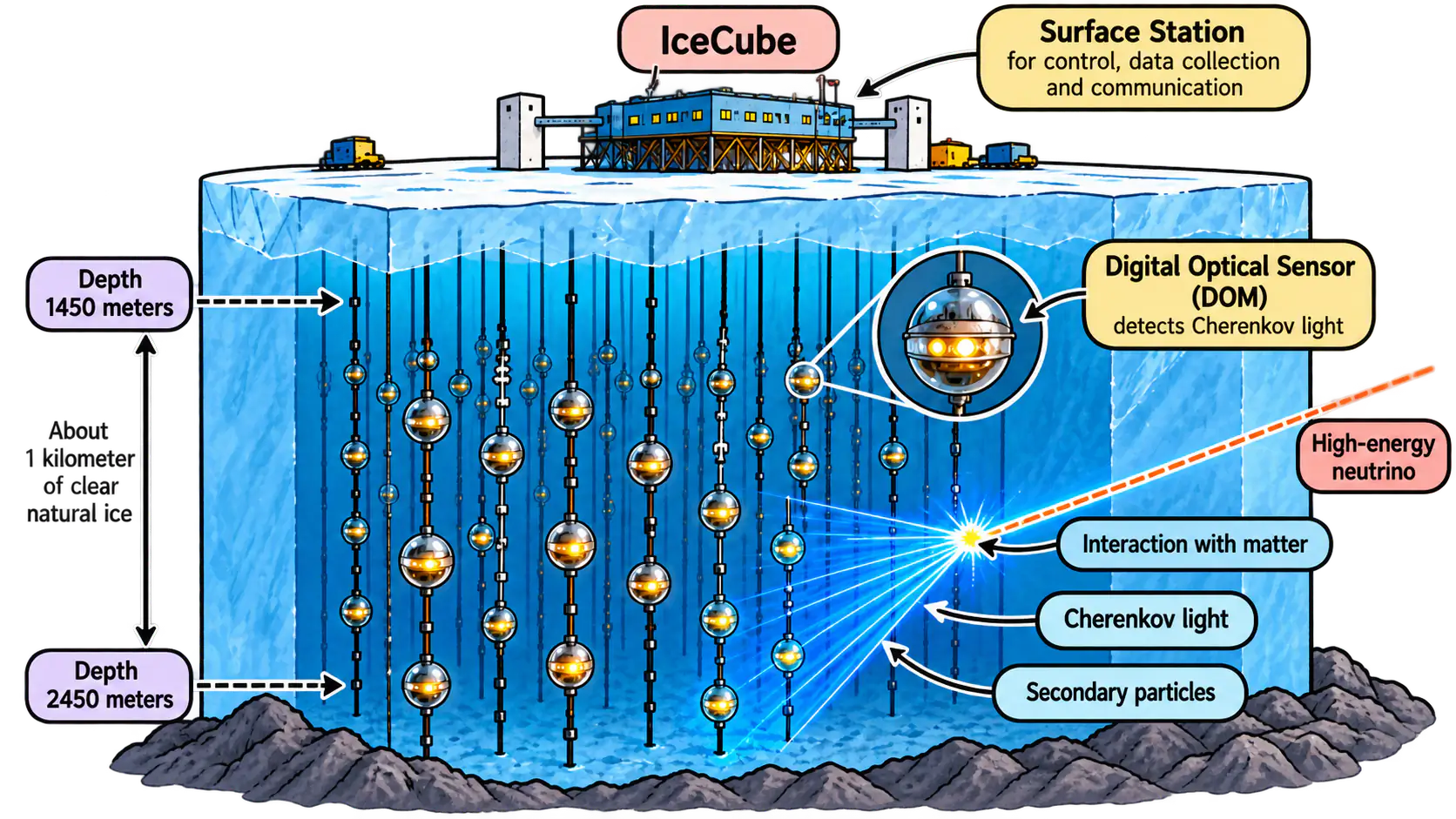
Figure 1: IceCube Neutrino Observatory.
Conclusion
For thousands of years, humanity explored the sky by looking at light.
Later, we learned to observe the same universe at radio, infrared, X-ray, and gamma-ray wavelengths. In the modern era, gravitational waves emerged as another messenger from distant cosmic events, opening an entirely new way to study the universe.
And now, neutrinos have joined the family of cosmic messengers.
Each of these messengers reveals a different aspect of the universe. Photons show us where light can escape. Gravitational waves allow us to detect violent distortions of spacetime. Neutrinos, meanwhile, can carry information directly from environments that are otherwise hidden from electromagnetic observation.
The result is a new form of astronomy, one in which the universe is no longer studied through light alone, but through multiple cosmic messengers, each telling a different part of the same story.