Introduction
The continuous advancement of classical computing architectures, together with the increasing complexity of computational workloads, is facing various physical and engineering limitations. As transistor dimensions shrink to extremely small scales, phenomena such as quantum tunneling, increasing power density, and leakage currents make the design and scalability of classical computing technologies more challenging. At the same time, modern Artificial Intelligence (AI) and Machine Learning (ML) workloads, ranging from deep neural network training to large-scale optimization problems, require substantial computational and energy resources.
In this context, Quantum AI refers to an interdisciplinary field at the intersection of quantum information processing, machine learning, and artificial intelligence. The objective of this field is to investigate how quantum computing capabilities can be used to perform or improve certain machine learning and artificial intelligence tasks. Conversely, machine learning methods are also expected to be used for the analysis and control of quantum systems. Concepts such as superposition, entanglement, and quantum interference play fundamental roles in many quantum algorithms and architectures.
Despite promising theoretical results, a general and experimentally demonstrated quantum computational advantage for AI applications has not yet been established. Such an advantage depends on factors including the type of problem, data representation, hardware architecture, and the cost of data access. This article examines the fundamental concepts of Quantum AI, some of its main frameworks, and the technical and algorithmic challenges facing the field.
Definition and Motivation of Quantum Artificial Intelligence
Definitional Framework
Quantum Artificial Intelligence cannot be regarded simply as the execution of a classical algorithm on a quantum computer. Rather, it encompasses a range of approaches in which quantum information processing and machine learning methods are combined either independently or within hybrid architectures.
In general, two major directions can be considered in this field:
1. Quantum Machine Learning for Quantum Data:
The use of machine learning methods, whether quantum or classical, to analyze, classify, or extract information from data obtained from quantum systems; for example, in quantum simulations, quantum chemistry, and the study of condensed-matter systems.
2. Machine Learning and Artificial Intelligence Assisted by Quantum Subroutines:
The use of quantum algorithms and circuits in specific parts of the learning or optimization process, with the aim of reducing the computational cost of particular tasks. This approach may include quantum algorithms for linear algebra, kernel evaluation, sampling, or optimization.
Therefore, Quantum AI can be viewed as a broad framework in which quantum computing and machine learning are used complementarily to address specific problems.
Why Quantum Artificial Intelligence?
One of the primary motivations for studying Quantum AI is the increasing complexity of certain machine learning and optimization problems. In many high-dimensional problems, increasing the number of variables can dramatically increase the computational cost, data requirements, and search space. This phenomenon is known in some contexts as the Curse of Dimensionality.
On the other hand, training large AI models requires extensive computational infrastructure, including graphics processing units and specialized accelerators, and can result in substantial energy consumption. From this perspective, quantum computing is being investigated not as a general replacement for classical hardware, but as a potential platform for accelerating certain specialized computations.
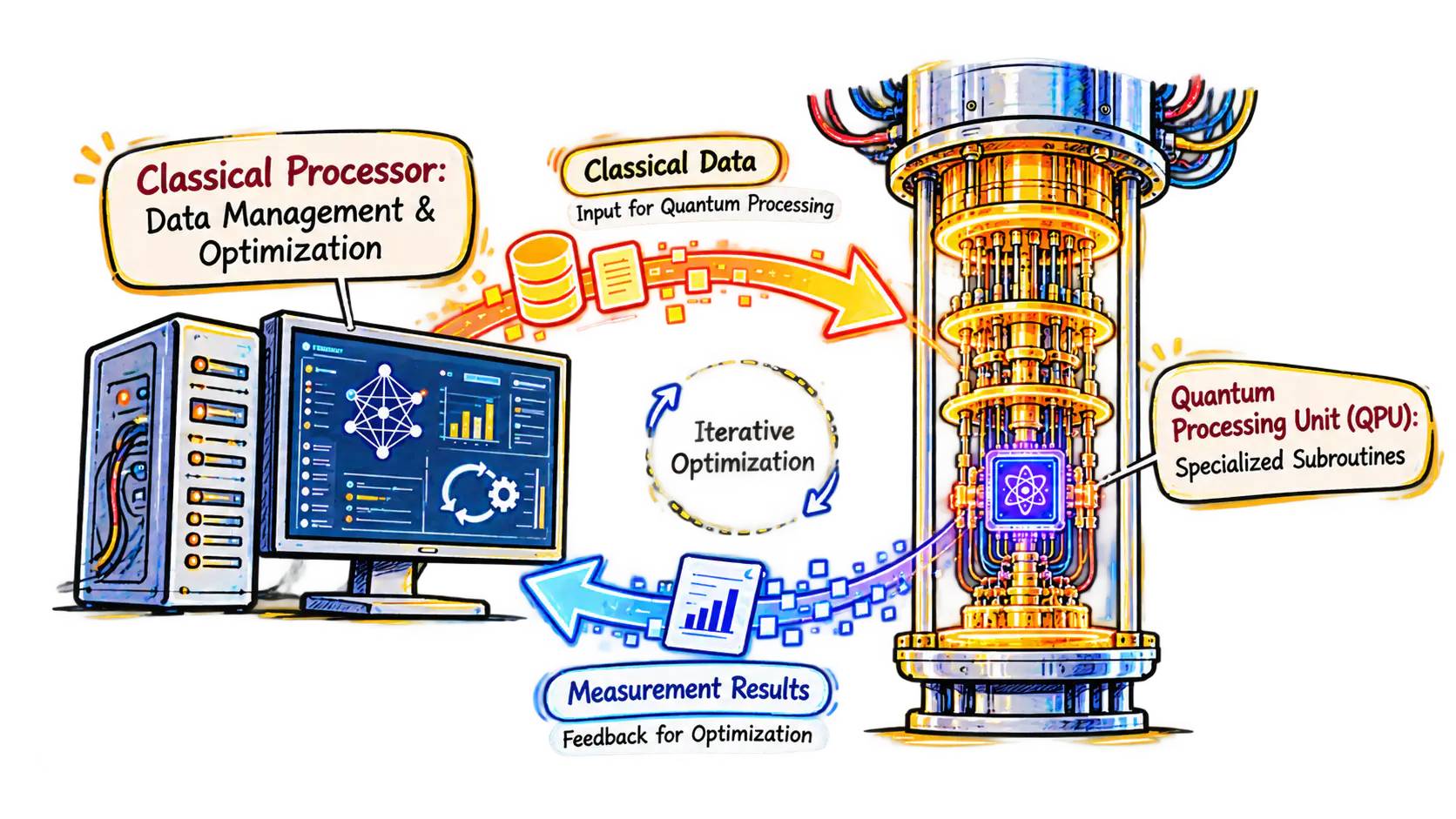
Figure 1: Hybrid computational architecture. The classical processor is responsible for data management and optimization, while the quantum processor (housed inside a cryostat) serves as an accelerator for executing specialized subroutines, with a continuous feedback loop maintained between them.
However, reduced energy consumption is not a general or guaranteed outcome of quantum computing. Quantum systems, particularly those requiring cryogenic cooling or complex control equipment, can themselves involve substantial energy and infrastructure costs. Therefore, any claim of energy advantage must be evaluated for a specific architecture, algorithm, and performance metric.
Scientific Concepts of Quantum Artificial Intelligence
Fundamentals of Quantum Mechanics
To understand many Quantum AI methods, it is first necessary to become familiar with some fundamental concepts of quantum information processing. Among the most important of these are superposition, entanglement, and quantum interference.
Architectural Paradigms in Quantum Artificial Intelligence
The implementation of Quantum AI relies on approaches that combine quantum hardware with machine learning and optimization algorithms. Some of the most important approaches include:
A. Quantum Neural Networks (QNNs) and Parameterized Quantum Circuits (PQCs)
Current-generation quantum computers largely operate within the Noisy Intermediate-Scale Quantum (NISQ) paradigm, where noise, gate errors, and decoherence are among the major limitations on the execution of deep circuits. Under these conditions, Parameterized Quantum Circuits (PQCs) are considered one of the main frameworks for constructing quantum machine learning models.
In a hybrid quantum-classical architecture, the overall process can proceed as follows:
Input data are encoded or mapped into a quantum state using an encoding method or Feature Map.
A parameterized quantum circuit transforms the resulting state according to trainable parameters.
Measurement of the circuit provides the required statistical quantities or expectation values.
A classical cost function evaluates the performance of the model.
A classical optimizer updates the circuit parameters.
Consequently, many current QNNs are in fact hybrid quantum-classical systems, in which quantum processing and classical optimization cooperate within an iterative loop.
B. Quantum Kernels and Quantum Support Vector Machines (QSVMs)
Kernel-based methods in classical machine learning map data into spaces in which nonlinear structures in the data may become more suitable for classification. In quantum approaches, certain data mappings can be implemented using quantum circuits, and appropriate measurements can be used to obtain information about the similarity or overlap between quantum states.
In a quantum kernel estimation method, two data points encoded in the states and can be used to calculate a quantity related to their overlap, such as the corresponding kernel value(). These values can be used to construct a kernel matrix and subsequently employed in a classical algorithm such as a support vector machine.
The potential advantage of this approach depends on factors such as the data-encoding method, the number of measurements required, the circuit structure, and the cost of data access. Therefore, the existence of an exponentially large Hilbert space alone does not imply an exponential computational advantage in a practical application.
C. Quantum Approximate Optimization Algorithm (QAOA)
The Quantum Approximate Optimization Algorithm (QAOA) is a hybrid quantum-classical algorithm for combinatorial optimization problems. It uses a sequence of operations associated with a cost Hamiltonian and a mixer Hamiltonian, while its parameters are optimized through a classical optimization loop. QAOA has been studied for problems such as certain allocation, scheduling, routing, and graph problems. Despite promising theoretical and experimental results, a definitive computational advantage over the best classical methods for general practical problems has not yet been established. The performance of QAOA depends on the problem structure, circuit depth, hardware quality, and optimization method.
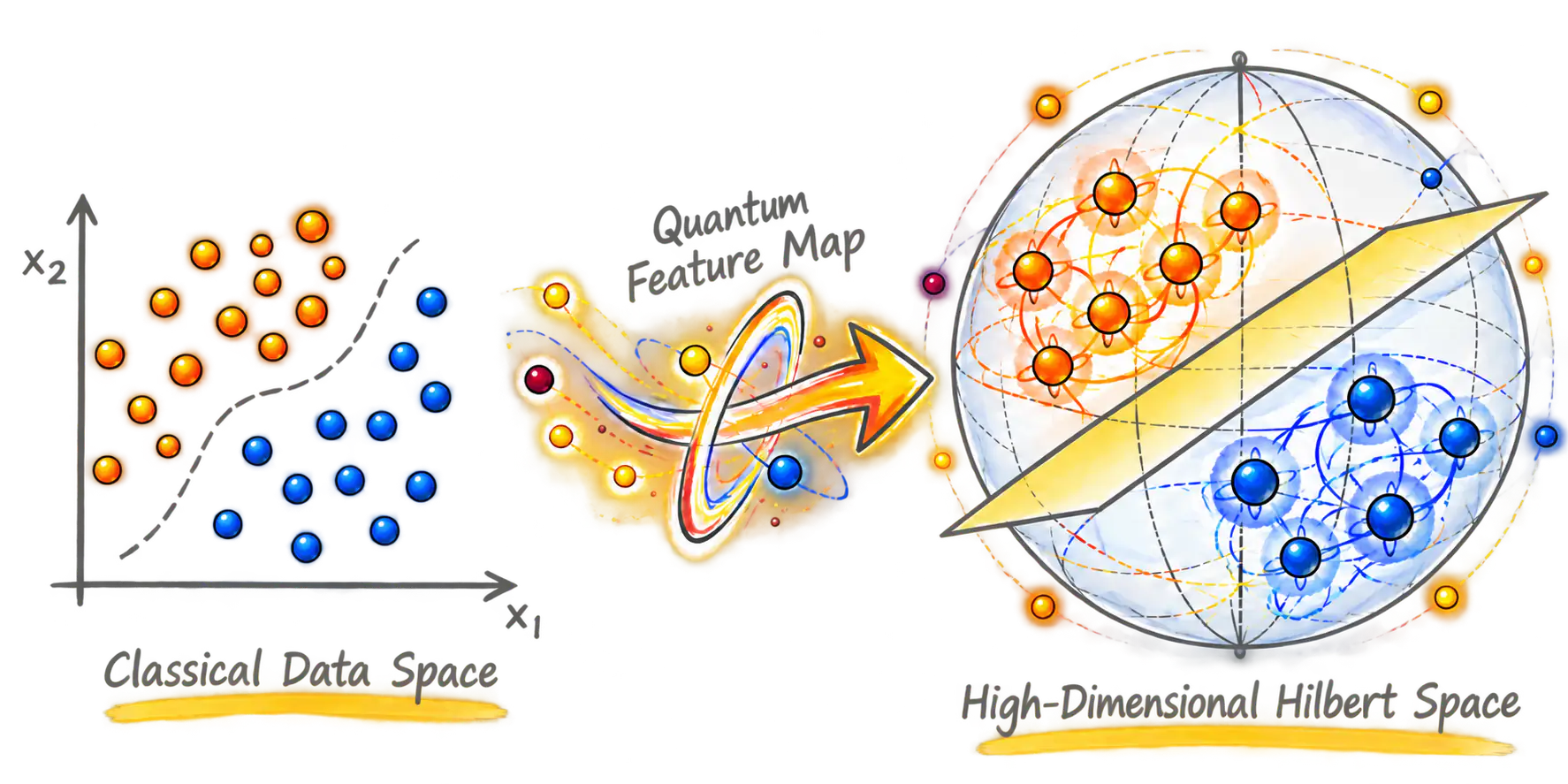
Figure 2: Hybrid computational architecture. The classical processor handles data management and optimization, while the quantum processor (housed inside a cryostat) serves as an accelerator for executing specialized subroutines, with a continuous feedback loop between them.
Future Outlook and Critical Challenges
Despite theoretical and experimental progress, transforming Quantum AI into a scalable technology with practical advantage requires overcoming a range of physical, hardware, and algorithmic challenges.
Technical and Physical Challenges
Decoherence and Noise: Interactions between a quantum system and its environment, together with errors arising from control operations, can degrade quantum information. Quantum Error Correction (QEC) is essential for reliable execution of long computations; however, realizing a fault-tolerant logical qubit requires a substantial number of physical qubits and control resources.
Barren Plateaus: In some parameterized quantum circuits, the gradient of the cost function may become extremely small as the circuit size increases. This phenomenon can make model training difficult using gradient-based optimization. However, the severity and occurrence of barren plateaus depend on the circuit structure, cost function, initialization method, and characteristics of the problem.
Data-Encoding Bottleneck: Converting classical data into quantum states can constitute a significant portion of the computational cost of a quantum algorithm. This issue, sometimes discussed in connection with quantum memory-access models such as QRAM, is particularly important because a quantum algorithm can provide a practical advantage only when the costs of data preparation and access are also taken into account.
Future Directions
One important future direction is the development of Fault-Tolerant Quantum Computers. If fault-tolerant hardware can be achieved at a sufficiently large scale, it will enable the execution of deeper quantum algorithms and more rigorous experimental investigation of certain quantum machine learning algorithms. Quantum algorithms for linear algebra, certain data-analysis methods, and optimization algorithms are among the areas being studied in this context.
In the future, quantum computing will likely not completely replace classical computing; rather, it may serve as a specialized accelerator within hybrid quantum-classical architectures. In such architectures, classical processors perform tasks such as data management, computational flow control, and optimization, while the quantum processor is used for subroutines that have theoretical or experimental potential to benefit from quantum resources.
Furthermore, combining quantum computing with AI accelerators, edge computing, and neuromorphic architectures may create new opportunities for the design of heterogeneous computing systems. However, the usefulness of such architectures should be evaluated based on actual performance, energy cost, communication latency, and the cost of access to the quantum processor.
Conclusion
Quantum Artificial Intelligence is an interdisciplinary field at the boundary between quantum information processing, machine learning, and artificial intelligence. By leveraging quantum-mechanical properties and hybrid quantum-classical architectures, this field provides opportunities to investigate new approaches to learning, optimization, and data processing.
Parameterized quantum circuits, quantum neural networks, quantum kernels, and algorithms such as QAOA are among the major frameworks being studied in this field. However, quantum advantage in AI applications is not yet a general and established result and depends on factors including the problem type, data-encoding method, hardware architecture, number of measurements, and classical and quantum costs.
Challenges such as decoherence, hardware errors, barren plateaus, data-encoding costs, and the substantial resources required for error correction remain among the major obstacles to the development of this technology. With advances in fault-tolerant hardware and the development of suitable algorithms, quantum computing may be used as a specialized accelerator alongside classical infrastructures and may provide new capabilities for machine learning and artificial intelligence in specific problems.
From this perspective, the future of Quantum AI lies not in the complete replacement of classical AI, but in the intelligent convergence of classical and quantum computing for solving problems for which either paradigm alone faces limitations.