As quantum information theory advanced, drawing on inexplicable yet remarkable phenomena such as quantum superposition and entanglement, expectations suddenly arose for significant advances across nearly every branch of technology. Although we are still far from understanding these concepts, those expectations have spurred extensive research and industrial activity in computing, cryptography, and sensing. Emerging quantum technologies built on these phenomena are expected to ultimately bring about a transformative technological revolution.
Past technological revolutions have also emerged from and been driven by the development of new scientific theories. Two centuries ago, for example, the success of the First Industrial Revolution was closely linked to the development of thermodynamics. As an empirical theory whose laws are derived from experience, thermodynamics rests on universal principles and makes predictions that hold in the classical framework and are expected to hold in the quantum framework as well. For instance, just as heat cannot flow from a cold reservoir to a hot one, the efficiency of a heat engine based on a quantum system is not expected to exceed the Carnot limit. Likewise, entanglement is not expected to make it possible to extract more work from an energy reservoir. At first glance, there might seem to be no room for a quantum advantage in thermodynamics.
In fact, thermodynamics in the quantum regime is still poorly understood. Basic thermodynamic quantities such as temperature and pressure have no definition at the quantum level. Work and heat are not well defined even at the classical level, and the situation becomes more complicated in the quantum regime. What constitutes thermodynamic equilibrium at the quantum level remains unclear. Some experiments have shown violations of classical thermodynamic principles at the quantum level. Some researchers also argue that thermodynamic parameters are fundamentally emergent and arise only in macroscopic systems made up of many particles acting collectively. Despite these uncertainties and our incomplete understanding of quantum thermodynamics, we can still advance the technology in this field without fully understanding how its processes work.
Despite the limitations discussed above, even classical thermodynamics places no limit on the rate at which energy can be converted into heat and work. It is therefore natural to look for thermodynamic quantum advantages in quantum systems far from equilibrium. In fact, foundational theoretical results in quantum thermodynamics have linked the generation of entanglement to faster work extraction when energy is stored in many-particle quantum systems. These and other findings have sparked interest in using quantum systems as heat engines and energy storage devices. This marked the beginning of research into quantum batteries and the search for quantum effects that could improve their performance.
Like electrochemical batteries, quantum batteries are systems for storing energy temporarily. They have limited energy capacity and power, and they can lose energy through dissipation. Quantum batteries can, however, be charged or discharged using operations that create coherent superpositions of different states. In quantum batteries made up of many cells, such coherence can give rise to entanglement and other nonclassical correlations, leading to super extensive scaling of charging power. In other words, charging rates can reach values far beyond anything achievable with electrochemical batteries. This quantum effect, akin to Heisenberg scaling in quantum metrology and to Grover’s search algorithm, offers an advantage over classical devices and has therefore been one of the main driving forces behind this technology.
A major breakthrough came with the introduction of the first quantum battery model, known as the Dicke quantum battery, which could be implemented in a solid-state architecture. Since then, theorists have proposed a range of concrete, practical quantum battery models, from one-dimensional spin chains to strongly interacting fermionic batteries. Recently, researchers have also taken important early steps toward implementing quantum batteries experimentally.
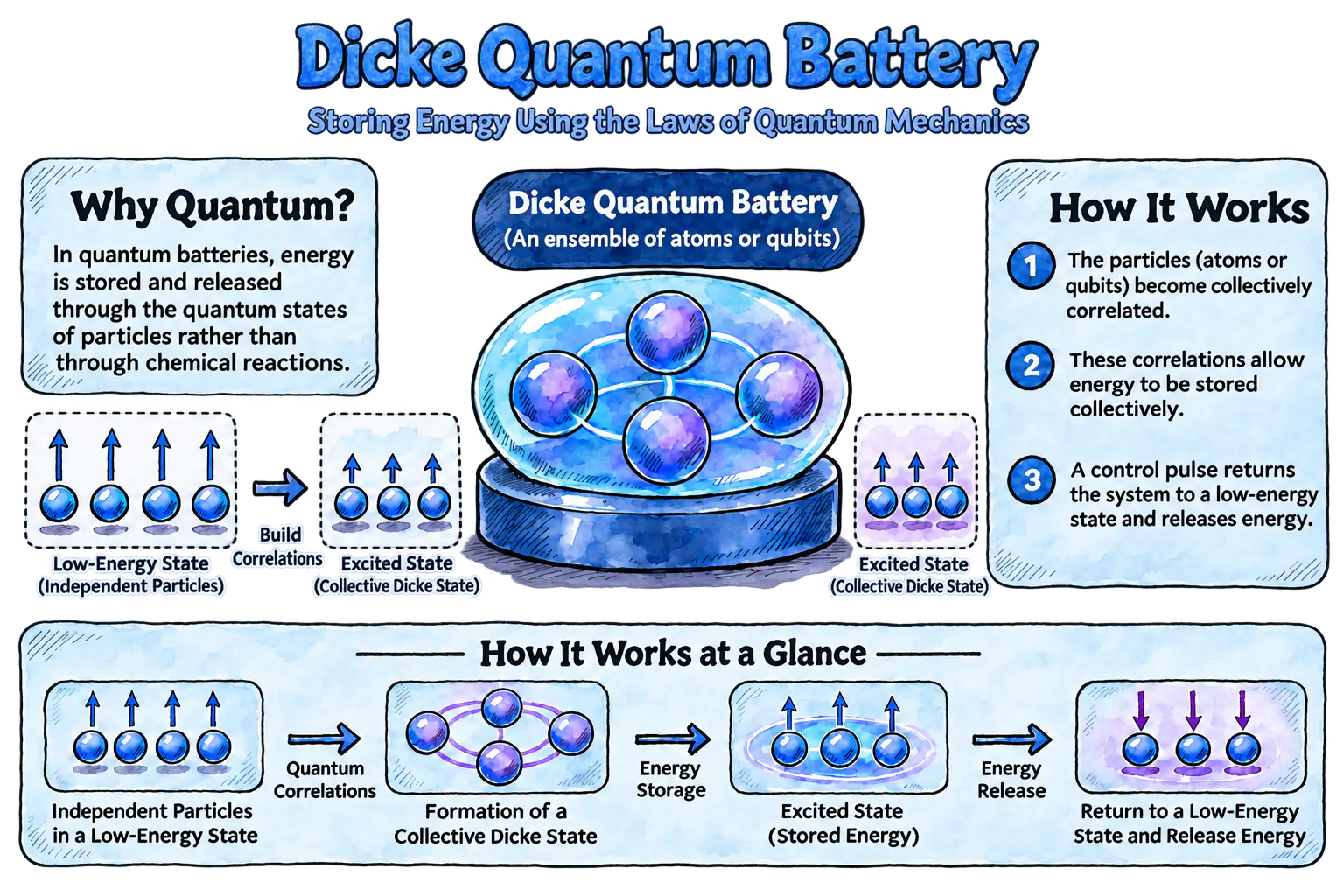
Figure 1: An overview on Dicke quantum battery" and how it works.
Meanwhile, theoretical studies have clarified the role of quantum correlations and collective effects in achieving super extensive power scaling, meaning that charging power grows faster than the number of cells. Recent studies have also proposed protocols for improving charging efficiency and precision, as well as methods for preventing energy loss due to environmental effects. Nevertheless, many aspects of quantum battery physics remain unknown, including the ultimate limits on energy density, absolute power, and energy storage lifetime. Experimental work on quantum batteries is still in its infancy, but in the latest study, conducted in 2026 [1], Australian researchers demonstrated that, as expected, the charging rate increases as a quantum battery gets larger. In other words, quite contrary to intuition, when the battery cells are entangled and their numberincrease, the charging rate grows on the order of. This means that when the battery cells are entangled, charging one cell also affects how the others charge.
References
[1] Hymas, K., Muir, J. B., Tibben, D., Van Embden, J., Hirai, T., Dunn, C. J., ... & Quach, J. Q. (2026). Superextensive electrical power from a quantum battery. Light: Science & Applications, 15(1), 168.