The Quantum Cheshire Cat
The cat said, “All right,” and this time it vanished very slowly, beginning with the tip of its tail and ending with its grin, which remained for some time after the rest of it had disappeared.
Alice thought to herself, “Well! I’ve often seen a cat without a grin, but a grin without a cat! It’s the strangest thing I’ve ever seen in my life.”1
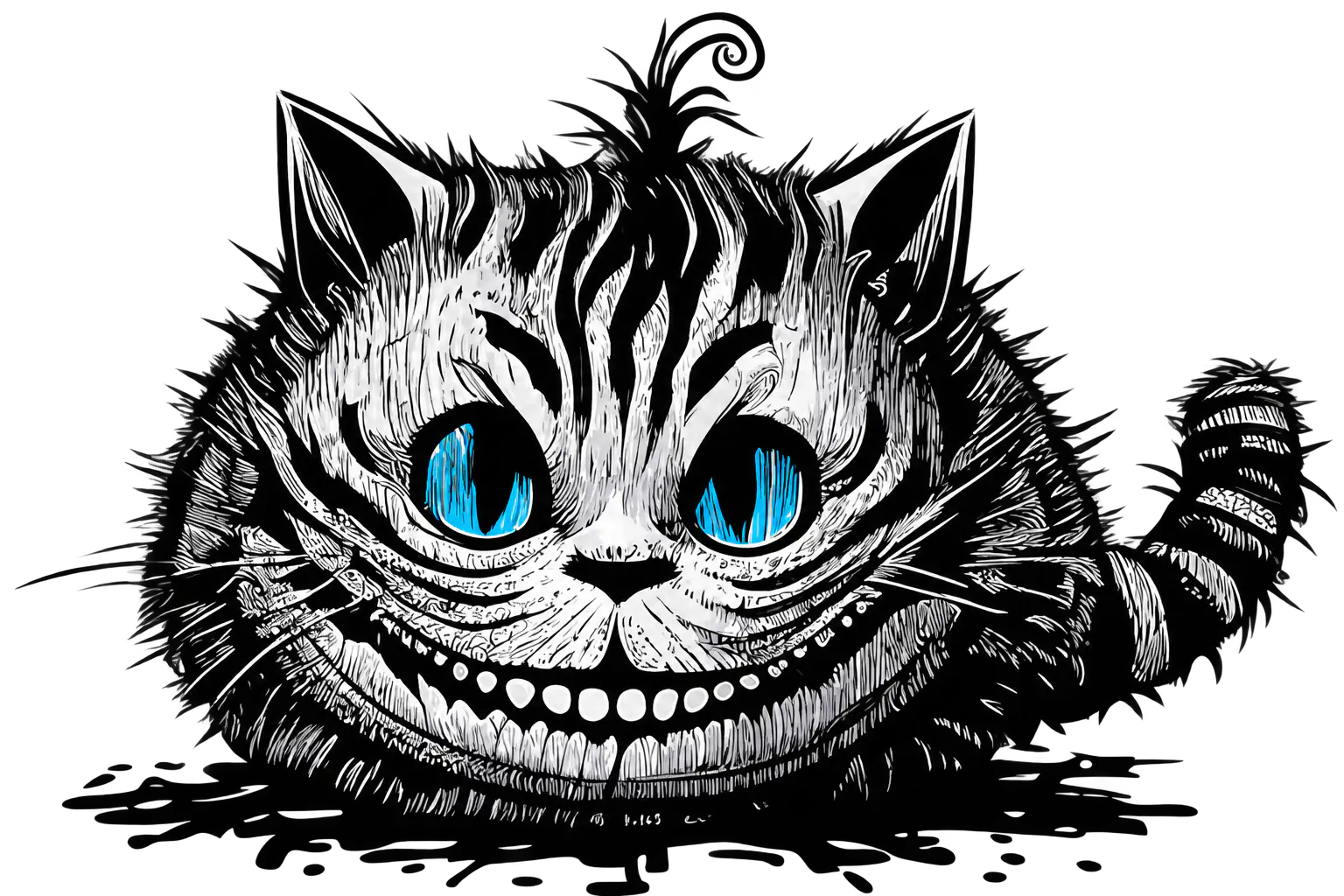
Fig 1.
It is hardly surprising that Alice is so astonished. If we assume that cats in the real world can grin, then a grin is one of a cat’s properties, and it seems impossible to imagine the grin existing independently of the cat itself. By analogy, polarization is one of the properties of a photon, and it seems equally difficult to conceive of polarization existing without a photon. Yet one of the more remarkable features of quantum mechanics is that polarization can, in a sense, appear to exist without the photon—or at least that is the story quantum mechanics seems to tell us.
Before turning to that story, however, we first need to become familiar with the idea of measurement strength.
You may remember that measuring a quantum system causes it to collapse into one of its eigenstates. If we return, for example, to Schrödinger’s cat, opening the box and making a measurement causes the cat to collapse into either the alive state or the dead state. But there is another possibility. By reducing the strength of the measurement, we can obtain a limited amount of information about the system, with some uncertainty, while disturbing the system as little as possible.
In this method, a system is prepared in a pre-selected state and later filtered according to a post-selected state. Rather than making a full, projective measurement of the system in between, we probe it only very gently. In other words, if the system begins in the pre-selected state, we do not extract complete information about it; instead, we obtain only limited information related to the transition toward the post-selected state. If the experiment is repeated many times and the results are averaged, the underlying behavior of the system can be inferred without strongly disturbing it in each individual trial. This type of measurement is known as a weak measurement.
Weak measurements have revealed some of the most surprising aspects of quantum mechanics, and the Quantum Cheshire Cat experiment is perhaps the most famous example.
Consider a simple optical interferometer. The cat is represented by a photon of light, which can travel through either the left or the right arm of the interferometer. The cat’s grin, meanwhile, is represented by the photon’s circular polarization.
The photon—the “cat”—is initially prepared in a linear combination of the left and right paths. This is the pre-selected state used in the weak-measurement scheme. After entering the interferometer, the photon can in principle emerge through different output ports. The apparent separation of the cat from its grin occurs only for those events in which the photon is detected at a particular output. This detection condition provides the post-selection.
Weak measurements are then performed on the particle’s properties inside the interferometer, between the pre-selected and post-selected states. Because these measurements must be repeated many times, the results are averaged over a large number of trials. For certain choices of pre-selection and post-selection, the photon—the “cat”—appears to be found in one arm of the interferometer, while its polarization—the “grin”—appears in the other.
The result is so strange that even our language struggles to express it. We can barely refer to the grin—or polarization—without also referring to the thing whose property it is: the cat, or the photon.
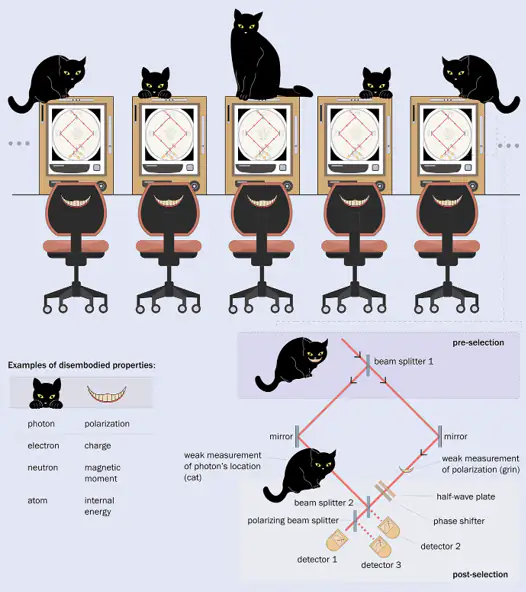
Fig 2: The Quantum Cheshire Cat Thought Experiment.
When the original Quantum Cheshire Cat paper was submitted for review, its mathematics was quickly recognized as valid. But the physical picture it suggested was so counterintuitive that the review process took roughly a year. The work was eventually published in 2013, alongside experimental investigations supporting the predicted effect. Even today, however, the interpretation of these results remains a subject of debate, and research into their deeper meaning is still ongoing.
To gain a more intuitive picture of the experiment, imagine the pre-selection and post-selection process as something like a Plinko board. A ball enters the board from a particular opening at the top—the pre-selected input—and then falls through a series of pegs until it reaches one of several possible destinations at the bottom. One particular destination is chosen as the post-selected outcome.
If we count how many balls arrive at that chosen destination, we can estimate the corresponding probability distribution. In the classical world, we could also observe the position and properties of each ball at different points along the way—for example, using a camera—and this observation would not significantly alter the ball’s path or its probability of reaching the post-selected destination.
A quantum version of such a device would follow the same general idea of pre-selection and post-selection, but with one crucial difference: the “balls” could enter in superpositions of different paths. A weak measurement can then be used to probe the system with only minimal disturbance, and by repeating the experiment many times, the statistics of particular outcomes can gradually be revealed.
The result of such a weak measurement is not necessarily an ordinary eigenvalue corresponding directly to a physical property of the system. Instead, it can produce what are known as weak values. Exactly how these weak values should be interpreted is still not completely settled.
To make sense of all this in genuinely quantum terms, we need some kind of intuitive mental picture, even if that picture is necessarily limited. This is precisely why the thought experiment of the Quantum Cheshire Cat is such a powerful metaphor: it gives us a way to think about phenomena that have no straightforward classical equivalent, and it continues to point researchers toward new ways of understanding the quantum world.
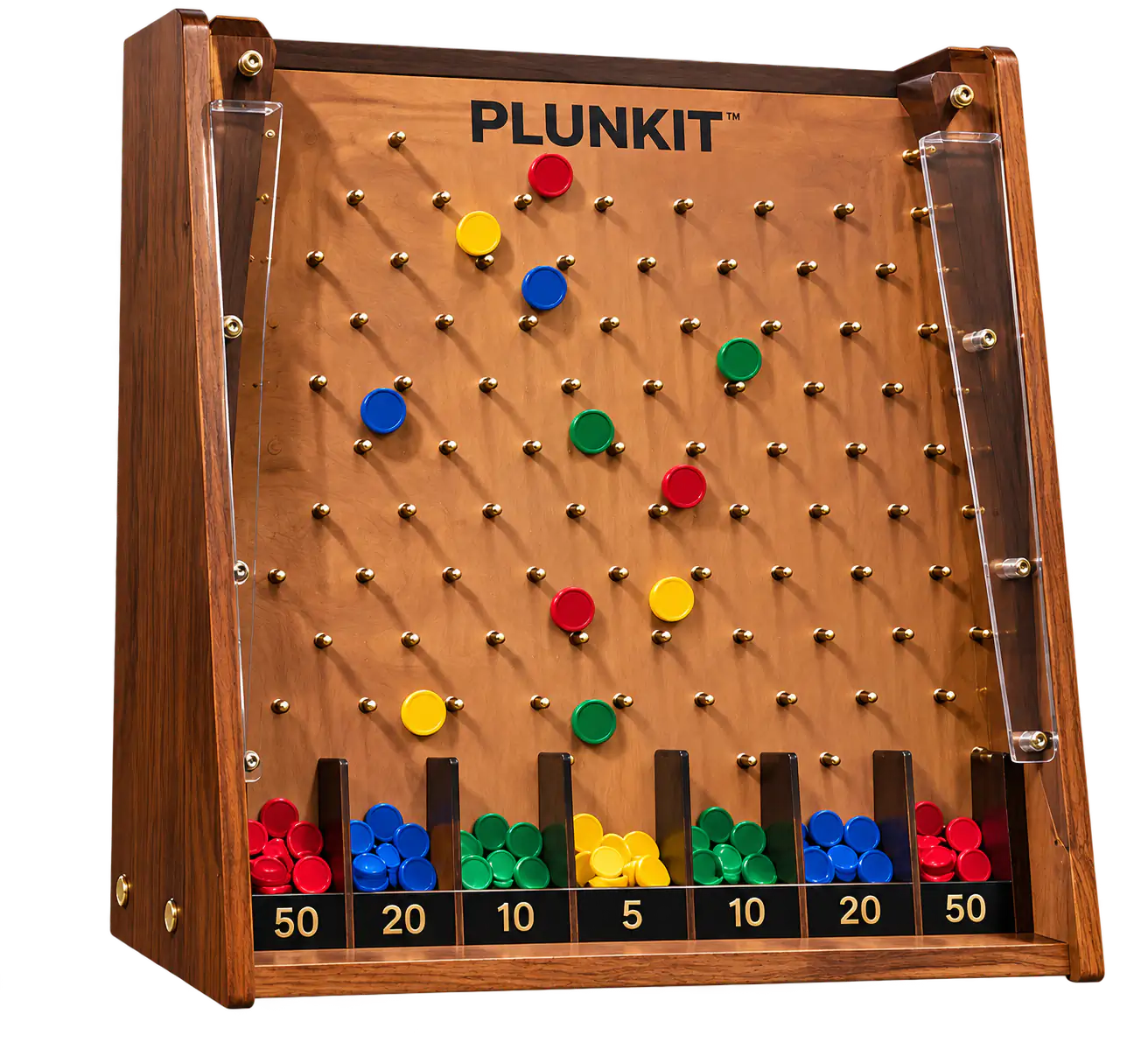
Fig 3.
2Alice's Adventures in Wonderland, by Lewis Carroll