What is Quantum Communication?
With recent advances in quantum physics and nanotechnology, Quantum Communications have emerged as a foundational pillar of the "Second Quantum Revolution." Unlike classical communications, which rely on the processing and transmission of classical bits (0 or 1), quantum communications utilize qubits as fundamental units of information. Qubits can exist in superposition states and leverage fundamental physical phenomena such as Quantum Entanglement. These unique characteristics enable protocols that are inherently impossible in classical frameworks, including the transmission of quantum states without the physical transfer of matter (Quantum Teleportation) and Quantum Key Distribution (QKD) to achieve provably unconditional security. In this infrastructure, Quantum Channels serve as the backbone of the network. These channels facilitate the transmission of quantum information over optical fibers, free-space links, or satellite connections. Their behavior is strongly affected by environmental noise and losses (Decoherence & Attenuation). Therefore, accurate characterization and mathematical modeling of these channels are essential for designing resilient protocols and evaluating system performance. A conceptual overview of a quantum communication system is shown in Figure (1).
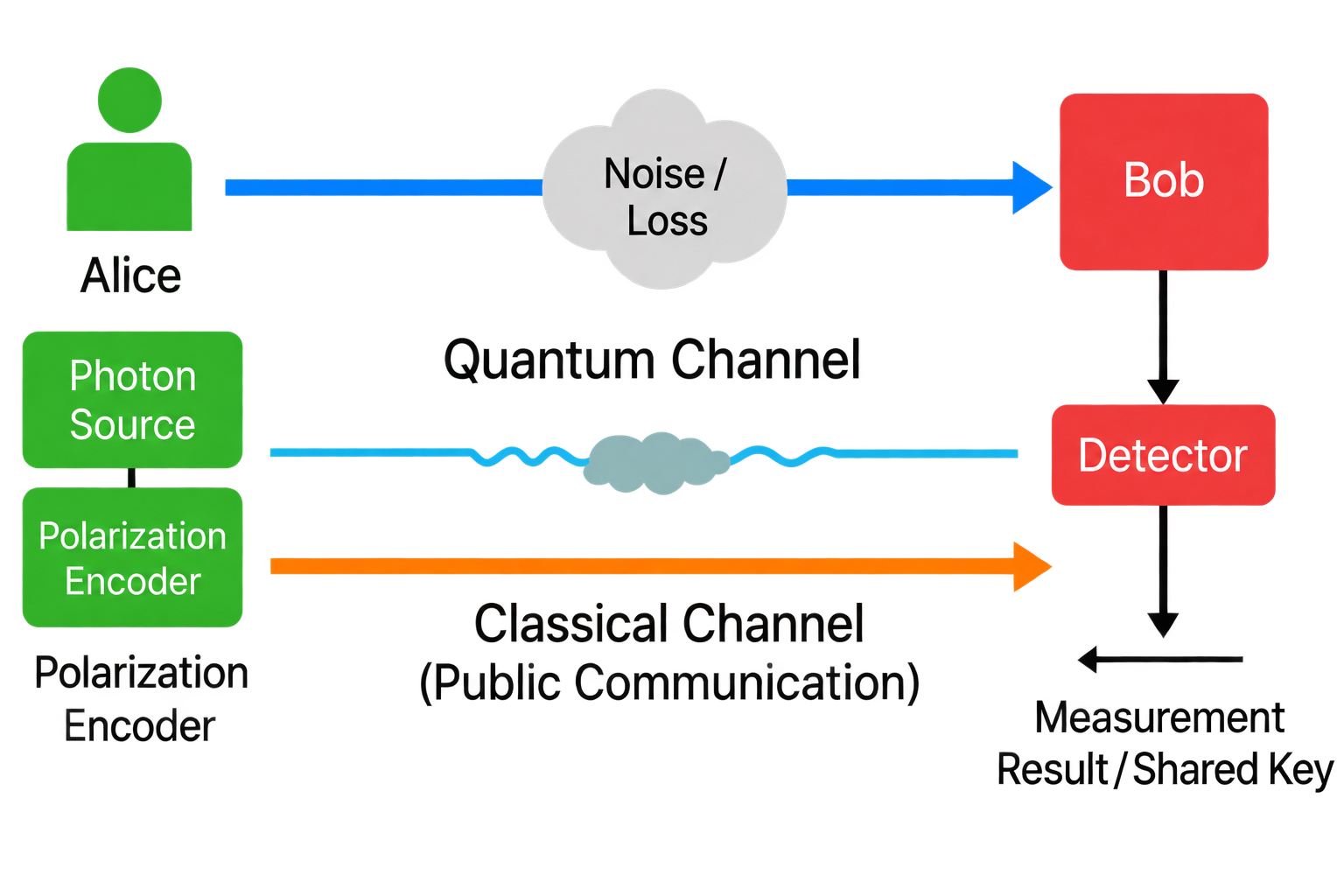
Figure (1): Basic architecture of a quantum communication system. Alice transmits information-bearing photons to Bob via a Quantum Channel. Concurrently, necessary classical information for synchronization and state reconstruction is transmitted through a public Classical Channel. This dual-path configuration forms the core foundation of all quantum communication protocols.
From an engineering perspective, implementing quantum communication systems requires the integration of advanced photonics, quantum optics, ultra-sensitive single-photon detectors, and Quantum Memories. When integrated into Quantum Networks, these components lay the groundwork for the "Quantum Internet"—a network capable of supporting physics-based security, distributed quantum computing, and high-precision quantum sensor arrays. Metrics for Quality and Security in Quantum Communication: A primary objective in quantum communications is the accurate transfer of a quantum state from one point to another. The central challenge in qubit transmission is preserving information quality and mitigating Fidelity degradation against environmental noise and decoherence. Fidelity Metric: To evaluate the quality of quantum state transmission, a metric known as Fidelity is employed. This scalar quantity, ranging between 0 and 1, measures the degree of similarity between the output state and the ideal input state. If the initial state is represented as a pure stateand the output state after passing through a noisy channel is described by a density matrix , the fidelity corresponds to the expectation value of their overlap:
When both input and output states are mixed, fidelity is defined based on the overlap of their respective densitymatrices (and ). A value of signifies flawless transmission and perfect identity between the output and input states. As this value decreases toward zero, it indicates degradation in quantum information quality due to loss, noise, or channel decoherence. Quantum communications represent a next-generation paradigm that offers capabilities far exceeding classical systems by leveraging quantum mechanical principles. In classical communications, signals and data can be easily amplified, reproduced, or copied along the transmission path. In contrast, the No-Cloning Theorem dictates that exact replication of an unknown quantum state is strictly impossible. This fundamental property, combined with the principle of Measurement Disturbance, forms the security foundation of quantum communications; any eavesdropping, tampering, or measurement attempt by an adversary inevitably disturbs the quantum state and leaves a detectable trace.
Future Outlook
Despite these unique capabilities, quantum communications are not intended to replace classical networks. Classical infrastructure will remain the primary backbone for transmitting massive volumes of daily data, while quantum technologies act as a complementary layer to enhance existing systems. From this perspective, quantum communication serves as an added layer over classical telecommunications designed to address critical challenges, particularly regarding absolute security and quantum information exchange. In the future, the convergence of classical and quantum platforms is expected to yield Hybrid Networks, where classical technologies handle routine data transmission tasks and quantum infrastructure guarantees information-theoretic security along with emerging capabilities. Consequently, the strategic value of quantum communications lies not in replacing existing networks, but in enhancing, completing, and upgrading modern communication infrastructures. In the subsequent sections of this article, various quantum state transmission methods will be analyzed and discussed.
Resources
Gisin, N., Ribordy, G., Tittel, W., & Zbinden, H. (2002). Quantum cryptography. Reviews of Modern Physics, 74(1), 145–195.
Pirandola, S., Andersen, U. L., Banchi, L., Berta, M., Bunandar, D., Colbeck, R., ... & Wallden, P. (2020). Advances in quantum cryptography. Advances in Optics and Photonics, 12(4), 1012–1236.
van Meter, R. (2014). Quantum networking. Wiley-IEEE Press..