Introduction
In the previous section, the fundamental protocols for the transfer of quantum states—including direct transmission of physical carriers, quantum teleportation, and superdense coding—were examined within a completely abstract framework under the assumption of ideal system behavior. Although such initial analyses are essential for understanding the theoretical mechanisms underlying information exchange, the practical realization of quantum networks in real-world environments introduces substantially greater complexity.
In operational settings, quantum carriers never propagate through a perfectly isolated vacuum. Instead, throughout their transmission path—whether through optical fibers or free-space links—they inevitably interact with the surrounding environment. These unwanted interactions give rise to detrimental phenomena such as energy loss, signal attenuation, and the degradation of quantum coherence (decoherence). Therefore, accurate evaluation, mathematical modeling, and the design of noise-resilient systems require a more comprehensive framework known as the quantum channel.
A quantum channel provides a structured theoretical framework for describing the physical effects of the environment and quantifying the degradation of transmitted information in a mathematically rigorous manner. Furthermore, it enables the determination of fundamental limits on achievable information transmission rates.
Definition and General Concept
In quantum communications, a quantum channel refers to a physical process, or more precisely, a mathematical mapping, that transforms the quantum state of a system from an input state into an output state. This channel can be implemented through various physical platforms, including optical fibers, free-space links, or solid-state systems. Ideally, a quantum channel should transfer the input quantum state to the output without any modification. However, in real-world systems, factors such as noise, losses, and interactions between the system and its environment can alter the state and reduce its fidelity.
From the perspective of quantum information theory, a quantum channel is described by a Completely Positive and Trace-Preserving (CPTP) map. This mapping transforms the input quantum state into an output quantum state:
whereandrepresent the density matrices of the input and output states, respectively. The trace-preserving condition ensures that the trace of the density matrix remains conserved and that the total probability remains equal to one. Furthermore, the completely positive condition guarantees that the channel mapping produces a physically valid quantum state, even in the presence of an auxiliary system that may be entangled with the system under consideration.
Noise-Based Classification of Quantum Channels
In quantum communication systems, no channel is completely ideal. Every transmission path, depending on the physical environment and the underlying technology, introduces a certain type of noise or quantum error into the transmitted states. Understanding different types of noisy channels is essential for designing error-correction algorithms and evaluating the information-carrying capacity of quantum communication systems.
The most important categories of quantum channels include:
Ideal or Noiseless Channel
This type of channel is a purely theoretical model in which the input quantum state appears at the output without any modification. Such a condition is impossible to achieve in practice because every physical environment naturally contains noise and unwanted interactions. Nevertheless, this model serves as an ideal reference for comparing other types of channels.
Depolarizing Channel
In this model, the input state is subjected, with a certain probability, to one of the Pauli errors:،or. As a result, the quantum state undergoes random transformations, and as the noise strength increases, the quantum information content and state purity decrease.
In the limiting case, when the depolarization strength reaches its maximum value, the output state becomes a completely mixed state, and no information about the original input state remains. This channel is commonly used as a model for random and unknown noise in quantum systems.
Amplitude Damping Channel
In this type of channel, energy is transferred from the quantum system to the environment, causing changes in the probability amplitudes of the quantum state. This model is used to describe processes such as spontaneous emission and other energy-loss mechanisms in quantum systems.
In optical systems, photon loss can also lead to a reduction in the amplitude and probability of finding a photon in the desired state. However, an accurate description of this process depends on the specific quantum system and the physical model used for the channel.
Phase Damping or Dephasing Channel
In this type of channel, the energy of the system does not necessarily change; instead, the coherence of the quantum state decreases due to environmental fluctuations or interactions.
As a result, the phase relationships between the components of the quantum state become weakened, and the observable effects of superposition are reduced. This type of noise is one of the most important models for describing coherence loss in quantum systems, particularly in solid-state platforms.
Bit-Flip Channel
In this type of error, the computational basis stateis converted into, and vice versa. This quantum noise model is equivalent to a logical error in classical bits and is used as a fundamental model in the design of quantum error-correcting codes.
Memory Channel
In many theoretical models, errors are assumed to be independent for each transmission event. However, in real environments, particularly in solid-state materials or certain optical fibers, consecutive errors may exhibit temporal or spatial correlations.
Such systems are referred to as memory channels, and their analysis is particularly important for developing stable and reliable quantum networks.
Quantum Erasure Channel
In this model, with a certain probability, the input quantum state is converted into a specific and distinguishable state known as the erasure state.
In this case, the receiver can detect that an erasure event has occurred, although the information associated with the original state has been lost. This property distinguishes the quantum erasure channel from many other error models and makes it an important model for analyzing quantum channel capacities and designing fault-tolerant communication systems.
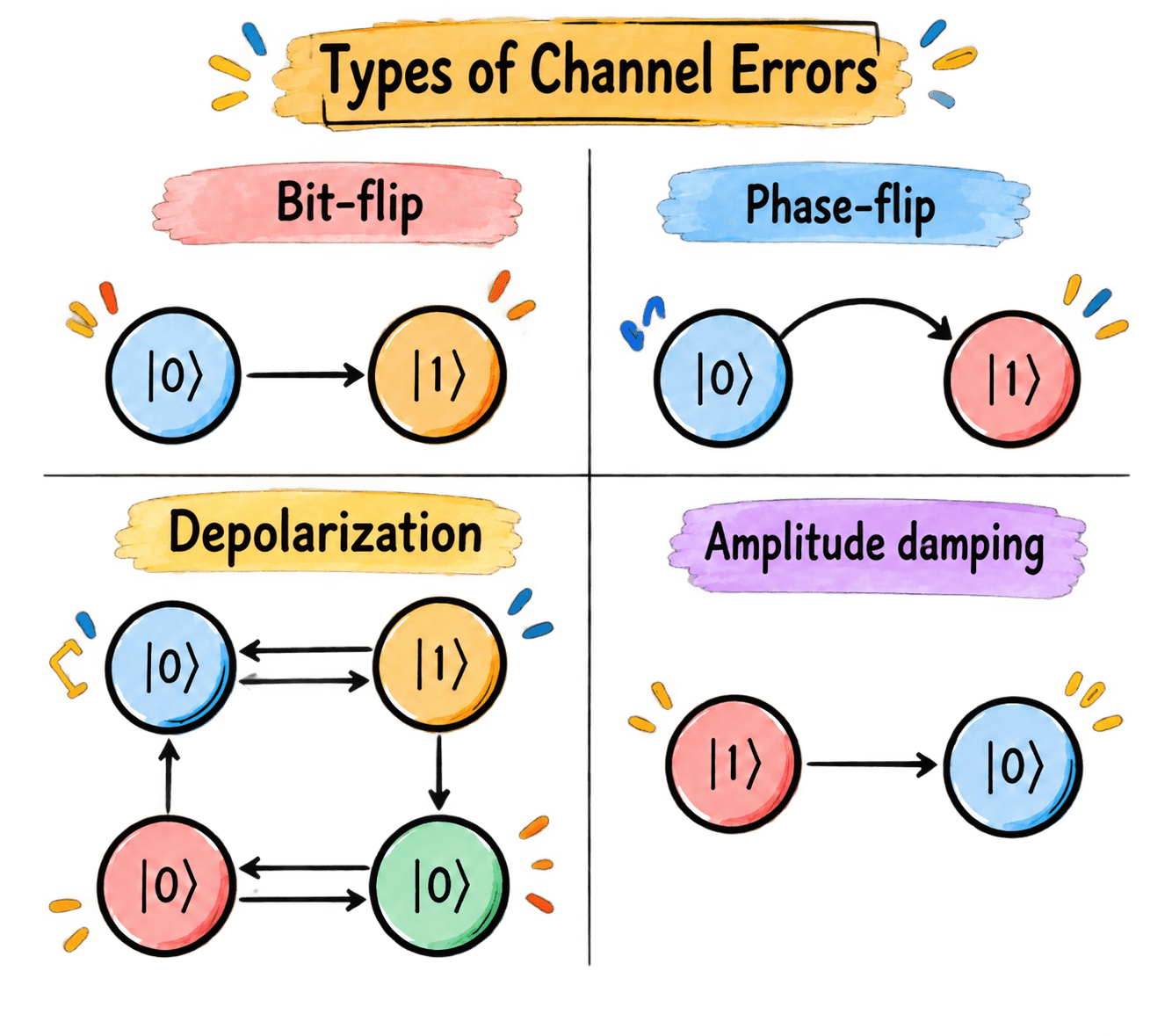
Figure (1): Four main types of quantum channel errors based on the type of noise.
Bosonic or Gaussian Channels
In light-based quantum communication systems, information can be transmitted using optical modes and photons. To describe information transmission and phenomena such as loss and noise in these systems, bosonic channel models are used. Within the framework of Continuous Variables (CV), an important class of these channels is the Gaussian Channels, whose properties are characterized by parameters such as gain, loss or transmissivity, and thermal noise. These models play an important role in the analysis and design of optical fiber-based quantum communication systems and free-space quantum links. Figure (2) illustrates several schematic models of these channels.
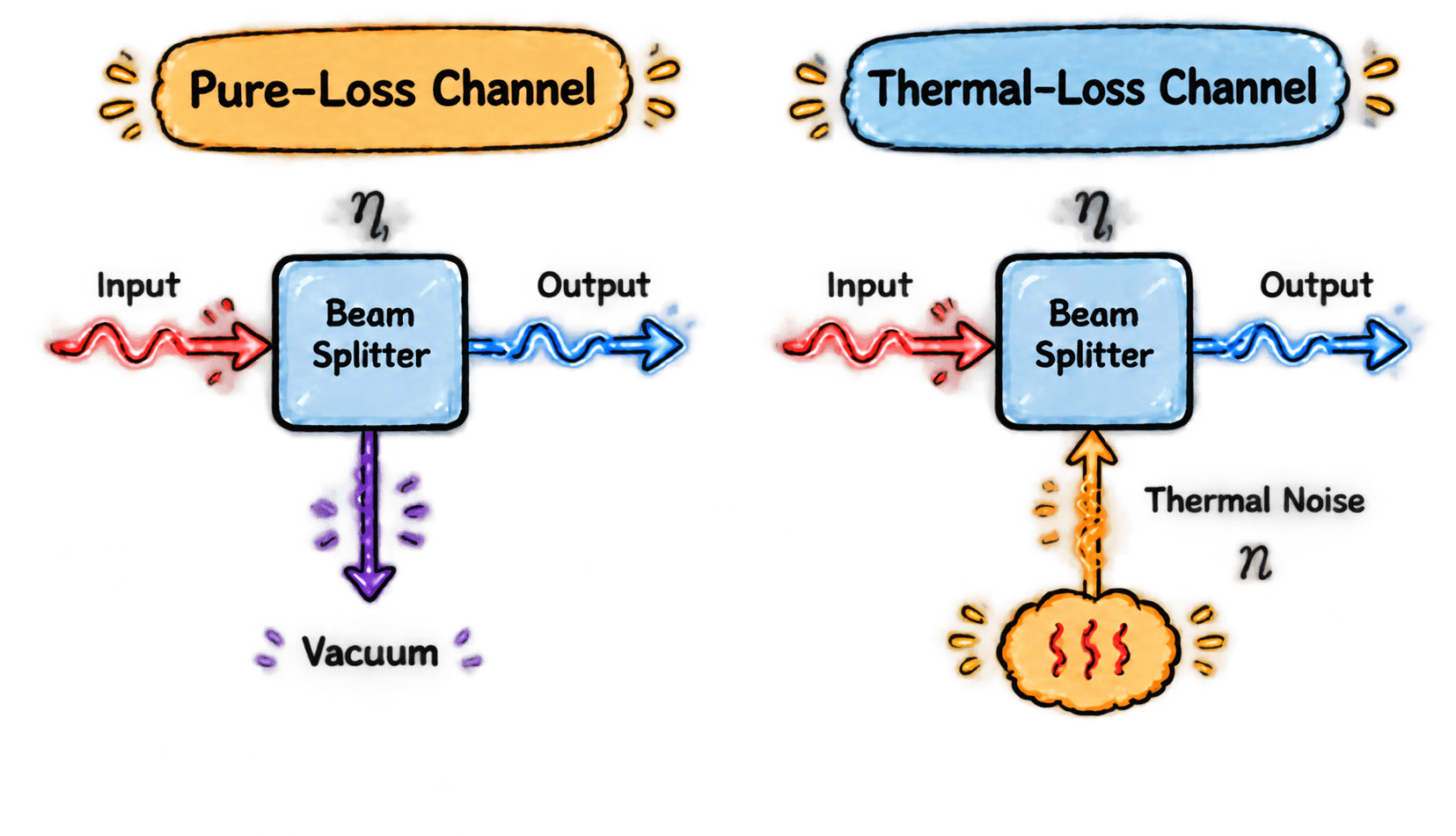
Figure (2): Schematic models of bosonic Gaussian channels. On the left, the pure-loss channel is illustrated, where the input state is transferred to the output through a beam splitter with a transmissivity coefficientand the lost portion is coupled into the vacuum environment. On the right, the thermal-loss channel is shown, where the environment contains thermal noise with an average photon numberand, in addition to loss, thermal noise is added to the signal.
Pure-Loss Channel
This is the simplest and most widely used model for optical fibers or free-space communication links. In this case, a fraction of photons is lost during transmission, and only a portion of them reaches the receiver.
The key characteristic of this channel is the transmissivity, represented by the symbol, which has a value between zero and one. The smaller the value of , the greater the loss and, consequently, the lower the transmission quality.
Thermal-Loss Channel
This model is similar to the pure-loss channel, with the difference that, in addition to energy loss, thermal noise is also introduced into the system.
This noise originates from background photons in the environment, which can become particularly significant at high temperatures or in optically congested environments (such as metropolitan networks or satellite ground stations).
Therefore, this model is more suitable than the pure-loss model for analyzing communication channels under non-ideal conditions.
Phase-Insensitive Amplifier Channel
This type of channel is used to model quantum amplifiers whose purpose is to compensate for signal losses.
However, according to the principles of quantum mechanics, no amplifier can operate without introducing additional noise. As a result, although the signal intensity increases, the fidelity of the quantum state decreases.
This type of noise plays an important role in systems employing optical amplifiers, such as long-distance optical fiber links or space-based communication networks.
In practice, real optical channels are often described using combinations of the above models. In particular, the pure-loss model is the most widely used model for fiber-based communications, whereas satellite and free-space links typically involve both loss and thermal noise effects.
The use of combined models enables researchers to simulate and evaluate the actual performance of quantum communication systems with greater accuracy.
Bosonic Channel Capacities and the PLOB Bound
One of the fundamental aspects in the analysis of these channels is the study of their information transmission capacity.
Depending on the type of information being transmitted, different capacities can be considered, including classical capacity, quantum capacity, and private capacity.
A fundamental result in this field is the rate-loss bound (PLOB Bound).
One of the most important results in quantum channel capacity theory is the PLOB rate-loss bound, whose name is derived from the initials of the researchers Pirandola, Laurenza, Ottaviani, and Banchi.
This bound demonstrates that, in a communication channel without quantum repeaters, the maximum rate of quantum information transmission or key distribution decreases logarithmically with the channel transmissivity.
In practice, the PLOB result means that even the most advanced communication protocols cannot surpass this fundamental limit unless quantum repeaters or additional entanglement resources are employed.
Therefore, designing systems capable of overcoming this limitation is one of the major goals in the engineering of quantum networks and the future quantum Internet.
The PLOB Limit and the Limitation of Repeaterless Communications
One of the most important fundamental limits in optical quantum communications is the PLOB limit (Pirandola–Laurenza–Ottaviani–Banchi).
This limit defines the fundamental constraint on the rate of quantum communication and secret key distribution over a pure-loss bosonic channel without the use of quantum repeaters.
For a channel with a transmissivity coefficient of, the PLOB limit is expressed as follows:
where is the channel transmissivity and represents the fundamental communication rate bound in units of information per channel mode.
This relation shows that as the channel transmissivity decreases, the communication capacity of the channel also decreases. For values ofthe above relation approximately behaves proportionally to .
Since the transmissivity of an optical fiber channel decreases exponentially with increasing distance, it can be approximately expressed as:
where represents the transmission distance and is the channel loss coefficient.
Therefore, the PLOB limit also decreases approximately exponentially with distance over long transmission lengths. Consequently, the exponential reduction of the communication rate with distance originates from the dependence of the channel transmissivity on distance, rather than from the PLOB relation itself being directly an exponential function of distance.
The PLOB limit is used as a fundamental benchmark for evaluating the performance of repeaterless communication systems. Overcoming this limitation requires architectures such as quantum repeaters or advanced quantum networks.
Channel Capacities and Bounds
One of the fundamental questions in quantum information theory is how much information a quantum channel can transmit. To answer this question, several types of capacities have been defined, each representing the maximum achievable information transmission rate under specific conditions.
These capacities play a fundamental role in the design and analysis of quantum networks, cryptographic systems, and secure communication technologies.
Classical Capacity
The classical capacity describes the extent to which classical information can be transmitted through a quantum channel using quantum states (for example, photons with different polarization states).
The maximum achievable rate in this case is determined by the Holevo Bound, which defines the upper limit on the amount of classical information that can be extracted from an ensemble of quantum states.
For example, in an optical communication system, classical messages can be transmitted using different photon polarization states; however, the amount of retrievable information is limited by this bound.
Quantum Capacity
The quantum capacity represents the maximum rate of quantum information transmission, namely the number of qubits that can be securely transmitted and reliably recovered through a quantum channel.
This capacity is defined based on a quantity known as coherent information.
An interesting point is that some channels, although capable of transmitting classical information, have zero quantum capacity. This means that in such channels, quantum states cannot be reliably reconstructed due to noise or loss of coherence.
Private Capacity
The private capacity of a quantum channel is the maximum asymptotic rate at which classical information can be transmitted through the channel while maintaining confidentiality against an eavesdropper.
In this framework, the objective is for the receiver to recover the transmitted message with a negligible probability of error, while preventing any significant amount of information about the message from being revealed to the eavesdropper.
Therefore, private capacity represents a theoretical limit on the amount of confidential information that can be transmitted through a quantum channel, and its value depends on the characteristics of the channel and the security criteria being considered.
Entanglement-Assisted Capacity
The entanglement-assisted capacity refers to the maximum rate of classical information transmission through a quantum channel when the sender and receiver have prior access to a shared entangled resource.
The use of shared entanglement can increase the classical information transmission capacity of a channel compared with the case where no entanglement is available.
This capacity can be exploited through protocols such as quantum superdense coding and is described in quantum information theory using quantities such as quantum mutual information.
Additivity Problems
In quantum information theory, one of the important challenges is the study of the additivity of channel capacities.
In general, additivity refers to whether the capacity of using multiple channels simultaneously can be obtained simply by summing the capacities of each individual channel.
For certain types of quantum capacities, particularly quantum capacity and private capacity, non-additive structures and phenomena such as super additivity may cause the combined use of multiple channels to exhibit performance different from their independent use.
Therefore, calculating the overall capacity of quantum channels in composite scenarios can be significantly more complex than calculating the capacity of each channel separately.
In this section, various noise behaviors and quantum channel models were investigated, ranging from discrete-variable channels, such as depolarizing and dephasing channels, to bosonic Gaussian channels, including pure-loss and thermal-loss channels. As demonstrated, unwanted interactions with the environment inevitably lead to energy dissipation and the destruction of quantum coherence (decoherence).
However, the physical and mathematical description of how noise is introduced through a completely positive trace-preserving (CPTP) map represents only the first step in analyzing a quantum communication system. The subsequent key operational question is:
In the presence of such noise sources and physical constraints, what is the maximum achievable asymptotic rate of secure or classical information transmission?
Answering this question requires the introduction of the concept of quantum capacities, which will be examined in the following part.
Resources
Gisin, N., Ribordy, G., Tittel, W., & Zbinden, H. (2002). Quantum cryptography. Reviews of Modern Physics, 74(1), 145–195.
Pirandola, S., Andersen, U. L., Banchi, L., Berta, M., Bunandar, D., Colbeck, R., ... & Wallden, P. (2020). Advances in quantum cryptography. Advances in Optics and Photonics, 12(4), 1012–1236.
van Meter, R. (2014). Quantum networking. Wiley-IEEE Press..