Quantum Channel Capacity
Following the modeling of the interaction between quantum carriers and their environment in the previous chapter, and the derivation of a mathematical framework for noisy quantum maps, two fundamental and complementary questions arise:
To what extent can a noisy quantum channel transmit different types of information, including quantum, classical, and private information?
How can the unknown characteristics or behavioral variations of the channel itself be identified through experimental characterization and measurement?
In classical information theory, the Shannon capacity determines the maximum achievable data transmission rate. In the quantum domain, however, the multifaceted nature of information and the presence of nonclassical phenomena such as entanglement lead to several distinct notions of channel capacity, including classical, quantum, private, and entanglement-assisted capacities, each of which defines a specific asymptotic limit. The first part of this chapter examines these capacities and their associated mathematical challenges, particularly non-additivity.
The second part addresses the problem from a system identification perspective. In practice, accurate characterization and calibration of an operational quantum channel require channel discrimination protocols and well-defined mathematical metrics, such as the diamond norm, to quantify the distinguishability between different noisy channel behaviors.
Channel Capacities and Bounds
One of the fundamental questions in quantum information theory is how much information a quantum channel can transmit. To address this question, several notions of capacity have been introduced, each representing the maximum achievable transmission rate under a particular set of operational assumptions. These capacities play a fundamental role in the design and analysis of quantum networks, cryptographic systems, and secure communication protocols.
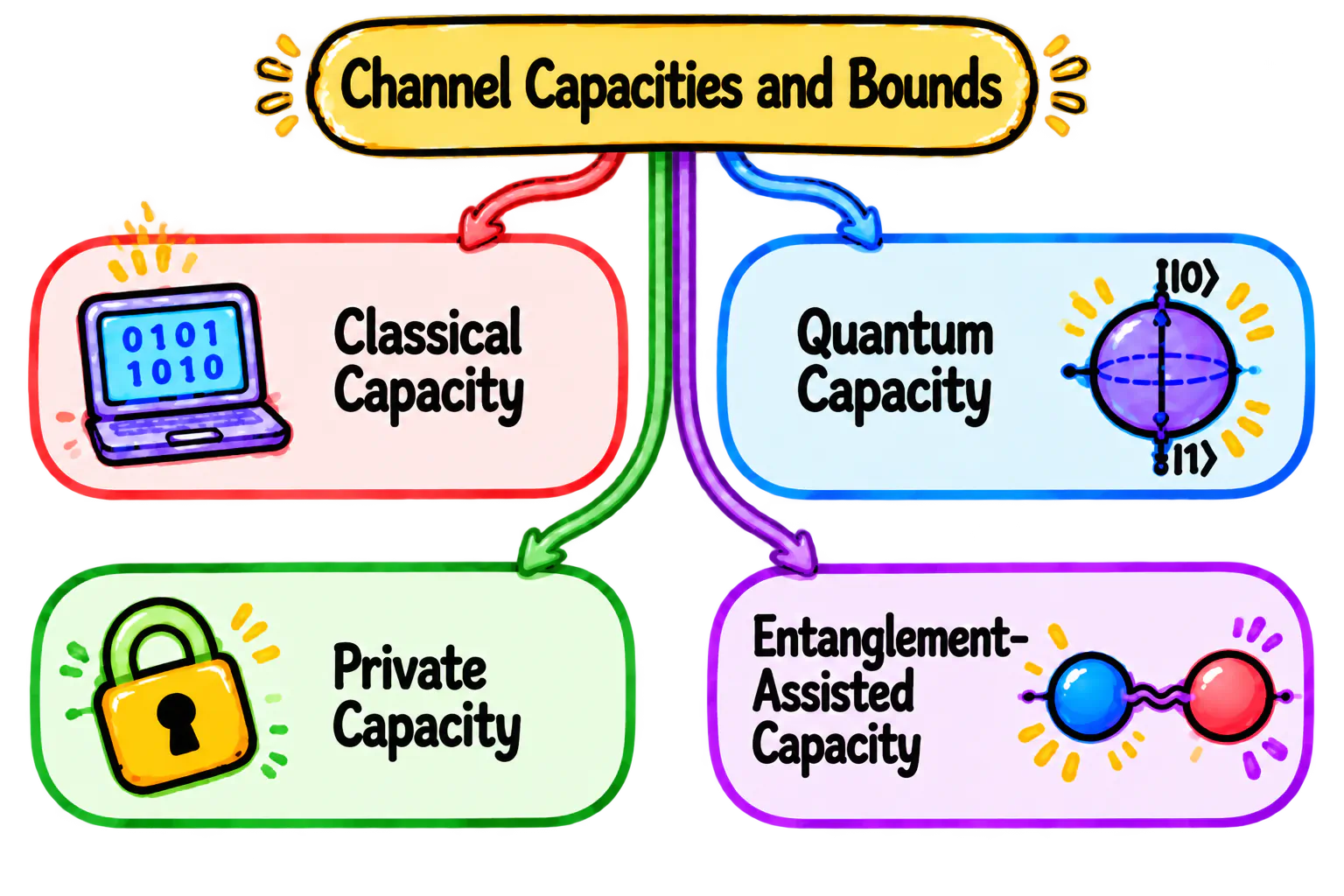
Figure 1: Channel Capacities and Bounds.
Classical Capacity
The classical capacity quantifies the maximum asymptotic rate at which classical information can be reliably transmitted through a quantum channel using quantum states as information carriers. For example, classical messages may be encoded into different polarization states of photons and transmitted through an optical communication system.
The amount of classical information that can be extracted from an ensemble of quantum states is fundamentally constrained by the Holevo bound, which provides an upper bound on the accessible classical information. Consequently, although quantum states can serve as carriers of classical messages, the amount of information that can ultimately be recovered is subject to fundamental quantum-mechanical limitations.
Quantum Capacity
The quantum capacity represents the maximum asymptotic rate at which quantum information can be reliably transmitted through a quantum channel. In other words, it characterizes the maximum number of qubits per channel use that can be transmitted with arbitrarily small error in the asymptotic limit.
The quantum capacity is characterized, in general, by a regularized coherent-information expression, reflecting the possibility that joint uses of the channel can outperform single-use strategies. An important feature is that some quantum channels can transmit classical information while having zero quantum capacity. This occurs when the noise introduced by the channel is sufficiently detrimental to quantum coherence or entanglement, preventing the reliable transmission and reconstruction of arbitrary quantum states.
Private Capacity
The private capacity of a quantum channel is the maximum asymptotic rate at which classical information can be transmitted reliably while maintaining its confidentiality from an eavesdropper.
Within this framework, the receiver should be able to recover the transmitted message with an arbitrarily small probability of error, while the eavesdropper obtains only a negligible amount of information about that message. Thus, private capacity establishes a fundamental theoretical limit on the rate at which confidential classical information can be transmitted through a quantum channel. Its value depends on the properties of the channel as well as the security criterion adopted.
Entanglement-Assisted Capacity
The entanglement-assisted classical capacity is the maximum asymptotic rate at which classical information can be reliably transmitted through a quantum channel when the sender and receiver share an entangled resource prior to communication.
Pre-shared entanglement can increase the classical communication rate achievable through a quantum channel compared with the unassisted scenario. This capability can be exploited through protocols such as quantum super dense coding, in which shared entanglement enables the transmission of more classical information per transmitted quantum system than would otherwise be possible.
From an information-theoretic perspective, entanglement-assisted capacity is characterized using quantities such as quantum mutual information, which captures the correlations between the channel input and output.
Additivity Problems
An important problem in quantum information theory concerns the additivity of channel capacities. In general, additivity asks whether the capacity achievable by using multiple channels jointly can be obtained simply by summing the capacities achievable when each channel is used independently.
In quantum information theory, the capacity or information quantity achievable through joint use of multiple channels is not always equal to the sum of the corresponding quantities obtained from separate uses. In such cases, phenomena such as super additivity may allow joint use of multiple channel instances to outperform strategies based on separate uses.
Consequently, determining the overall capacity of composite quantum channels can be considerably more challenging than evaluating the capacity of each constituent channel separately.
Channel Discrimination
In quantum information theory, in addition to the problem of information transmission, another important question arises:
How can two different quantum channels be distinguished from one another?
This problem, known as quantum channel discrimination, plays an important role in device characterization, noise identification, performance evaluation, and the design of robust and fault-tolerant communication protocols.
General Concept
Suppose that one of two different quantum channels is available—for example, a depolarizing channel or an amplitude-damping channel. The objective is to determine which channel is actually present by selecting suitable input states, transmitting them through the unknown channel, and subsequently measuring the resulting output states.
The accuracy with which the two channels can be distinguished provides information about our ability to characterize and understand the behavior of quantum systems and to evaluate their operational performance.
Diamond Norm
One of the most important mathematical measures for quantifying the distinguishability between two quantum channels is the diamond norm.
The diamond norm characterizes the maximum possible distinguishability between the outputs of two channels when optimized over all allowed input states, including inputs that may be entangled with an ancillary system. Therefore, unlike simpler distance measures based solely on individual input states, the diamond norm captures the distinguishability of quantum channels in the presence of arbitrary ancillary entanglement.
A larger diamond-norm distance between two channels indicates that they can, in principle, be distinguished more reliably. In this sense, the diamond norm provides a worst-case measure of the difference between quantum channels and is widely used in the theoretical analysis of quantum communication, quantum processes, and channel discrimination.
Applications
Quantum channel discrimination has applications in several areas, including:
Laboratory Equipment Characterization:
For example, the noise behavior of an optical fiber can be experimentally characterized to determine whether it more closely resembles an amplitude-damping channel, a depolarizing channel, or another noise model.
Communication Protocol Design: Identifying the dominant noise mechanism can assist in selecting appropriate encoding, decoding, and quantum error-correction strategies.
Security in Quantum Cryptography: In certain attack scenarios, an adversary may attempt to alter the characteristics of a communication channel in order to extract information. Channel discrimination and characterization techniques can help detect such anomalous behavior and support the development of appropriate countermeasures.
Limitations and Challenges
Exact evaluation of the diamond norm for complex quantum channels is mathematically demanding and often requires sophisticated numerical algorithms or analytical approximations. In practical implementations, additional limitations—including a finite number of transmitted photons, detector noise, imperfect state preparation and measurement, and limited experimental acquisition time—can further reduce the achievable discrimination accuracy.
Nevertheless, the development of optimal and experimentally feasible channel-discrimination techniques remains an active area of research in quantum communication engineering. Such capabilities are expected to provide an important foundation for the development of self-calibrating, adaptive, and robust quantum communication networks.
In this chapter, the fundamental bounds on information transmission—including classical, quantum, and private capacities—as well as the mathematical framework for quantum channel discrimination based on the diamond norm were examined. These theoretical analyses establish fundamental limits on the achievable transmission rate and distinguishability of quantum channels in the presence of noise.
However, the practical realization of these theoretical limits ultimately depends on the physical properties and behavior of the underlying medium through which quantum information is transmitted.
Resources
Gisin, N., Ribordy, G., Tittel, W., & Zbinden, H. (2002). Quantum cryptography. Reviews of Modern Physics, 74(1), 145–195.
Pirandola, S., Andersen, U. L., Banchi, L., Berta, M., Bunandar, D., Colbeck, R., ... & Wallden, P. (2020). Advances in quantum cryptography. Advances in Optics and Photonics, 12(4), 1012–1236.
van Meter, R. (2014). Quantum networking. Wiley-IEEE Press..