Introduction
Following the discussion of quantum channel capacity and the fundamental limits of information transmission in the previous section, it is necessary to examine the physical and practical aspects of establishing a quantum communication link. In a real-world system, channel performance depends not only on its theoretical characteristics but also on the transmission medium, the generation and detection of quantum carriers, and the environmental conditions along the transmission path.
This section examines the main transmission media, photon sources, and detectors, together with the characteristics that influence their performance. The requirements for synchronization and link budgeting are also considered as key factors determining the operational feasibility and achievable range of quantum communication.
Optical Fibers
Optical fibers are one of the principal media for photon transmission in quantum communication systems. At the telecommunications wavelength of approximately 1550 nm, fiber attenuation reaches a minimum of about 0.2 dB/km. This means that after 100 km of transmission, approximately 1% of the initial optical power remains.
One of the main challenges is dispersion, which causes temporal broadening of optical pulses and, when the temporal separation between successive pulses is insufficient, can lead to pulse overlap and increased transmission errors. Another challenge is Raman scattering, which becomes particularly significant when quantum and classical traffic simultaneously propagates through the same fiber. Raman scattering can generate additional photons within the quantum receiver's detection band, appearing as detector noise and increasing the quantum error rate.
On the other hand, a major advantage of optical fibers is that the extensive existing classical telecommunications infrastructure can be utilized for quantum communications with relatively limited modifications. Furthermore, wavelength-division multiplexing (WDM), together with appropriate design of optical power levels, spectral separation, and transmission bands, enables the coexistence of classical and quantum channels within a single fiber.
Free-Space and Satellite Links
In these types of links, photons are transmitted through air or vacuum, eliminating the need for a physical fiber. This approach is particularly suitable for very long-distance links, including intercontinental communications. Successful projects such as China's *Micius* satellite have demonstrated the practical feasibility of quantum key distribution (QKD) over distances exceeding one thousand kilometers.
One of the major challenges in such links is atmospheric turbulence, which can introduce phase fluctuations, beam spreading, and additional losses. Environmental conditions such as clouds, rain, fog, and dust can also directly affect transmission quality. In addition, maintaining precise alignment between the transmitter and receiver requires highly accurate and stable tracking systems.
Solid-State and Spin-Chain Links
In some platforms, material carriers such as electrons or spins, rather than photons, are used to transmit quantum information. One important model in this context is the spin chain; a set of interacting spin systems or magnetic centers that can mediate quantum interactions along the chain.
These structures are particularly suitable for short-distance links within quantum chips, providing communication pathways between qubits. However, limited coherence times and the sensitivity of some solid-state implementations to environmental noise remain among the main challenges associated with these media.Figure 1 summarizes the Physical layers in quantum communication.
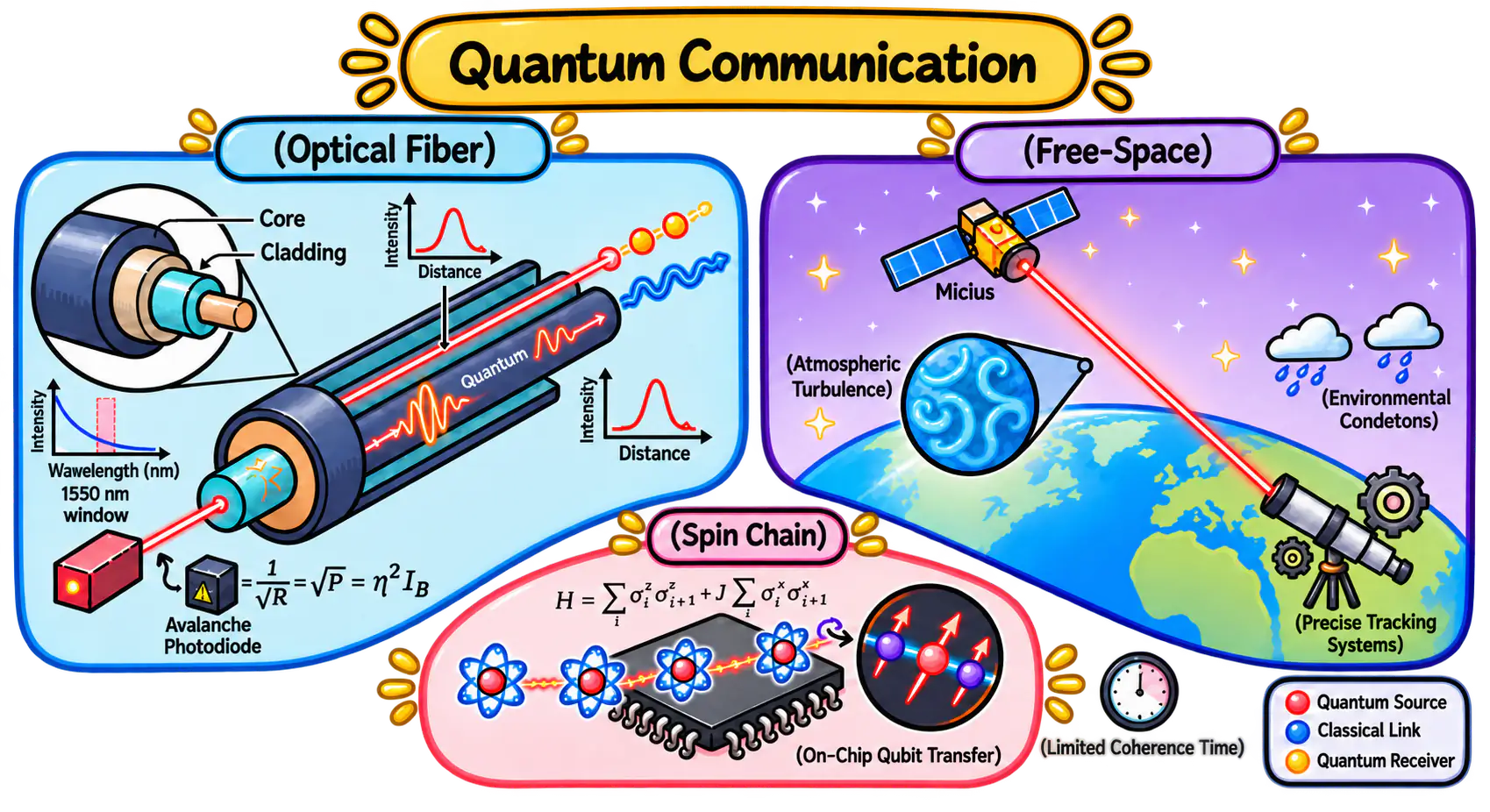
Figure 1. Physical layers in quantum communication
Sources and Detectors
Every quantum communication system relies on two essential components: a photon source for generating quantum carriers and a detector for receiving and measuring them. The quality, stability, and efficiency of these components directly affect the transmission rate, fidelity, and security of the communication.
Photon Sources
One of the most widely used approaches for generating entangled or single photons is a process known as spontaneous parametric down-conversion (SPDC). In this process, a pump beam is directed onto a nonlinear crystal and, under appropriate conditions, pump photons are converted into pairs of lower-energy photons that can be entangled in different degrees of freedom. Owing to its relative simplicity and stability, SPDC remains one of the most widely used photon-source techniques in quantum experiments and QKD systems.
Another type of source is based on quantum dots, which behave similarly to artificial atoms. These semiconductor structures can generate single photons in a controlled manner through optical or electrical excitation. A major advantage of quantum dots is their potential for integration with solid-state chips, together with precise temporal control and high-efficiency single-photon generation.
In practical applications where ideal single-photon sources are not readily available, weak coherent pulses (WCPs) are also widely used. These pulses are generated using conventional lasers, with the probability of emitting multiple photons kept low. Although WCPs are generated by classical optical sources, their statistical properties are taken into account in quantum protocols. Owing to their simplicity and ease of implementation, WCPs have been widely employed in QKD systems.
Photon Detectors
At the receiver side, photon detectors are responsible for identifying incoming photons and recording their arrival times or other relevant properties. One of the most commonly used detector technologies is the avalanche photodiode (APD). These detectors are relatively cost-effective, fast, and comparatively easy to operate at room temperature. However, compared with some more advanced technologies, they generally exhibit higher dark count rates, meaning that they may produce false detection events even in the absence of an incoming photon.
In contrast, superconducting nanowire single-photon detectors (SNSPDs) are a highly sensitive class of detectors that operate at very low temperatures, typically a few kelvin. They offer high detection efficiency, very fast response times, and very low dark count rates. Consequently, SNSPDs play an important role in precision experiments and quantum communication systems, particularly in long-distance and satellite-based links.
Importance of Source–Detector Matching
In the design of a quantum communication system, matching the characteristics of the source and detector is of great importance. The source's output wavelength should be compatible with the spectral range of the detector. The timing and synchronization of the pulses should be adjusted with appropriate precision according to the repetition rate, pulse duration, and link architecture. In addition, the detection efficiency, dark count rate, and other detector characteristics are among the factors that influence the probability of successful reception, error rate, and final communication fidelity.. The overall architecture of photon sources, quantum detectors, and their parameter matching requirements are summarized in Figure 2.
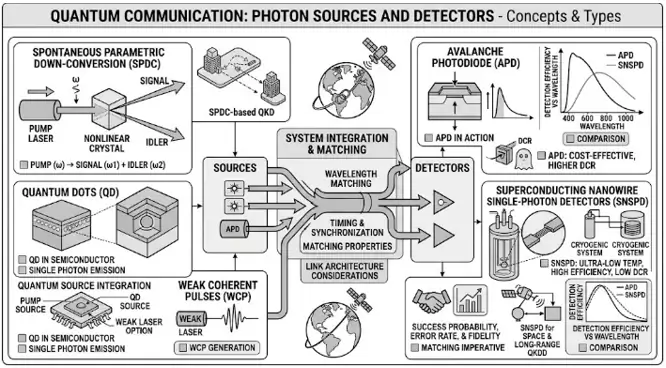
Figure 2. Conceptual diagram of physical layer components in quantum communication, highlighting photon sources (SPDC, Quantum Dots, and Weak Coherent Pulses), detection technologies (APDs and SNSPDs), and the required spectral and temporal matching between sources and detectors.
Overall, the performance of a quantum communication system depends on the appropriate selection of the transmission medium, sources, and detectors, as well as on precise coordination among the components of the link. The following section examines quantum-state encoding and state formats, together with the requirements for synchronization and link budgeting, to further address the practical aspects of quantum information transmission and reception.
Resources
Gisin, N., Ribordy, G., Tittel, W., & Zbinden, H. (2002). Quantum cryptography. Reviews of Modern Physics, 74(1), 145–195.
Pirandola, S., Andersen, U. L., Banchi, L., Berta, M., Bunandar, D., Colbeck, R., ... & Wallden, P. (2020). Advances in quantum cryptography. Advances in Optics and Photonics, 12(4), 1012–1236.
van Meter, R. (2014). Quantum networking. Wiley-IEEE Press..