Introduction
In the previous part, the physical layer of quantum communications and the main components of a practical link, including transmission media, photonic sources, and detectors, were examined. It was also shown that the appropriate selection and coordination of these components directly affect the quality, range, and reliability of the communication system.
Continuing this discussion, it is necessary to examine how quantum information is encoded onto a quantum carrier and how a system manages the timing and transmission budget of a communication link. Therefore, this part first examines different encoding schemes and quantum state representations, ranging from polarization and time-bin encoding to phase, frequency-bin, and continuous-variable encoding. It then considers two important components in the design of a practical link, namely, time synchronization and link budget. These factors ultimately determine the range, rate, and stability of quantum communication.
For the transmission of quantum information, the choice of a quantum encoding scheme plays a decisive role in the performance and stability of the communication system. Each encoding method is defined based on specific physical properties of photons or other quantum carriers and determines their sensitivity to noise, loss, and dispersion.
Polarization Encoding & Time-Bin Encoding
One of the simplest and most widely used approaches is polarization encoding. In this scheme, quantum information is encoded in different polarization states of light, such as horizontal and vertical polarization or diagonal polarization states. This approach is widely used in laboratory experiments because it is relatively straightforward to implement, while polarization can be controlled and measured using optical components such as polarizers, wave plates, and polarization beam splitters. However, in long optical fibers, polarization stability can be degraded by environmental fluctuations. To address this issue, time-bin encoding can be employed. In this approach, information is encoded in the different arrival times of optical pulses. For example, a quantum state can be defined as a superposition of an “early” pulse and a “late” pulse. This type of encoding is less sensitive to polarization changes along the transmission path and is therefore particularly attractive for long-distance fiber-based systems.
Phase Encoding & Frequency-Bin Encoding
Another approach is phase encoding, in which quantum information is encoded in the relative phase difference between optical components. This technique is commonly implemented using interferometric structures such as Mach–Zehnder or Michelson interferometers and is highly effective for implementing quantum key distribution (QKD) protocols. In some implementations, information is encoded based on relative phase differences, which can reduce sensitivity to certain intensity fluctuations.
In some systems, frequency-bin encoding is also employed. In this approach, quantum information is encoded in distinct frequency modes and their superpositions. This encoding method enables the use of well-defined frequency modes and can be compatible with spectral multiplexing techniques, allowing multiple quantum channels to be transmitted simultaneously.
Continuous-Variable (CV) Encoding
Finally, a group of approaches is known as continuous-variable (CV) encoding. In this framework, quantum information is encoded in continuous variables of the optical field, particularly its field quadratures. Detection in these systems is commonly performed using homodyne detection. This type of encoding offers a high degree of compatibility with conventional optical communication technologies and can be implemented using stable lasers and standard photodetectors. Figure 1 illustrates different quantum information encoding schemes and their corresponding schematic representations.
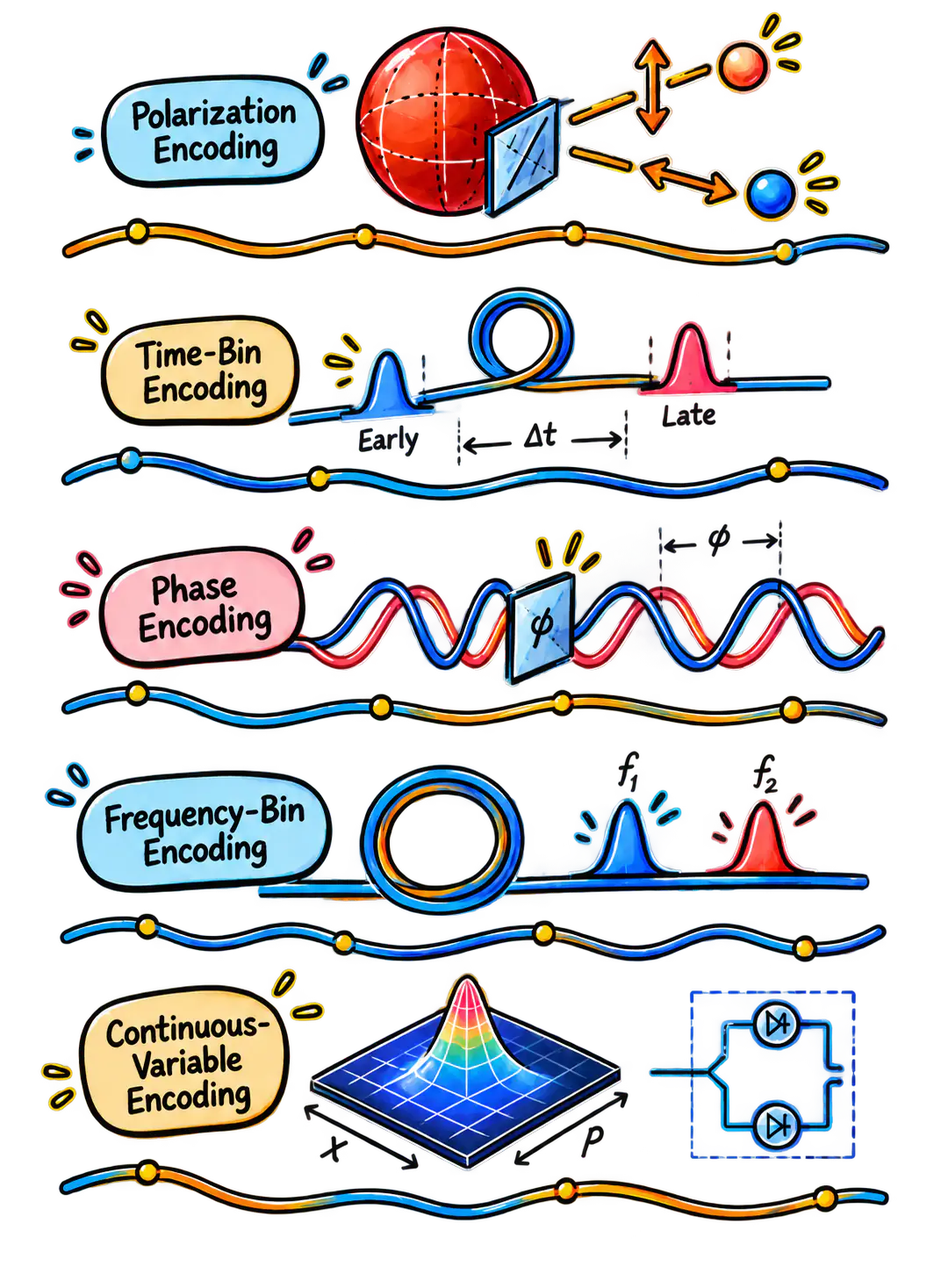
Figure 1. Schematic representation of different approaches for quantum information encoding. From top to bottom: photon polarization states represented on the Bloch sphere and their separation using an optical polarization element; early and late optical pulses in an unbalanced fiber interferometer; information encoding based on the relative phase difference between optical components using a phase modulator in an interferometric setup; distinct frequency modes and their superpositions; and a phase-space representation of a Gaussian state with homodyne detection.
In general, the selection of an appropriate encoding format for quantum information depends on the type of channel, transmission distance, environmental conditions, and detection technology. In some practical systems, multiple encoding methods or multiple photonic degrees of freedom may be combined to meet specific system requirements. This diversity of encoding approaches is one of the key factors in the development of versatile and reliable quantum communication systems.
Synchronization and Link Budget
In quantum communication systems, one of the most important challenges is precise temporal synchronization between the transmitter and receiver. Since quantum information is often transmitted using very short optical pulses, with durations ranging from nanoseconds to even picoseconds, small timing mismatches can cause photons to fall outside the detection window, resulting in missed detections and information loss.
To achieve such synchronization, the clocks at both ends of the communication link must be aligned with high precision. This is typically achieved through the distribution of a timing or frequency reference, which may rely on optical reference signals, stable optical sources, or phase-coherent radio-frequency signals. In some advanced systems, two-way synchronization is employed to estimate and compensate for propagation-delay variations along the transmission path. The accuracy of temporal synchronization can affect detection performance and, consequently, the quantum bit error rate (QBER) and, in some systems, the fidelity of the transmitted quantum state.
Another important aspect of quantum-system design is the link budget, which plays a role similar to loss analysis in classical telecommunications, although quantum links are often more sensitive to loss and detection inefficiencies. A link budget includes the evaluation of transmission losses and the efficiencies of system components, including channel losses (in fiber or free-space paths), optical component losses, photon-source efficiency, and detector efficiency. Background noise and other sources of error are also considered when estimating the detection rate and overall system performance. The purpose of these calculations is to estimate the probability of successful photon transmission and detection at the receiver and to evaluate the performance of the quantum link.
For example, if the probability of photon generation or coupling into the transmission path is 60%, the optical fiber has a loss of 0.2 dB/km, and the detector has a detection efficiency of 80%, the approximate probability of detecting a photon can be estimated for different transmission distances. Based on these parameters, the detection probability and its variation with increasing transmission distance can be estimated.
In the design of practical networks, the link budget plays a critical role because it helps evaluate system requirements and select appropriate components, such as optical sources with suitable performance, higher-efficiency detectors, and optical components with lower insertion losses. At very long distances, advanced architectures may also consider technologies such as quantum repeaters as a potential approach for extending the communication range.
This analysis provides a foundation for planning metropolitan, intercity, and satellite-based quantum networks. Without a proper assessment of synchronization requirements and link losses, achieving stable and reliable quantum communication over practical distances would be difficult.
Ultimately, precise synchronization and optimized link-budget design can be regarded as two fundamental pillars of quantum communication-system engineering. These factors not only influence the quality and stability of communication but also help define the practical limits on transmission distance and achievable communication rates in future quantum networks.
In the next part, building on these foundations, the main components of quantum networks and their different architectures will be examined. The interactions and interconnections among these components in the formation of an integrated quantum network will also be discussed.
Resources
Gisin, N., Ribordy, G., Tittel, W., & Zbinden, H. (2002). Quantum cryptography. Reviews of Modern Physics, 74(1), 145–195.
Pirandola, S., Andersen, U. L., Banchi, L., Berta, M., Bunandar, D., Colbeck, R., ... & Wallden, P. (2020). Advances in quantum cryptography. Advances in Optics and Photonics, 12(4), 1012–1236.
van Meter, R. (2014). Quantum networking. Wiley-IEEE Press..