Introduction
In the previous sections, quantum communications were examined from both fundamental and physical perspectives, ranging from the basic concepts and different types of quantum channels to channel capacities and the fundamental limitations on information transmission. The role of quantum measurements, transmission media, photonic sources, detectors, and synchronization mechanisms in establishing a practical communication link was then examined. Subsequently, different approaches to encoding quantum states and the considerations associated with their transmission and detection were discussed. However, establishing quantum communication on a large scale does not depend solely on the performance of an individual link. Rather, it requires a collection of nodes, memories, interface devices, and mechanisms capable of integrating these links into a coherent network infrastructure. Accordingly, this part shifts the focus from the link level and individual components to the network level, examining the major components of quantum networks and their roles in the generation, storage, distribution, and extension of entanglement.
In the design and analysis of quantum networks, understanding the overall structure and the interactions among subsystems is of fundamental importance. The architecture of such a network can be viewed as a set of interconnected components, each performing a specific role in the generation, distribution, and preservation of entanglement. These components, ranging from quantum memories and repeaters to quantum transducers and communication layers, operate in a coordinated manner to enable reliable communication over large distances.
Quantum Memories
One of the fundamental components of quantum networks is the quantum memory, which is responsible for storing quantum states for a specified period and retrieving them when required. Quantum memories provide the necessary temporal interface for coordinating operations among different network nodes.
A variety of platforms have been proposed and demonstrated for implementing quantum memories, including cold atoms trapped in magnetic or optical traps, rare-earth-doped crystals, nitrogen-vacancy (NV) centers, and trapped ions. The performance of these memories is typically characterized by parameters such as coherence time, bandwidth, and multi-mode capacity.
Quantum Repeaters
One of the major challenges in establishing long-distance quantum communication is the severe loss of photons during transmission. In optical fibers, the probability of successful photon transmission decreases exponentially with distance, making the probability that photons carrying quantum information reach the destination increasingly small. Since conventional optical amplifiers cannot amplify and regenerate an unknown quantum state without destroying its quantum properties, due to the no-cloning theorem, specialized technologies known as quantum repeaters are employed to overcome this limitation.
Quantum repeaters are designed to enable long-distance quantum communication by generating, storing, and performing entanglement swapping and, in some architectures, entanglement purification or distillation. These processes allow entanglement to be extended over long distances and thereby enable the establishment of quantum communication beyond the range of a single physical link.
First, entanglement swapping connects two shorter quantum links by performing a Bell-state measurement (BSM) on two intermediate quantum systems. As a result, entanglement is established between two more distant nodes without requiring direct transmission of a photon between them. This process can be repeated along the communication path, allowing entanglement to be progressively extended between increasingly distant nodes.
Second, entanglement purification or distillation is employed to improve the quality of entangled links. In this approach, multiple entangled pairs with relatively low fidelity are processed jointly to produce a smaller number of entangled pairs with higher fidelity. Consequently, the quality and reliability of the resulting entangled pairs can be improved.
From both historical and technical perspectives, three major generations of quantum repeaters have been proposed, each characterized by different levels of performance and implementation complexity:
- First generation: These repeaters rely on entanglement generation and storage, entanglement swapping, and, in many architectures, entanglement purification or distillation. Quantum memories are used to temporarily store quantum states and coordinate operations across different nodes. Although this approach is conceptually and technologically feasible, it requires quantum memories with sufficiently long storage times and generally provides lower communication rates.
- Second generation: These repeaters employ quantum error correction to control errors introduced during the transmission and processing of quantum information and, compared with first-generation architectures, reduce their reliance on entanglement distillation. As a result, higher communication rates and improved system stability can be achieved.
- Third generation: These architectures rely on quantum error correction and the transmission of encoded quantum information across the network. By employing quantum error-correcting codes, reliable long-distance transmission of quantum information can be achieved, while architectures based on error correction can substantially reduce or eliminate the need for entanglement distillation. In principle, this approach offers higher communication rates and improved scalability. provides a conceptual overview of the architectures and operating principles of quantum repeaters. Figure 1 illustrates a conceptual overview of quantum repeater mechanisms and generations.
Overall, quantum repeaters are analogous to classical amplifiers in their general objective of overcoming transmission limitations over long distances. However, rather than directly amplifying a signal, quantum repeaters preserve quantum coherence and exploit processes such as entanglement swapping and, in some architectures, entanglement distillation to extend entanglement over long distances. The development of quantum repeater technology is therefore regarded as one of the key approaches for overcoming the transmission-rate limitations imposed by the PLOB bound and for enabling quantum communication on intercontinental scales.
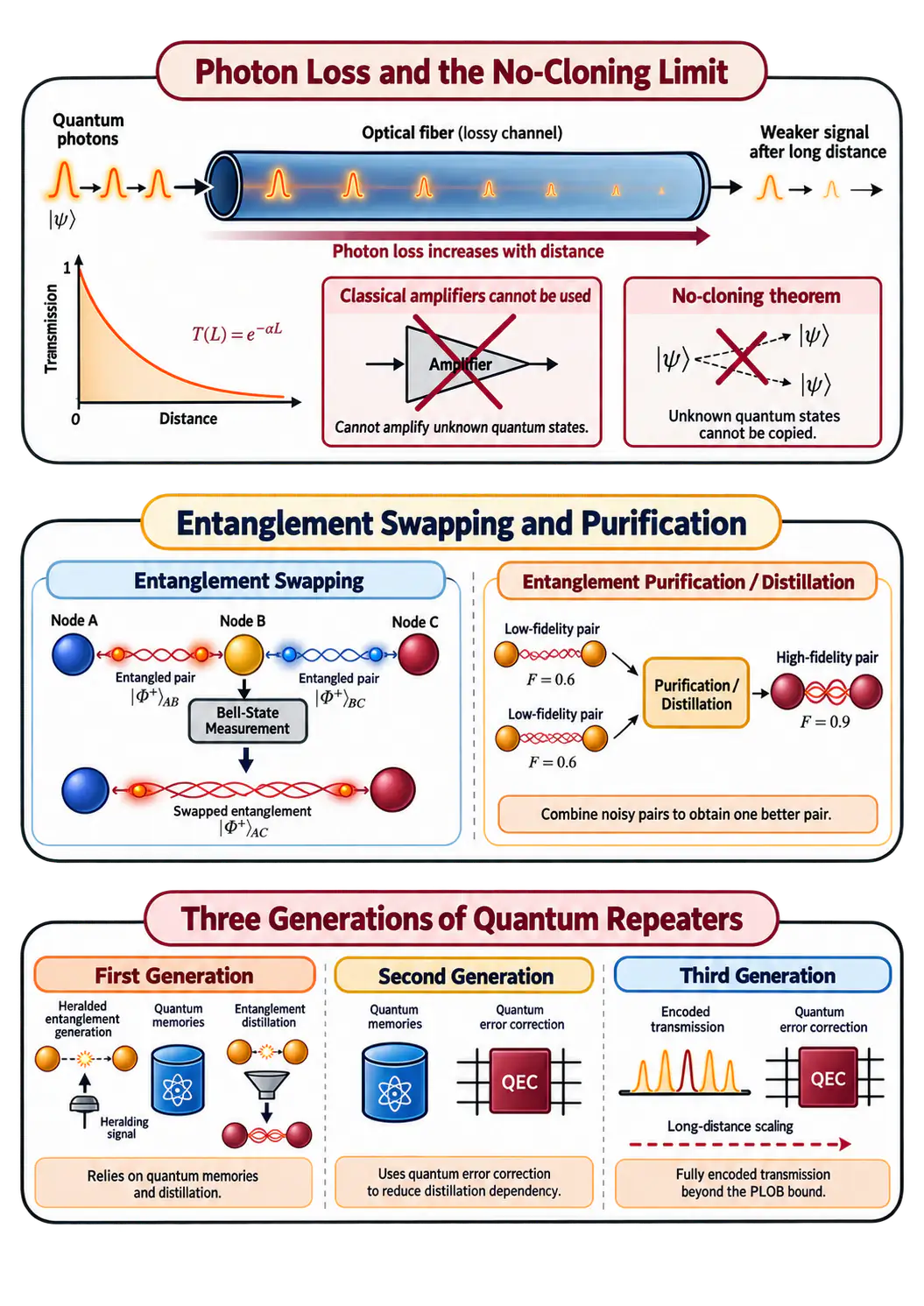
Figure 1: Conceptual schematic of the mechanisms and generations of quantum repeaters and their role in overcoming the limitations of long-distance quantum transmission. Top: Exponential attenuation of photon transmission in optical fiber and the fundamental limitation on the amplification and regeneration of unknown quantum states imposed by the quantum no-cloning theorem. Middle: Entanglement swapping between network nodes using Bell-state measurements (left) and entanglement distillation for increasing entanglement fidelity (right). Bottom: Classification and comparison of three generations of quantum repeaters: first generation (memory- and distillation-based), second generation (employing quantum error correction to reduce reliance on distillation), and third generation (encoded quantum-information transmission for improved scalability and enabling rates beyond the repeaterless PLOB bound).
Quantum Transducers
In heterogeneous quantum systems, which employ different physical platforms and carriers, one of the fundamental challenges is enabling quantum communication and information exchange between these distinct systems. Quantum transducers are devices designed to address this challenge. Their primary function is to convert a quantum state from one physical platform to another while preserving the quantum information encoded in the state and minimizing the degradation of its coherence.
For example, in many superconducting quantum computers, qubits are controlled and read out using microwave-frequency signals. However, microwave signals encounter substantial losses when transmitted over long distances through conventional communication media and, in particular, when interfacing with superconducting systems operating at cryogenic temperatures. In contrast, optical photons at telecommunications wavelengths, typically around 1550 nm, can propagate through optical fibers with relatively low loss. In such systems, transducers must therefore enable the conversion of quantum states between microwave and optical fields, allowing superconducting quantum processors to interface directly with optical communication networks.
Another important application of quantum transducers is the conversion between visible and telecommunications-wavelength photons. Some atomic and solid-state systems, including certain trapped-ion platforms and NV centers in diamond, exhibit optical transitions in the visible or near-visible spectral range, whereas optical communication networks typically operate at telecommunications wavelengths. To connect these systems to one another or to fiber-based networks, transducers are required to convert photons from the visible range to the telecommunications band and vice versa, while minimizing information loss and added noise and preserving the relevant quantum properties of the state as faithfully as possible.
The development of quantum transducers with high conversion efficiency, adequate bandwidth, and extremely low added noise is a major objective in the engineering of future quantum networks. Various technologies are being investigated for this purpose, including optomechanical systems, in which mechanical oscillators mediate interactions between microwave and optical fields, as well as hybrid atomic and photonic systems that exploit energy transitions in atoms or engineered materials to perform wavelength conversion. Figure 2 presents a conceptual overview of quantum transduction within heterogeneous quantum networks.
Overall, quantum transducers play a critical role in establishing compatibility among heterogeneous quantum platforms and connecting them to larger-scale quantum networks. In heterogeneous architectures, these elements are essential for interfacing different physical platforms and enabling scalable quantum networks, because optical, superconducting, solid-state, and atomic systems generally operate at different frequencies, interfaces, and physical conditions and therefore cannot be directly interconnected. Consequently, the development of efficient, stable, and low-noise quantum transducers represents one of the key pillars of future quantum communication architectures and infrastructure.
Figure 2:Schematic illustration of quantum transduction for connecting heterogeneous quantum systems to communication networks. The upper path shows the conversion of microwave signals associated with a superconducting quantum processor, operating in a cryogenic environment at approximately 10 mK, into telecommunications photons at a wavelength of approximately 1550 nm through a mechanical oscillator-based electro-optomechanical transducer. The lower path illustrates the conversion of visible photons emitted by a solid-state quantum emitter based on an NV center in diamond into telecommunications photons using a nonlinear crystal, such as PPLN, through difference-frequency generation (DFG). In this process, a 532-nm laser is used to optically excite the NV center and should not be interpreted as the emission wavelength of the NV center. Both pathways enable heterogeneous quantum systems to interface with optical-fiber networks and support long-distance quantum communication.
Ultimately, a quantum network cannot be regarded simply as a collection of independent quantum links. Rather, its overall functionality emerges from the coordinated interaction of quantum memories, repeaters, transducers, and other communication components. These elements enable network-level management of limitations arising from transmission loss, distance, heterogeneous physical platforms, and finite coherence times. However, the presence of these components alone is not sufficient to establish a scalable network; their organization, interconnection, and coordination are equally fundamental. Therefore, the next step is to examine network architecture, including how these components are organized across different layers, how entanglement is routed and scheduled, and how an appropriate topology can be selected to extend the network from local links to regional, national, and ultimately global-scale systems.
Resources
Gisin, N., Ribordy, G., Tittel, W., & Zbinden, H. (2002). Quantum cryptography. Reviews of Modern Physics, 74(1), 145–195.
Pirandola, S., Andersen, U. L., Banchi, L., Berta, M., Bunandar, D., Colbeck, R., ... & Wallden, P. (2020). Advances in quantum cryptography. Advances in Optics and Photonics, 12(4), 1012–1236.
van Meter, R. (2014). Quantum networking. Wiley-IEEE Press..