Introduction
Following the examination of the major components of quantum networks and their roles in establishing and extending quantum communications, the central question now shifts from “What components constitute a network?” to “How are these components organized and managed?” Just as the performance of a quantum link depends on the coordination of the channel, source, detector, encoding, and synchronization mechanisms, reliable communication at the network scale requires coordination among nodes, links, memories, and quantum resources. This section therefore examines the layered architecture of quantum networks, entanglement routing and scheduling mechanisms, as well as different topologies and distance regimes, with the aim of providing an integrated view of how quantum networks can be organized and scaled.
Layered Architecture
Similar to the layered architecture underlying the classical Internet, quantum networks can be organized according to a comparable structure while incorporating the distinctive characteristics of quantum information. The objective of such an architecture is to establish a standardized and modular framework for the gradual development of a quantum Internet, in which each layer performs well-defined functions while interacting coherently with the other layers.
At the Physical Layer, the hardware components of the network are located, including transmission media such as optical fibers, free-space links, and satellite channels, as well as photonic sources and detectors. This layer is responsible for transmitting quantum states and providing the physical conditions required for entanglement distribution, coherence preservation, and the minimization of noise and transmission losses.
Above the physical layer is the Data Link Layer, which manages and maintains short-range quantum links. Its functions include synchronization, coordination of quantum-link establishment and maintenance, management of entanglement-generation attempts, and assessment of link quality. In this sense, the data link layer serves as an interface between the physical hardware and the higher network layers that control network-level functions.
At a higher level, the Network Layer is responsible for entanglement routing, scheduling, allocation of quantum-memory resources, and optimization of multi-node paths. Algorithms at this layer determine how and through which paths entanglement should be distributed across the network in order to maximize performance in terms of parameters such as entanglement generation rate and fidelity. Conceptually, this layer is analogous to the IP layer in the classical Internet; however, its decisions are based not only on conventional network parameters but also on physical and quantum characteristics.
Finally, the Application Layer encompasses protocols and services that are directly accessible to users or higher-level systems. Important examples include Quantum Key Distribution (QKD), Quantum Teleportation, Superdense Coding, and Distributed Quantum Computing. At this layer, users exploit the underlying capabilities of the network to perform quantum communication and computational tasks.
Such a layered architecture offers several advantages, including the gradual development of quantum networks, the possibility of independently upgrading individual layers, and interoperability among different types of equipment and technologies. Ultimately, this structure provides an integrated and standardized framework for implementing and scaling a global quantum Internet. Within such a network, entanglement, as one of the fundamental resources of quantum communication, plays a central role in supporting many network services. **Figure 1** illustrates the hierarchical architecture of a quantum network.
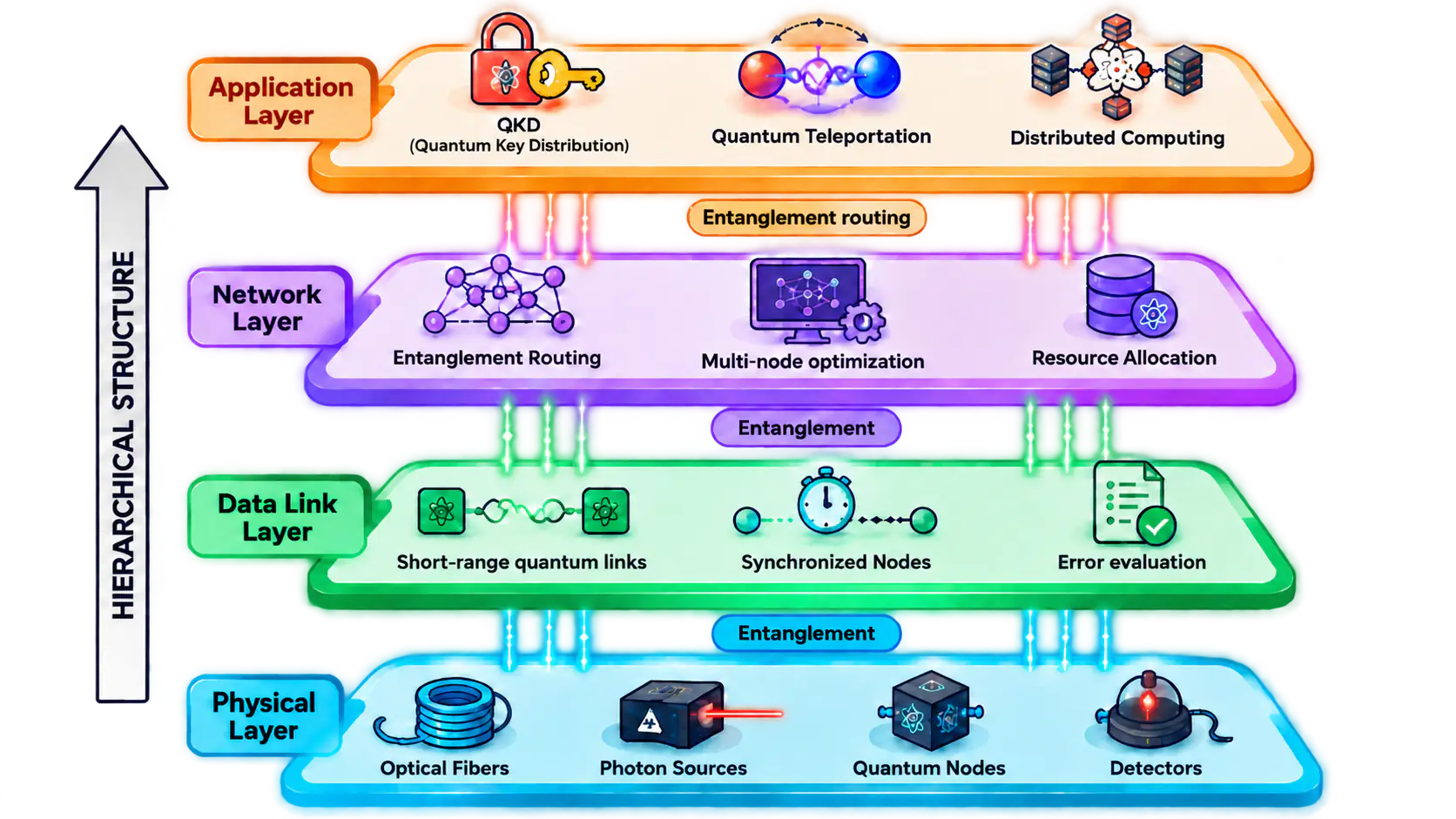
Figure 1: A hierarchical layered architecture of a quantum network, illustrating the organization of network functions from the physical hardware infrastructure to higher-level quantum applications. This conceptual architecture consists of four layers: Layer 4 (Physical Layer), which includes optical fibers, photon sources, detectors, and quantum nodes; Layer 3 (Data Link Layer), responsible for short-range link management, synchronization, and error evaluation; Layer 2 (Network Layer), responsible for entanglement routing, multi-hop path establishment, and resource allocation; and Layer 1 (Application Layer), supporting applications such as QKD, quantum teleportation, and distributed quantum computing.
Entanglement Routing and Scheduling
In large-scale quantum networks, one of the fundamental challenges is selecting an appropriate path for entanglement distribution among different network nodes. Unlike routing in the classical Internet, which typically relies on parameters such as path length, latency, and link capacity, quantum networks require fundamentally different criteria. In this context, path quality depends not only on its physical length but also on quantum characteristics such as fidelity, entanglement generation rate, or, in QKD applications, the key generation rate, as well as the preservation of coherence in intermediate quantum memories.
Because entanglement generally experiences loss and noise as it propagates through a network, selecting an appropriate path can have a significant impact on overall network performance. Paths containing nodes and links with better performance, higher success probabilities, and lower losses can contribute to achieving higher fidelity between two end nodes. In practice, quantum routing constitutes a multi-objective optimization problem in which a balance must be established among fidelity, success probability, and latency.
In addition to path selection, resource scheduling is of critical importance. In quantum networks, quantum memories used for temporarily storing qubits or entangled pairs have finite storage times. Therefore, the generation, storage, and utilization of entanglement must be scheduled so that the required connections between nodes are established before significant decoherence occurs. This requires precise coordination among network nodes and synchronization at very fine time scales.
In advanced architectures, intelligent algorithms can be employed to jointly optimize entanglement routing and scheduling. By exploiting real-time network information, such as loss rates, memory availability, and link quality, these algorithms can determine optimized paths and scheduling strategies to maximize the overall network performance in terms of transmission rate and fidelity.
Overall, entanglement routing and scheduling can be viewed as playing a role analogous to the combination of routing and resource management in classical networks. However, in quantum networks, these decisions must account for physical and quantum constraints. The development of such algorithms is therefore one of the key requirements for realizing a scalable quantum Internet, in which entanglement can be dynamically and efficiently distributed throughout the network.
Topologies and Distance Regimes
Depending on their scale, application, and underlying technology, quantum networks can be designed using a variety of configurations and topologies. The objective of selecting an appropriate structure is to establish a balance among coverage, reliability, cost, and the efficiency of entanglement and quantum-information distribution.
The simplest form of a quantum network is end-to-end communication, in which two nodes communicate directly without intermediate nodes. This configuration is commonly used in laboratory environments and short-range applications, including certain metropolitan-scale QKD implementations. In such networks, losses and noise are generally more limited than in longer links, and there is no need for repeaters or intermediate nodes.
At larger scales, multi-hop networks can be employed, in which a communication path between two distant nodes is established through multiple intermediate nodes. These intermediate nodes may include quantum repeaters, quantum-memory-equipped nodes, and the necessary hardware for entanglement processing and distribution. Multi-hop networks can enable communication over distances ranging from hundreds to thousands of kilometers and are regarded as an important foundation for the development of regional and national-scale quantum networks.
For larger-scale network designs, more diverse topologies can be employed. A mesh topology provides multiple connections among nodes and can offer greater resilience against node or link failures as well as increased traffic. A ring topology, in which each node is connected to two neighboring nodes, can provide path redundancy and enable the selection of alternative routes in the event of a failure. A star topology, in which a central node is connected to multiple peripheral nodes, can be useful for controlled and structured networks, particularly in metropolitan environments.
At the next level of scale, hybrid ground–space networks have emerged as a promising architecture for a global quantum Internet. In such architectures, terrestrial optical fibers can be used for regional and metropolitan connections, while satellite-based links can provide connectivity between geographically distant regions and even across continents. This combination incorporates the advantages of both types of channels: the stability, relatively low loss, and established infrastructure of optical-fiber networks, together with the broad coverage and reduced dependence on terrestrial infrastructure offered by space-based communication. Figure 2 illustrates different quantum-network topologies and distance regimes.
Overall, network topology and structure determine important characteristics of the system, including communication capacity, latency, entanglement stability, and overall scalability. The optimal choice of these parameters depends on the nature of the application, such as QKD, distributed quantum computing, or quantum sensing, as well as on the underlying technical constraints. Ultimately, combining diverse topologies within a multilayer network framework can pave the way toward the development of an integrated and globally connected quantum Internet.
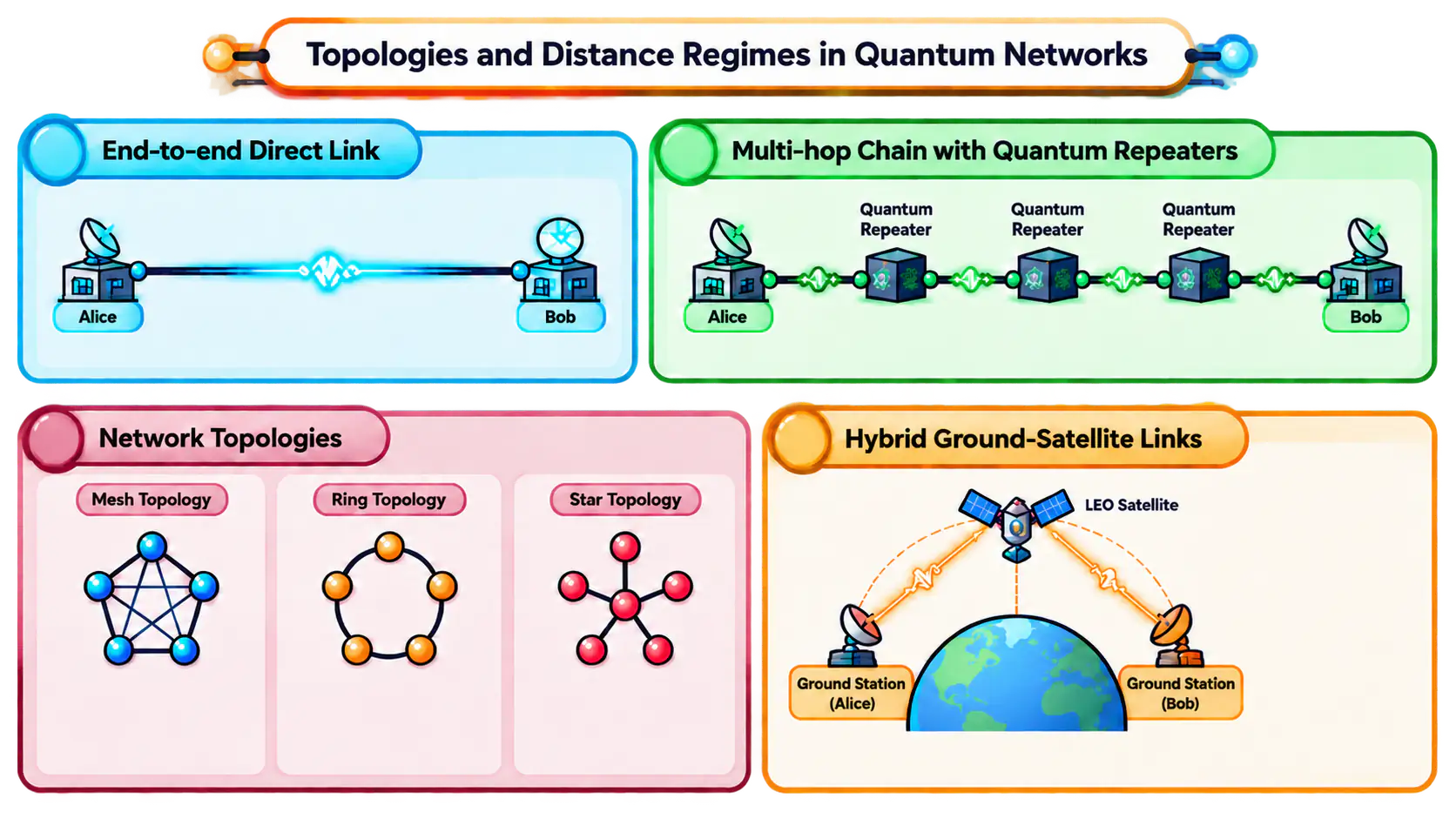
Figure 2: Topologies and distance scenarios in quantum networks. Four representative configurations are shown: (1) direct end-to-end links without repeaters, suitable for short to metropolitan-scale distances; (2) multi-hop chains using quantum repeaters and memory nodes to extend the range of entanglement distribution; (3) mesh, ring, and star topologies to provide path redundancy and support scalable network architectures; and (4) hybrid ground–satellite links for extending quantum communications to intercontinental scales and, ultimately, global-scale quantum networks.
The last two sections discussed above trace the development of a quantum network from its physical and functional components to its architecture, resource management, and communication structure. It is now clear that establishing a scalable quantum network depends not only on the availability of suitable channels, photonic equipment, quantum memories, and network nodes, but also on a set of communication rules and mechanisms that determine how quantum resources are generated, distributed, managed, and utilized.
This role is fulfilled by quantum communication protocols and networking mechanisms. Accordingly, the next section will address the major challenges associated with this field. Subsequently, the principal operational mechanisms of quantum networks, together with their applications in areas such as quantum key distribution, quantum-information transfer and sharing, distributed quantum computing, and other emerging applications, will be examined.
Resources
Gisin, N., Ribordy, G., Tittel, W., & Zbinden, H. (2002). Quantum cryptography. Reviews of Modern Physics, 74(1), 145–195.
Pirandola, S., Andersen, U. L., Banchi, L., Berta, M., Bunandar, D., Colbeck, R., ... & Wallden, P. (2020). Advances in quantum cryptography. Advances in Optics and Photonics, 12(4), 1012–1236.
van Meter, R. (2014). Quantum networking. Wiley-IEEE Press..