Primary Methods for Quantum State Transmission
Following the topics discussed in the first section regarding the preservation of information fidelity and the implementation of a quantum security layer, the operational realization of such systems necessitates the deployment of specific transmission protocols. This section presents a specialized analysis of the primary methods for quantum state transmission, encompassing both the direct transmission of physical carriers and entanglement-assisted protocols (such as quantum teleportation).
Direct Transmission:
The simplest method for transmitting quantum information is the direct transmission of photons through optical fibers or free-space channels. However, the performance of this approach over long distances is fundamentally constrained by optical attenuation and photon loss within the transmission channel. For instance, standard telecommunication optical fibers operating at a wavelength of approximately 1550nm typically exhibit a loss of about 0.2dB/km. Consequently, while direct transmission remains viable for short-to-medium range links, the exponential scaling of loss with distance severely diminishes the transmission success probability, thereby limiting the scalability of this architecture. Therefore, the implementation of direct transmission in intercity and intercontinental quantum networks—without integrating auxiliary technologies such as quantum repeaters—faces critical physical bottlenecks due to channel loss and the corresponding reduction in state arrival probability.
Quantum Teleportation:
In this scheme, an unknown quantum state is transferred between distant locations without the physical propagation of the state-bearing carrier through the transmission channel; a mechanism designated as quantum teleportation. Initially, the communicating parties, Alice and Bob, share a maximally entangled qubit pair. Alice then performs a Bell State Measurement jointly on the input qubit—which encodes the unknown target state—and her half of the shared entangled pair. This measurement projects the system into one of four orthogonal Bell states, the outcome of which Alice transmits to Bob via a classical communication channel using two classical bits. Upon receiving this classical feed-forward information, Bob applies the corresponding single-qubit unitary operation to his held qubit, thereby precisely reconstructing the original target state. Throughout this procedure, the initial state at Alice's terminal is destructively projected, leaving no independent replica in her subsystem. This outcome rigorously complies with the No-Cloning Theorem, which forbids the exact, deterministic replication of an arbitrary, unknown quantum state. This intrinsic property is fundamental to guaranteeing both the physical security and state fidelity during quantum information transfer via teleportation.
Super dense Coding:
In the super dense coding protocol, Alice and Bob pre-share a bipartite entangled qubit pair. To transmit a classical message, Alice physically sends only a single qubit to Bob; however, by exploiting the pre-shared entanglement, she successfully communicates two classical bits of information. To achieve this, Alice applies one of four local unitary operations—typically drawn from the Pauli operator basis (I, X, Z, XZ)—to her local qubit. Each unitary operation uniquely encodes one of the four possible two-bit classical messages. She subsequently transmits her transformed qubit over the quantum channel to Bob. Upon receipt, Bob executes a joint Bell State Measurement on both qubits (the received qubit and his localized entangled qubit), thereby deterministically decoding Alice's two-bit classical message. This protocol demonstrates that entanglement functions as a physical resource capable of doubling the classical information capacity per transmitted qubit. Under ideal noiseless channel conditions and given sufficient physical resources, an entanglement-assisted quantum channel achieves a classical capacity of two bits per transmitted physical qubit.
Figure 1 illustrates a comparison of three fundamental approaches to quantum information transmission: direct transmission, quantum teleportation, and super dense coding.
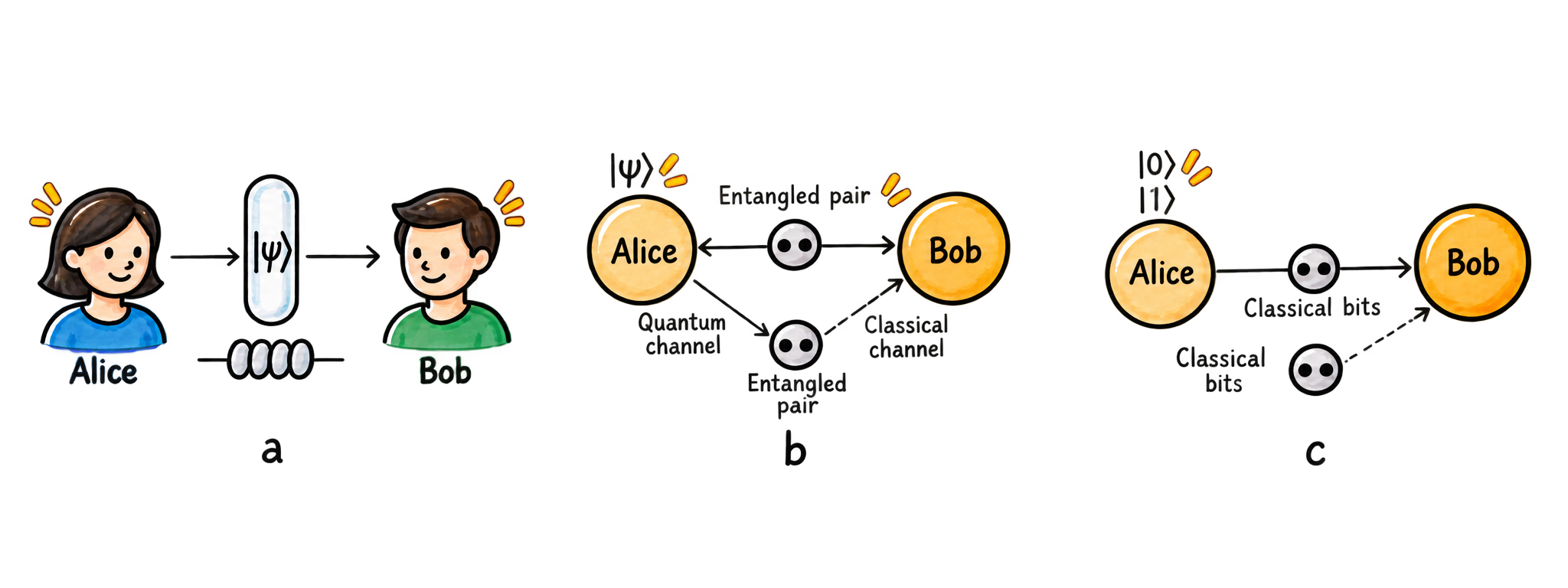
Figure 1: Comparison of three fundamental approaches to quantum information transmission.
(a) Direct Transmission: The qubitis physically transmitted from the sender to the receiver through a quantum channel, such as an optical fiber.(b) Quantum Teleportation: The quantum state of the qubit is transferred without physically transporting the particle, using a shared entangled pair and the transmission of classical information.(c) Super dense Coding: By exploiting a shared entangled pair, the sender can transmit two classical bits of information to the receiver by physically sending only a single qubit.
In this section, the primary mechanisms for quantum state transmission and the role of fundamental protocols—such as quantum teleportation—in secure information exchange were investigated. However, analyzing these methods under ideal conditions represents merely the first step toward understanding their behavior; in practice, the real-world performance of any protocol is severely constrained by noise, loss, and decoherence introduced by the transmission medium. Consequently, the next section focuses on the modeling of quantum channels, where the mathematical formulation of noise and the physical dynamics of the environment are utilized to evaluate the practical throughput and performance of information transfer over operational telecommunication infrastructures.
Resources
Gisin, N., Ribordy, G., Tittel, W., & Zbinden, H. (2002). Quantum cryptography. Reviews of Modern Physics, 74(1), 145–195.
Pirandola, S., Andersen, U. L., Banchi, L., Berta, M., Bunandar, D., Colbeck, R., ... & Wallden, P. (2020). Advances in quantum cryptography. Advances in Optics and Photonics, 12(4), 1012–1236.
van Meter, R. (2014). Quantum networking. Wiley-IEEE Press..