Introduction
Quantum sensing is one of the important fields of quantum physics that enables the measurement of physical quantities with high sensitivity and precision by exploiting quantum properties and phenomena. In this technology, quantum systems and properties such as superposition, coherence, and entanglement can play a role in the measurement process or in information detection. In addition to improving the performance of some conventional measurement methods, the development of this field has made it possible to investigate phenomena whose detection using classical methods faces limitations.
To better understand the operating principles of quantum sensors, they can be divided into three main approaches based on how quantum resources and properties are used: the direct use of a quantum system as the sensing element, the use of quantum-enhanced detection techniques, and the use of entanglement to improve measurement performance.
These approaches provide a basis for examining a wide range of quantum sensors used in areas such as electromagnetic-field measurement, inertial and gravitational sensing, time and frequency measurement, thermal and mechanical sensing, chemical and biological detection, imaging and ranging, as well as the search for dark matter. In this text, the conceptual framework and classification of quantum sensing are first introduced, followed by examples of sensors, their operating principles, and their applications.
Definition of Quantum Sensing
Quantum sensing refers to the use of quantum systems, quantum properties, and quantum phenomena to measure physical quantities.
In other words, if a quantum system or a quantum property/phenomenon is used as part of the “measurement” process when measuring a physical quantity, that process can be referred to as “quantum sensing.”
This technology can exploit quantum properties to achieve high sensitivity and precision and, in some applications, enables non-invasive measurements on various organic materials.
Three Main Approaches in the Definition of Quantum Sensing
The earliest examples of quantum sensors included SQUID magnetometers, atomic vapors, and atomic clocks. As the field developed, quantum sensing expanded to the measurement of various quantities such as magnetic and electric fields, time, the frequency of electromagnetic waves, mechanical rotations, temperature, and pressure.
Subsequently, a new generation of sensors known as second-generation quantum sensors was developed, in which measurements can be performed at the level of a single atom or spin. In this generation, in addition to using quantum properties, quantum entanglement can also be employed as a resource to increase measurement sensitivity and precision.
Based on the manner in which quantum resources and phenomena are used, quantum sensors can be divided into three main categories:
Type 1: Using a Quantum System as the Sensor
In Type 1 sensors, a quantum system (quantum object) is directly used to measure a physical quantity, such that the interaction of the quantity with the system causes a change in a measurable property of its quantum state.
In this type of sensor, the quantum system itself acts as the sensing element. The physical quantity of interest, such as a magnetic field, temperature, or acceleration, can affect properties such as energy levels, quantum phase, or spin states. By measuring these changes, the value of the quantity of interest can be estimated.
For example, in an atomic magnetometer, an external magnetic field affects the quantum state of the atoms, and by measuring the atomic response, the magnetic field can be determined. In this type of sensor, the use of a quantum system to perform the measurement is essential, but the presence of quantum entanglement is not required.
Qubit Nature | Sensor Type |
|---|---|
Current spins | Quantum dots |
Supercurrent | SQUIDs |
Charge eigenstates | Single-electron transistor |
Phonons | Optomechanics |
Table 1: Examples of quantum sensors used in Type 1 sensors.
Type 2 Sensors
In Type 2 sensors, the input state of the system is not necessarily a nonclassical quantum state; however, during the reception and detection stage, a quantum-enhanced detection technique is used to extract information about the quantity that is to be measured. In these sensors, the main role of quantum properties appears at the detection stage, rather than necessarily in signal generation or in the quantity itself. In other words, even if the input state is a classical state, properties such as quantum coherence or quantum superposition can be used in the receiver to improve information extraction.
Therefore, the main difference between Type 2 and Type 1 sensors lies in where quantum resources are used. In Type 1, the quantum system itself is the sensing element, whereas in Type 2, quantum properties are mainly used to improve the detection and information-extraction process.
Qubit Nature | Sensor Type |
|---|---|
Atomic spin | Atomic vapor |
Atomic spin | Cold atom clouds |
Rydberg states | Rydberg atoms |
Electronic state | Trapped ions |
Vibrational mode | Trapped ions |
Nuclear spins | NMR |
Electron spin | NV/SiC center ensembles |
Electron spin | P donors in Si |
Electron spin | Quantum dots |
Electron spin | Single NV center |
Supercurrent | SQUIDs |
Circulating current | Flux qubits |
Charge eigenstates | Charge qubits |
Photons, atoms | Interferometer |
Table 2: Examples of quantum sensors used in Type 2 sensors.
Type 3: Using Entanglement to Enhance Measurement Performance
In this type, quantum entanglement is used as a direct resource for increasing the sensitivity or precision of measuring a quantity. In this type of sensor, several quantum systems are placed in a shared entangled state. The interaction of the quantity with the quantum system can create or modify information contained in the quantum correlations present within the system. By appropriately measuring this joint state, information about the quantity of interest can be extracted with better performance than some conventional methods.
An important point regarding Type 3 is that entanglement is not merely a property present in the system; rather, it is used as a resource for improving measurement performance. For this reason, this category is closely related to concepts such as Quantum Metrology and Quantum-Enhanced Sensing.
Qubit Nature | Sensor Type |
|---|---|
Atomic spins | Atomic vapor |
Atomic spins | Cold atom clouds |
Rydberg states | Rydberg atoms |
Electronic state | Trapped ions |
Photons, atoms | Interferometer |
Table 3: Examples of quantum sensors used in Type 3 sensors.
Examples of Quantum Sensors
The figure below shows the general classification of the different areas of Quantum Sensing based on the physical quantity to be measured and the associated applications. In each of these areas, quantum properties and resources are used to achieve high sensitivity and precision in measurement.
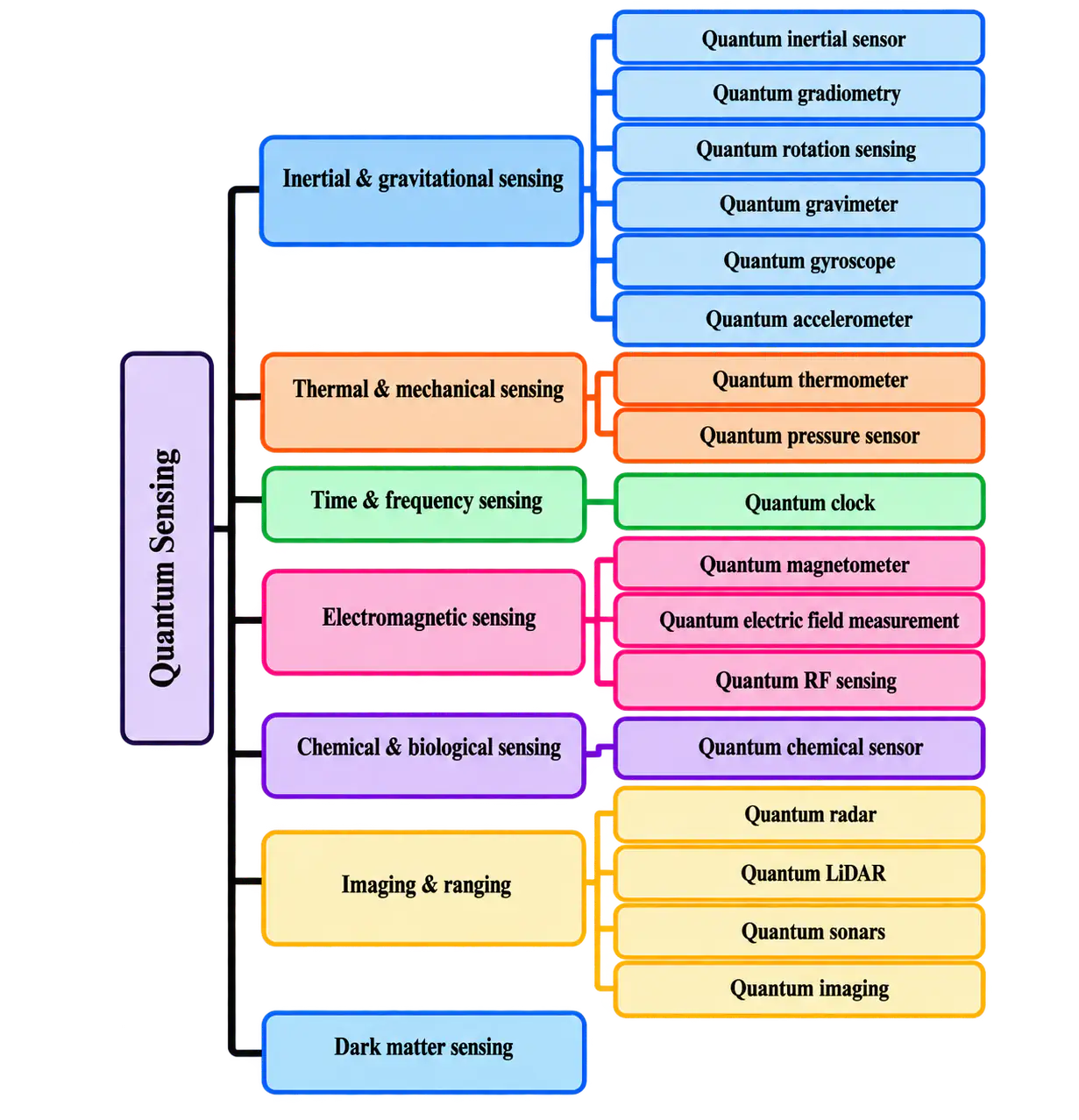
Figure 1: General classification of the different areas of Quantum Sensing based on the physical quantity to be measured and the associated applications.
Inertial and Gravitational Sensing
Quantum inertial and gravitational sensing refers to the use of the quantum properties of systems such as cold atoms, trapped ions, and atom interferometers to measure inertial and gravitational quantities, including acceleration, rotation, gravity, and gravitational-field gradients.
Quantum gravimeters measure gravity with very high precision. These sensors are generally based on Cold-Atom Matter-Wave Interferometry and are used in a wide range of applications, including earthquake detection and volcano monitoring, inertial sensing and quantum positioning systems intended to complement or replace GPS in aircraft, ships, submarines, and drones, mapping the Earth’s gravitational field, detecting underground cavities before construction operations, identifying underground water resources, monitoring changes in ice mass, oil and mineral exploration—albeit with a cautious approach—as well as searching for gravitational waves and even dark matter.
Quantum inertial sensors have been developed with the aim of replacing or complementing GPS systems and also reducing dependence on GPS signals under conditions in which such signals are disrupted or subject to jamming.
Table 4: Information on quantum inertial and gravitational sensors.
Quantum Thermal and Mechanical Sensing
Quantum thermal and mechanical sensing refers to the use of quantum degrees of freedom to measure quantities such as temperature, pressure, force, and displacement. In these systems, changes in the physical quantity of interest cause changes in detectable quantum properties, such as energy levels, transition frequencies, spin states, or the motion of a quantum oscillator.
Quantum thermometry is used to measure very low temperatures, including in cryostats and fundamental physics experiments. In 2017, the U.S. National Institute of Standards and Technology (NIST) developed a very small Quantum Photonics Thermometer that enabled optical measurement of the surface temperature of metals. However, the image of this sensor does not show the associated electronic control equipment.
Other methods have also been developed based on optomechanical systems, in which an optical field is coupled to a mechanical resonator and quantum changes in the system are used to extract temperature information. In addition, superconducting qubits have also been studied as another platform for the development of quantum thermometers.
A quantum pressure sensor is a method for measuring pressure using the quantum response of a system to atomic collisions and interactions. One important method in this field involves the use of cold atoms and measuring the effect of collisions between sensing atoms and ambient gas particles, such that the rate of atomic collisions and scattering depends on the gas pressure.
Article / Source | First Practical Achievement | First Experimental Implementation / Year | Topic |
|---|---|---|---|
Kucsko, G., Maurer, P. C., Yao, N. Y., Kubo, M. I. C. H. A. E. L., Noh, H. J., Lo, P. K., ... & Lukin, M. D. (2013). Nanometre-scale thermometry in a living cell. Nature, 500(7460), 54-58. | Nanoscale thermometry using an NV center, even inside a living cell | 2013 | Quantum thermometer |
Shen, P., Madison, K. W., & Booth, J. L. (2020). Realization of a universal quantum pressure standard. Metrologia, 57(2), 025015. | Experimental realization of a quantum pressure standard based on atomic scattering; final version published in 2020 | 2019 / 2020 | Quantum pressure sensor |
Table 5.
Time and Frequency Sensing
Quantum time and frequency sensing is based on the highly precise measurement of time and frequency using stable quantum transitions in systems such as atoms and ions. Because the frequency of quantum transitions depends on the fundamental properties and energy structure of the system, it can be used as a highly stable reference for defining and measuring time and frequency. Atomic clocks are the main example in this category; by locking a classical oscillator to an atomic transition, they greatly reduce frequency fluctuations. In addition to establishing precise time standards, this technology forms the basis of many metrological applications and technologies that depend on precise timing, including navigation, telecommunications, and tests of fundamental physics.
Atomic clocks used in the GPS system play an important role in providing resilience for navigation systems, particularly in situations where conventional GPS satellite signals are unavailable. These clocks are also used in telecommunications infrastructure related to the Internet and mobile communications, particularly in high-speed fixed and mobile broadband networks.
Article / Source | First Practical Achievement | First Experimental Implementation / | Topic |
|---|---|---|---|
NIST, A Brief History of Atomic Clocks — NIST | First practical atomic clock using ammonia | 1949 | Quantum clock |
Table 6.
Electromagnetic Sensing
Quantum electromagnetic sensing includes the measurement of magnetic and electric fields, as well as radio-frequency and microwave signals, using the quantum response of sensing systems. In this approach, an external field interacts with quantum degrees of freedom, such as atomic spin, electron spin, or Rydberg atomic levels, causing changes in transition frequency, energy, phase, or the populations of quantum states. Detecting these changes makes it possible to convert the external field into a measurable quantity.
Article / Source | First Practical Achievement | First Experimental Implementation / Year | Topic |
|---|---|---|---|
Bell & Bloom, Optical detection of magnetic resonance in alkali metal vapor — PR 1957 | First notable experimental demonstration of an atomic magnetometer using optical pumping | 1957 | Quantum magnetometer |
Sedlacek et al., Microwave electrometry with Rydberg atoms in a vapor cell — Nature Physics 2012 | Measurement of a microwave electric field using Rydberg atoms | 2012 | Quantum electric-field measurement |
Sedlacek et al., 2012 — Nature Physics | RF/microwave field sensing using Rydberg atomic transitions | 2012 | Quantum RF sensing |
Table 7.
Chemical and Biological Sensing
Quantum chemical and biological sensing refers to the use of quantum systems and phenomena to detect, measure, or image chemical and biological characteristics at very small scales. In this approach, the interaction between the quantum system and its environment can provide information about molecular structure, chemical composition, species concentrations, or biological processes. For example, NV centers in diamond can be used as nanoscale magnetic sensors to detect the nuclear-spin signals of surrounding molecules, thereby enabling NMR measurements in extremely small volumes.
Article / Source | First Practical Achievement | First Experimental Implementation / Year | Topic |
|---|---|---|---|
Staudacher et al., Nuclear magnetic resonance spectroscopy on a (5 nanometer)³ sample volume — Science 2013 | Detection of NMR at the nanoscale using an NV center; a basis for nanoscale quantum chemical sensing | 2013 | Quantum chemical sensor |
Table 8.
Dark Matter Sensing
Quantum dark matter sensing refers to the use of highly sensitive quantum sensors to search for extremely weak effects arising from the possible interaction of dark matter with ordinary matter or from changes caused by fields associated with dark matter. Since the expected signal in many dark matter models is extremely small, systems such as atomic clocks, quantum magnetometers, atom interferometers, and other precision sensors can be used to detect very small changes in transition frequency, phase, field, or other measurable quantities. In this approach, rather than directly observing dark matter particles, their indirect effects on a quantum system are investigated as a possible signal signature, and the use of a network of quantum sensors can improve the ability to distinguish a genuine signal from local noise and environmental phenomena.
Article / Source | First Practical Achievement | First Experimental Implementation / Year | Topic |
|---|---|---|---|
Wcisło et al., First observation of a global network of optical atomic clocks for dark matter detection — Nature Astronomy / NIST | Use of a global network of quantum atomic clocks to search for dark matter signals | 2019 | Dark Matter Sensing |
Table 9.
Imaging and Ranging
The use of properties such as quantum correlations, entanglement, and the highly sensitive response of quantum systems makes it possible to extract information that, under similar conditions, may be difficult to obtain using classical imaging methods. In these systems, information about the position, distance, or structure of a target can be extracted from the time of flight of photons, correlations between photons, or changes induced in the quantum state of light. Quantum radar, quantum LiDAR, quantum sonar, and quantum imaging fall within this category, and their common objective is to exploit quantum resources to improve detection capability, resolution, or measurement performance under conditions in which classical methods face limitations due to noise and background.
Article / Source | First Practical Achievement | First Experimental Implementation / Year | Topic |
|---|---|---|---|
Luong, D., Chang, C. W., Vadiraj, A. M., Damini, A., Wilson, C. M., & Balaji, B. (2019). Receiver operating characteristics for a prototype quantum two-mode squeezing radar. arXiv preprint arXiv:1903.00101. | Demonstration of a prototype quantum microwave radar based on two-mode squeezing | 2019 | Quantum radar |
First experimental realization of Quantum Illumination for target detection; complete depth-ranging/imaging LiDAR was developed later | 2013 | Quantum LiDAR | |
Two-photon imaging based on quantum correlations; among the earliest experimental demonstrations of Quantum/Ghost Imaging | 1995 | Quantum imaging |
Table 10.
Conclusion
Quantum sensing provides a broad framework for exploiting the principles of quantum mechanics in the measurement of physical quantities. Examination of the three main approaches in this field shows that the role of quantum properties in the measurement process can vary: in some systems, the quantum system itself acts as the sensing element; in others, quantum properties are used to improve detection and information extraction; and in the third approach, entanglement is used as a resource to increase measurement sensitivity or precision.
The diversity of quantum sensors also shows that this technology is not limited to a particular physical quantity or application; rather, it encompasses the measurement of time, frequency, temperature, pressure, and electromagnetic fields, as well as the detection of gravitational changes, imaging, ranging, and the investigation of possible dark matter effects. Despite these capabilities, the actual performance of each sensor depends on factors such as the type of quantum system, the mechanism of interaction with the quantity being measured, the detection method, and limitations arising from noise and environmental conditions.
Therefore, evaluating the capabilities of quantum sensors requires simultaneous consideration of their physical principles, measurement methods, and practical limitations. Ultimately, understanding these principles and classifications provides a basis for comparing different sensing methods and examining their potential for the development of a new generation of precision measurement instruments.