Imagine throwing a tennis ball at a brick wall—but instead of bouncing back, the ball suddenly appears on the other side. The bricks have not broken, and there is no hidden passage. It sounds like magic, doesn’t it? Yet in the extremely small world of atoms, something very similar really does happen. This phenomenon is known as quantum tunneling. Without understanding it, we could not fully explain the Sun’s brilliance, and we would also be missing part of the foundation behind several modern electronic technologies and advanced imaging tools.
Walls That Are Not Always Walls!
In everyday life, barriers have a clear role. If we throw a ball up a hill without giving it enough energy, it rolls back before reaching the top. In classical physics, the same principle applies: a particle that does not have enough energy to overcome a barrier cannot pass through it. The probability of crossing is exactly zero.
Now imagine shrinking that same ball down to the scale of an electron. Suddenly, the story changes. An electron can sometimes be detected on the other side of an energy barrier even when its energy is lower than the height of that barrier. The probability of this happening may be very small, but it is not necessarily zero. In fact, this phenomenon is occurring around us every day. It is almost as if nature has hidden a secret passage inside the wall for very small particles—even though no physical tunnel actually exists.
How Is This Possible?
The key is that quantum particles do not behave only like tiny balls; they also have wave-like properties. The state of an electron is described by a mathematical quantity known as the wave function. From this function, we can determine the probabilities of observing different outcomes in a measurement.
When a wave reaches a barrier, it does not necessarily stop completely at the boundary. Part of it extends into the region that would be forbidden according to classical physics, and its amplitude usually decreases exponentially. If the barrier is thin enough, this amplitude can reach the other side, giving the particle a nonzero probability of being detected there.
An important point is that crossing a barrier whose energy is higher than the particle’s own energy does not mean that energy is being created from nothing. Energy conservation still holds. No mysterious extra energy is given to the particle; rather, our classical understanding turns out to have been incomplete.
In general, the higher or thicker the barrier is, the lower the probability of tunneling becomes. We can loosely compare it to a lottery: each encounter with the barrier does not guarantee passage, but nature assigns a precise probability to the outcome according to mathematical rules.
The Quantum Secret Behind the Sun’s Glow
This is where quantum tunneling becomes more than just a theoretical curiosity. The Sun produces its energy through nuclear fusion—reactions that ultimately convert hydrogen nuclei into helium and release the energy that keeps Earth warm.
But there is a problem. Protons carry positive electric charge, so they repel one another. For fusion to occur, nuclei must come close enough for the nuclear interaction to become effective. Even though the temperature at the center of the Sun is about 15 million degrees Celsius, the ordinary thermal energy of most protons is still not sufficient for them to cross the Coulomb repulsion barrier in the classical sense.
Quantum tunneling provides the way through. Nuclei can sometimes reach the necessary distance for a reaction even when they do not have enough classical energy to overcome the barrier. These events are still very rare, especially in the initial stage of proton–proton fusion. However, the enormous number of particles inside the Sun means that even these rare events occur often enough to power the star. With this new understanding, you may look at the next sunrise a little differently.
From Scientific Curiosity to Real Technology
Quantum tunneling does not occur only inside stars. Engineers have turned it into useful technology. One of the most elegant examples is the scanning tunneling microscope, or STM, an instrument capable of examining material surfaces with atomic-scale resolution.
In this microscope, an extremely sharp conductive tip is brought incredibly close to a surface without touching it. When an appropriate voltage is applied, electrons tunnel across the very narrow gap between the tip and the surface, producing an electric current. This current is extraordinarily sensitive to the distance between the two. As a result, by moving the tip and measuring the tunneling current, it is possible to build a highly detailed map of the surface.
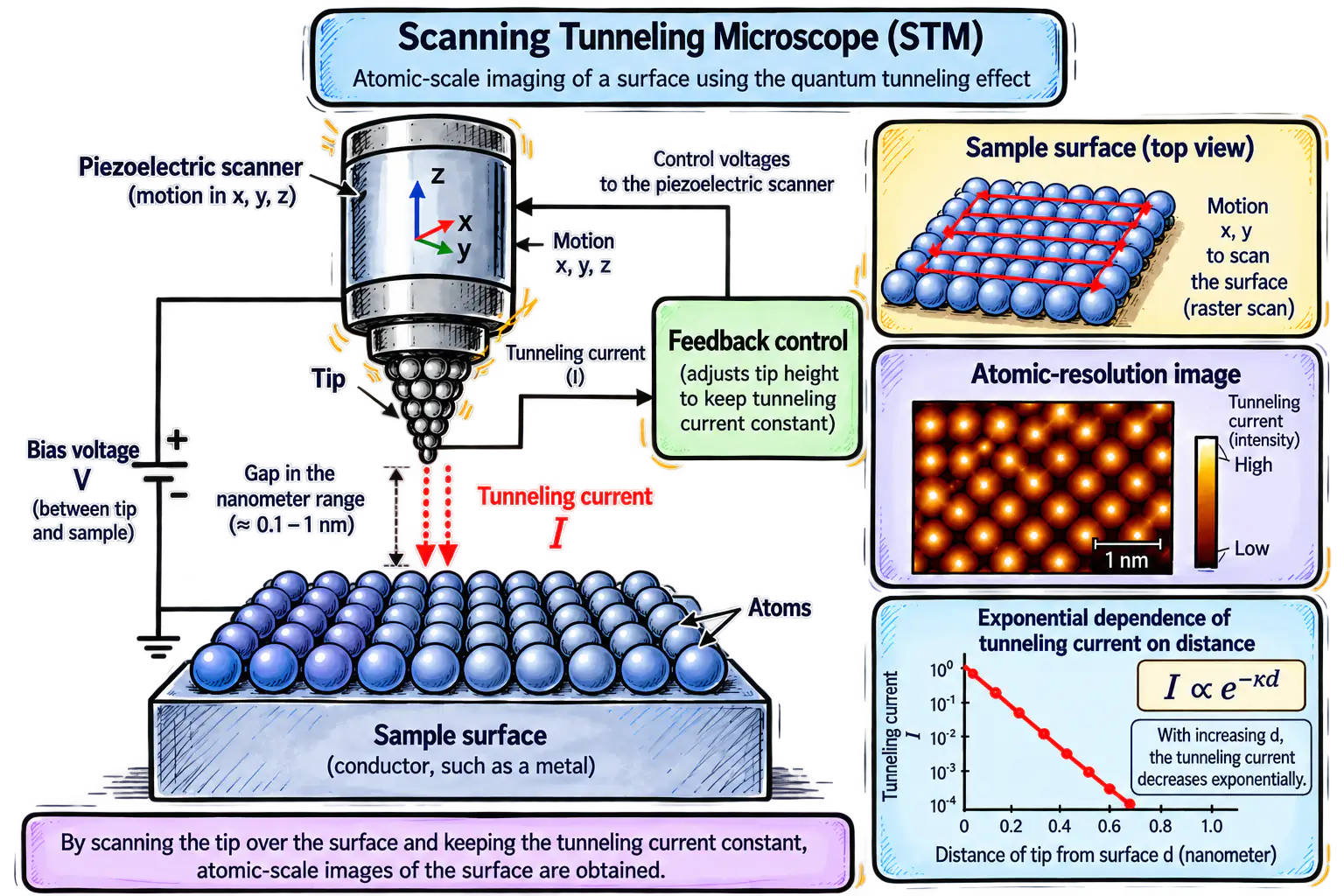
Figure 1: Structure and Operation of a Scanning Tunneling Microscope (STM)
Quantum tunneling also plays a role in certain semiconductor devices, flash-memory mechanisms, and superconducting quantum circuits. For example, in a Josephson junction, which is an important component of many superconducting qubits, electron pairs can tunnel through a thin barrier. What was once regarded as a mathematical puzzle has now become a practical engineering tool.
So, Can a Human Walk Through a Wall?
You might wonder: if an electron can pass through a barrier, could a human also pass through a wall? In quantum descriptions, the probability of some events involving large objects may not be exactly zero. However, the probability of a human tunneling through an ordinary wall is so unimaginably small that, in practice, it must be treated as impossible.
The Universe Is Stranger Than We Think
We are used to explaining the world through everyday experience: balls hit walls, obstacles block motion, and crossing a hill requires enough energy. But at the atomic scale, probability amplitudes, interference, and wave-like behavior play a fundamental role in determining what happens.
Quantum tunneling reminds us that “seeming impossible” is not the same as “being impossible.” The same phenomenon occurs in the hearts of stars, allows scientists to study matter at the atomic scale, and supports emerging technologies. Perhaps its greatest lesson is this: the universe contains possibilities that our everyday intuition was never trained to imagine.