Imagine a completely sealed box. You pump out all the air, remove every single atom, block every particle of light from entering, and then cool the box down to absolute zero—the lowest possible temperature in nature. Now, a simple question arises: Is there anything left inside the box?
If your answer is "nothing," quantum physics has a different answer. Inside that box, an endless activity is still taking place.
Still not convinced? Consider these intriguing questions: Why does helium remain a liquid at normal pressure, even near absolute zero? Why do two uncharged metal plates attract each other when placed close together in a vacuum? Why does an excited atom spontaneously emit light without any apparent external trigger? And, most remarkably, why does a simple calculation of vacuum energy produce a value approximately 120 orders of magnitude greater than the value observed in the universe?
The answer to all these questions lies in a phenomenon known as Zero-Point Fluctuations. In the following sections, we will explore what this unavoidable motion is and why it is considered one of the most fascinating ideas in modern physics.
To understand the origins of this phenomenon, let us begin with classical physics, where rest is relatively easy to imagine. A pendulum, for example, can be held motionless at the lowest point of its path. In this situation, its position is well-defined and its velocity is zero. From the perspective of classical physics, there is no problem or contradiction here.
But in the quantum world, this picture is no longer possible. According to Heisenberg's Uncertainty Principle, the position and momentum of a particle cannot both be determined simultaneously with arbitrary precision. In fact, the product of their uncertainties cannot be smaller than half the reduced Planck constant:
Imagine a ball whose diameter we gradually reduce until its dimensions approach those of an atom. What does our ball now resemble? A gas atom! If we want to determine the position of this ball, or rather this gas atom, we must confine it inside a small cube. In doing so, because of the rapid and significant variations in its velocity, its momentum can no longer be determined precisely. Therefore, at the quantum scale, even after removing excess energy, it is impossible to place a particle at a perfectly defined position while also assigning it an exactly defined momentum. The residual fluctuation that does not disappear, even when atoms are cooled and held in place, is what we call zero-point motion.
This concept can be explained using a simple mathematical model: the quantum harmonic oscillator, similar to a mass attached to a spring. The energy levels of this oscillator are given by the following equation:
In this equation, n can take values such as 0, 1, 2, and so on. The important point is that even when n = 0, meaning the oscillator is in its lowest possible energy state, its energy is not zero. An amount of energy equal to ½ℏω remains. This is known as zero-point energy—energy that persists even in the lowest possible state.
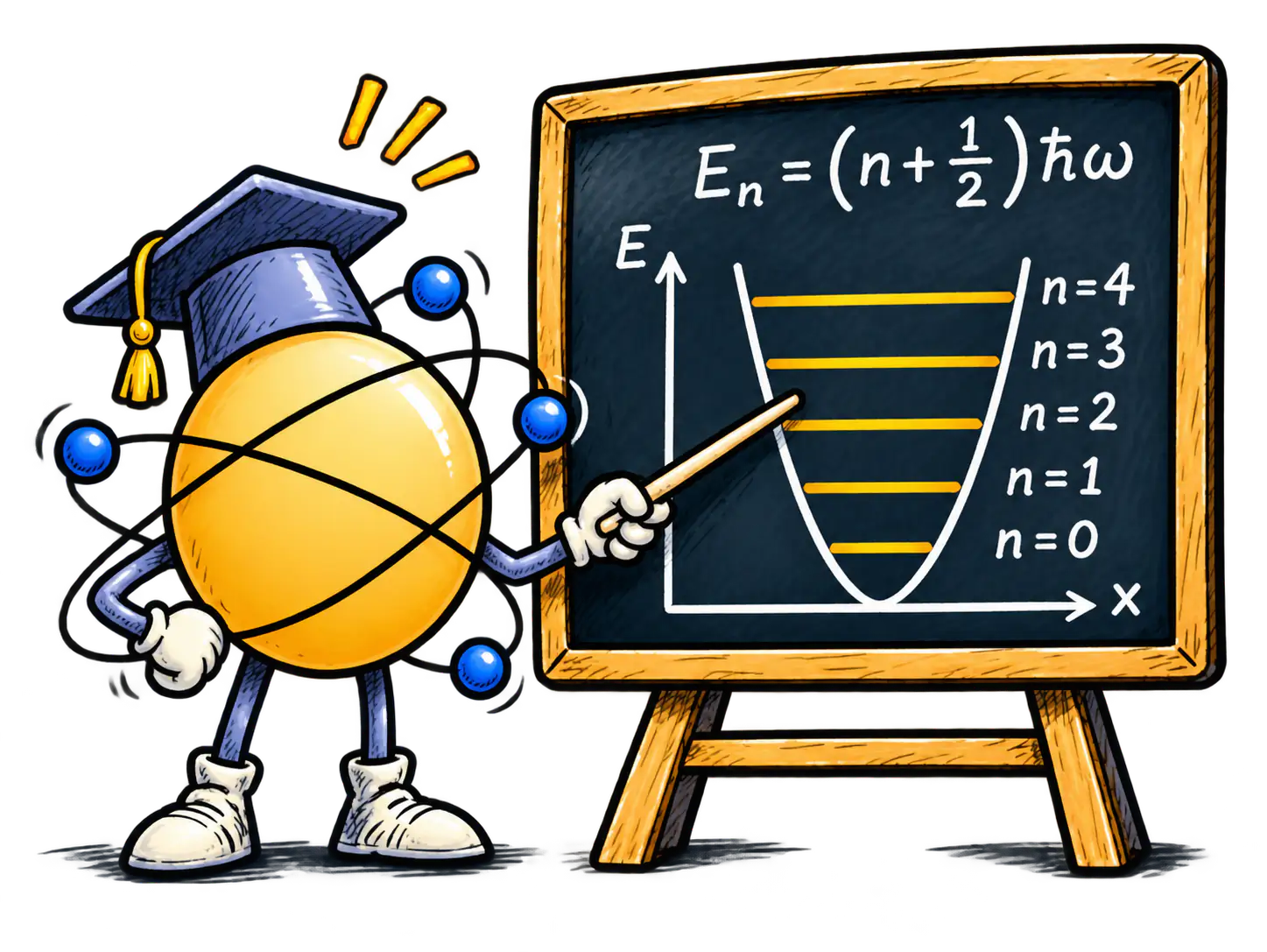
Figure 1: he energy levels of this oscillator are given by the following equation:In this equation, n can take values such as 0, 1, 2, and so on. The important point is that even when n = 0, meaning the oscillator is in its lowest possible energy state, its energy is not zero. An amount of energy equal to ½ℏω remains. This is known as zero-point energy—energy that persists even in the lowest possible state.
The more fascinating part of the story emerges in quantum field theory. In this theory, the electromagnetic field can be viewed as a collection of oscillators with different wavelengths. Each oscillator possesses an energy of ½ℏω, even in its ground state. Therefore, the quantum vacuum does not mean that fields are absent; rather, it represents their lowest-energy state. The average electric and magnetic fields in this state can be zero, but their fluctuations are not.
It is worth noting a common oversimplification here: the idea that virtual particles continuously appear out of nothing and disappear again is a popular but incomplete description. A more accurate explanation is that the fields themselves continue to fluctuate, even in their lowest-energy states.
One of the first examples of this behavior can be observed in low-temperature laboratories. Cool helium, the lightest noble gas, to temperatures close to absolute zero. You might expect it to solidify, but at normal pressure, helium remains a liquid even at these extremely low temperatures.
The reason for this behavior lies in the very small mass of helium atoms and the weak attractive forces between them. When the atoms attempt to arrange themselves into a crystalline lattice, their zero-point motion is so significant that it prevents the solid structure from becoming stable. To solidify helium, a pressure of approximately 25 times atmospheric pressure must be applied. This behavior provides an observable example of how zero-point motion affects the state of matter.
A second example is a force that originates from the properties of the quantum vacuum and is known as the Casimir Effect. In 1948, the Dutch physicist Hendrik Casimir predicted that two uncharged metal plates, when placed parallel and extremely close to each other in a vacuum, would attract one another.
An interesting question to consider is: Why does this happen in the first place?
Only certain field oscillation modes are allowed between the two plates, whereas fewer restrictions exist outside them. This difference creates a net force that pulls the plates toward each other. To understand this intuitively, imagine two boats floating close together on the sea. What happens is that longer waves tend to reach the boats more frequently from the outside, pushing them toward one another.
In the case of two plates, the magnitude of this force is highly sensitive to the distance between them. In the ideal model, Casimir pressure varies inversely with the fourth power of the separation distance. Consequently, as the distance decreases, the pressure increases rapidly. At a separation of approximately 10 nanometers, this pressure can approach one atmosphere. This phenomenon demonstrates that even the vacuum can produce measurable physical effects.
Steve Lamoreaux measured this effect with high precision in 1997. Today, the Casimir effect has practical significance in nanotechnology, as it can cause extremely small components to stick together and interfere with their proper operation.

Figure 2: In 1948, the Dutch physicist Hendrik Casimir predicted that two uncharged metal plates, when placed parallel and extremely close to each other in a vacuum, would attract one another. An interesting question to consider is: Why does this happen in the first place? Only certain field oscillation modes are allowed between the two plates, whereas fewer restrictions exist outside them. This difference creates a net force that pulls the plates toward each other. To understand this intuitively, imagine two boats floating close together on the sea. What happens is that longer waves tend to reach the boats more frequently from the outside, pushing them toward one another.
A third example can be found in the hydrogen atom. According to Dirac's theory, the 2S and 2P energy levels in a hydrogen atom were expected to have identical energies. However, in 1947, Willis Lamb and Robert Retherford demonstrated through a precise experiment that the energies of these two levels were slightly different, with a separation of approximately 1,058 megahertz.
This difference is known as the Lamb Shift and is associated with quantum fluctuations of the electromagnetic field. Simply put, the electron inside the atom is influenced by these fluctuations and experiences the electric potential of the nucleus slightly differently. As a result, the energies of certain atomic levels change more than those of others.
This measurement was one of the important milestones in the development of quantum electrodynamics. In the same year, Hans Bethe performed the first approximate calculation, and later, Feynman, Schwinger, and Tomonaga played major roles in developing the theory. Lamb himself received the Nobel Prize in Physics in 1955.
Vacuum fluctuations are also connected to another familiar phenomenon: Why does an excited atom spontaneously emit light? One intuitive explanation is that quantum field fluctuations act like a constant nudge, playing a role in the process through which an atom transitions to a lower energy level.
The effects of these fluctuations are not limited to small laboratory experiments; they also influence some of the most precise measuring instruments ever built. The LIGO observatory detects gravitational waves by measuring extremely tiny changes in the lengths of its arms—changes that can be even smaller than one-thousandth of the diameter of a proton. At this level of sensitivity, quantum noise in laser light becomes a limiting factor.
To reduce this noise, scientists use a technique called squeezed light. In this special state, the fluctuation of one property of light is reduced, while the fluctuation of its conjugate property increases. In this way, without violating the Uncertainty Principle, noise can be reduced in the quantity that matters for the measurement. LIGO has been using this technique since 2019.
In 2020, researchers also reported that the quantum effects of light on the observatory's 40-kilogram mirrors could be measured—an indication that quantum fluctuations can influence even relatively large objects.
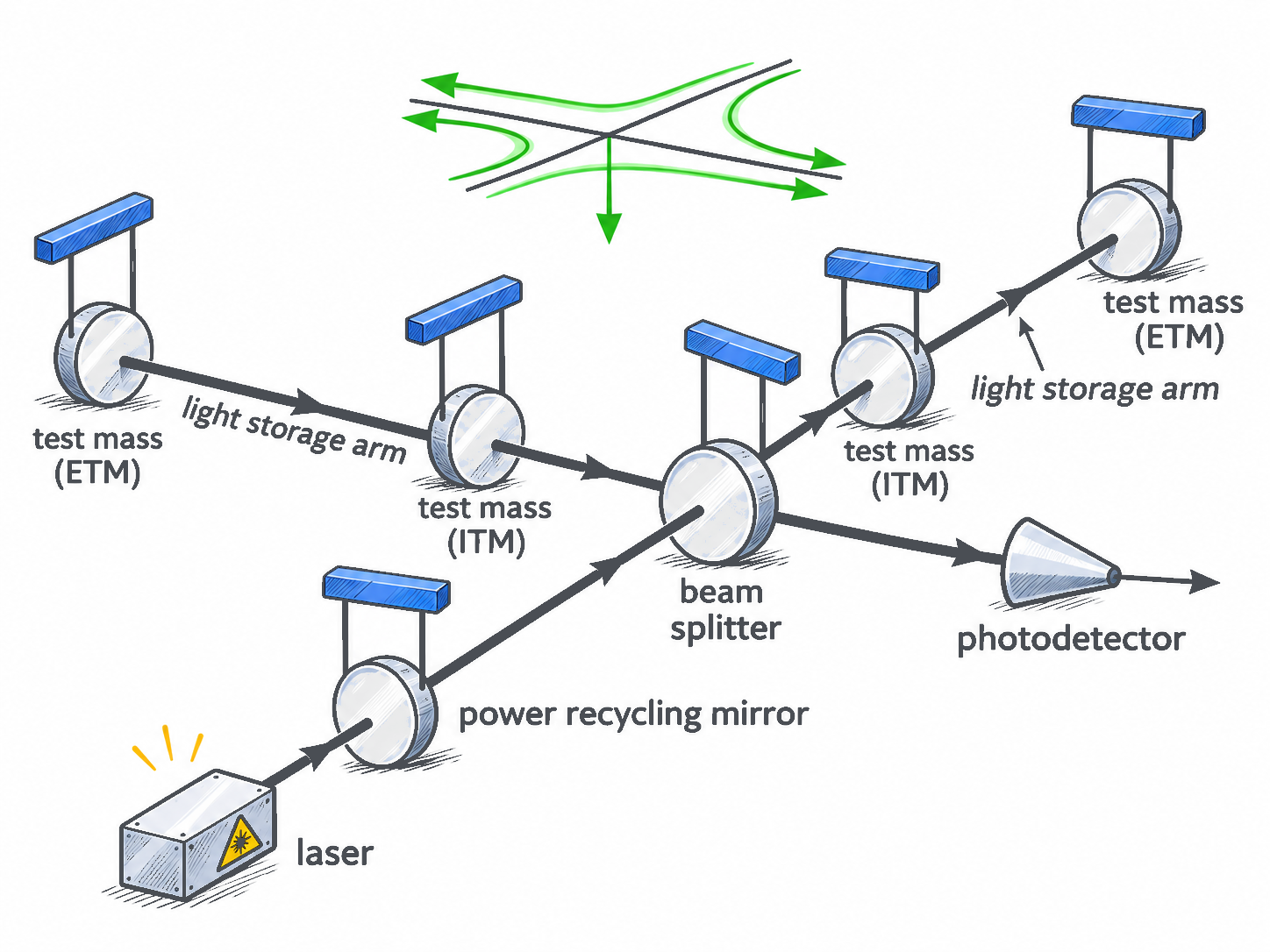
Figure 3: A simplified schematic diagram of a LIGO observatory.
The term zero-point energy may bring to mind claims about devices that generate free energy. However, the important point is that the ground state is the lowest possible energy state of a system. Energy cannot be continuously extracted by lowering a system into an even lower-energy state.
The Casimir effect is not a source of free energy either. If two plates move toward each other under the influence of this force, energy must be supplied to separate them again and restore the system to its original configuration. Therefore, claims about perpetual-motion machines based on vacuum energy have no scientific foundation.
Let us return to the box we imagined at the beginning of this article. We now know that even at the coldest possible temperature, quantum fields still exist inside it, and their fluctuations never come to a complete stop. This same phenomenon plays a role in helium remaining liquid, the attraction between two metal plates, the shifting of energy levels in hydrogen atoms, and the limitations on LIGO's sensitivity.
Zero-point fluctuations remind us that in the quantum world, "nothing" is not quite as simple as we tend to imagine in everyday life. Perhaps the deeper question is this: If even the vacuum possesses such dynamic properties, what else might we mistakenly consider empty or motionless?