Time moves forward relentlessly, without pausing or looking back. At least, that is how we perceive it. A broken egg does not put itself back together, and spilled milk does not return to the bottle. Although such phenomena seem self-evident to our intuition, physics has never had the final word on time. Most laws of physics, both in macroscopic and microscopic systems, are symmetric in time. In other words, these laws impose no requirement that time must flow in only one direction, and the reason for this remains a subject of debate among theoretical physicists and philosophers. Now, a group of theoretical physicists has found a way to reverse the direction of time in quantum systems.
The idea of reversing the direction of time is by no means new among physicists. In the nineteenth century, James Clerk Maxwell devised a thought experiment in which the second law of thermodynamics, which states that the total entropy of a system, a measure of probability and disorder, always increases, could be reversed. According to this law, heat always flows from a hotter object, or system, to a colder one. As a result of this heat flow, the entropy of the colder object increases. Most of us have probably experienced this principle quite simply by holding a cup of hot tea on a winter evening. The particles in these objects have a random distribution of speeds; that is, in both the hot and cold objects, some particles move faster while others move more slowly. In this thought experiment, “Maxwell’s demon”, having sufficient information about the speed of every particle, microscopic information, collects the faster-moving particles in the hot object and the slower-moving particles in the cold one. In this way, the hot object becomes hotter and the cold object becomes colder. From the perspective of an outside observer, this is like reversing the natural order of processes. It is as though the cup of hot tea were drawing heat out of your cold hands.
We all know that there is no Maxwell’s demon lurking in our cups of tea. But beneath the surface of quantum systems, beyond the atoms, electrons, and quantum laws we are familiar with, something else is at work. We know that the act of measurement changes quantum systems. Before measurement, a quantum system can exist in several different states, in what we call a linear combination. But measurement reduces the system to one of those states. In other words, the act of measurement fundamentally alters the very nature of the quantum system. The measurement problem may well be the greatest unresolved problem in quantum mechanics. In this new achievement, after performing multiple measurements, physicists use their knowledge of the system’s initial state and the measurement outcomes to calculate, through computer simulations, all the random trajectories that could have led to the observed result. They then use these trajectories to design and control the reverse dynamics, by constructing a Hamiltonian appropriate to the trajectories obtained. This controlled dynamics is analogous to generating pulses and fields that immediately return the system to its initial state. Taken together, these processes act like Maxwell’s demon: by using information, they return an irreversible process to its initial state and, from the perspective of an outside observer, this appears as the re-creation of time in the reverse direction. This method makes it possible to extract the energy spent on measurement from the system and store it in a battery. Perhaps this achievement could also open the way to reversing environmental effects on quantum systems—effects that, through an irreversible process, destroy the system’s quantum properties.
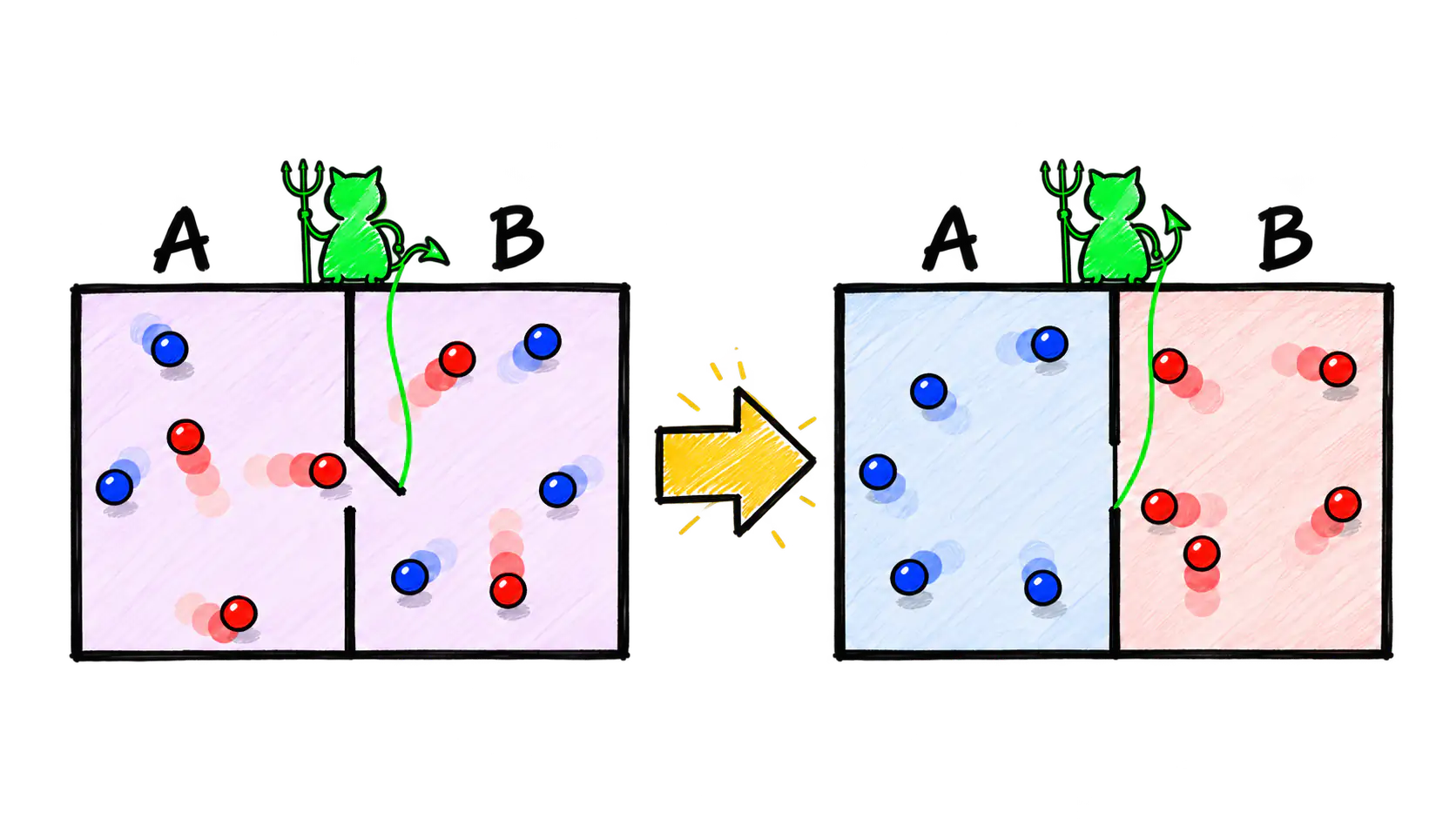
Figure 1: The sequence of processes involved—multiple measurements and computer simulations based on knowledge of the system’s initial state and the measurement outcomes—acts much like Maxwell’s demon. By using information, it returns an irreversible process to its initial state and, from the perspective of an outside observer, effectively recreates time in the reverse direction.
In practice, however, the efficiency of this process is very low, at around fifty percent. Simulating the process and reversing it requires perfectly precise measurements, and even a small amount of uncertainty in the measurements can dramatically reduce the final efficiency of the process after multiple measurements. When this information is lost, part of the quantum system’s evolution is lost as well, and the possibility of reconstructing its initial state is greatly reduced. Is this leakage of information, like the second law of thermodynamics, itself a fundamental limitation, or could advances in technology eventually allow us to overcome it?
References
https://journals.aps.org/prx/abstract/10.1103/l18s-9vmh