Before discussing what quantum mechanics is, let us take a look at some of the famous statements made by the founders of quantum physics. Let us begin with Erwin Schrödinger and Niels Bohr, two of the most influential figures in explaining and developing quantum mechanics. Niels Bohr famously said: “Anyone who is not shocked by quantum mechanics has not understood it.” Schrödinger went even further and stated: “I don’t like it, and I’m sorry I ever had anything to do with it.” Regarding his famous thought experiment, the “Schrödinger’s cat,” he described it as “a completely ridiculous problem.” These statements do not end here; almost everyone who has had even a small involvement with the subject has made similar remarks. For example, Richard Feynman said: “I think I can safely say that nobody understands quantum mechanics,” and elsewhere he pointed out that “If you think you understand quantum mechanics, you don’t understand quantum mechanics.”
If these quotes have not yet discouraged you from continuing to read, and despite all these points you are still interested in going further, it is better to clarify one thing from the beginning: we are not going to completely understand what quantum mechanics is (by now, we should have realized this from the quotes). Instead, we want to become somewhat familiar with its foundations and, more importantly, understand what quantum mechanics is not.

Figure 1: Niels Bohr, Erwin Schrödinger, and Richard Feynman helping a physics student learn quantum mechanics!
Quantum mechanics is physics. It is the physics of matter, and it is nothing beyond that.
The first, and perhaps the most important point, is that we must understand that quantum mechanics is physics—the physics of matter—and nothing beyond it. Just as classical physics attempts to predict the behavior of objects, and relativistic physics tries to do the same for extremely large objects or objects moving at very high speeds, quantum physics also pursues the same goal, but for microscopic particles. If we fully understand this idea and accept that the domain of quantum mechanics is matter and energy, our expectations become clear, and we stop attributing every unknown phenomenon to quantum mechanics. Of course, by now we have probably realized that we are dealing with a very unconventional form of physics—a physics that we can describe mathematically, but that we are unable to truly understand in an intuitive sense.
Quantum mechanics is in complete contradiction with our everyday understanding of phenomena. For example, our brains are designed in such a way that we perceive everything through the framework of position. We understand things through their spatial properties. Even sound is perceived by our brains through spatial vibrations acting on receptors located at specific positions in the ear. Quantum mechanics breaks this framework from the very beginning and does not restrict itself to describing reality in terms of any particular basis. This is why our brains were not designed to understand quantum mechanics, and why we cannot achieve a precise intuitive understanding of it.
In physics, to describe the behavior of a particle or a material system, we need to know quantities such as position, velocity, energy, and so on, and assign values to them over time. In classical physics, we can do this very successfully. For example, when we are driving, we can easily describe the position and velocity of a car and even predict its future path. By looking at the engine’s RPM and knowing its power, we can even determine its energy and obtain a relatively complete description of the car’s dynamics. Moreover, we know that the quantities we have described possess an objective physical reality. When we talk about the position or velocity of a car and assign values to them, these quantities correspond to something that physically exists in the external world.
However, as soon as we take our first step into the physics of microscopic particles and attempt to describe these same quantities, we encounter a complete failure. Quantum mechanics does not even accept the idea of assigning physical reality to these quantities.
To better understand this concept, imagine that a factory production line produces perfectly identical balls. If we randomly select several balls from the production line and measure their dimensions, we will find that all of them have the same size. Now, if we replace these balls with quantum particles, every time we perform a measurement, we obtain a different value. Even if we measure the very same particle again, we encounter a different result. The story becomes even stranger. Imagine that one of these particles is moving along a path, and we continuously measure its position to track its motion. Now we are also interested in knowing its velocity. By measuring it at that moment, we can determine the particle’s velocity, but we lose all information about its position. We do not even know whether something called “position” has any reality at all.
At this first step, we fail to assign physical quantities to a microscopic particle. Therefore, we redefine our understanding of these quantities within the framework of quantum mechanics. We no longer consider them as quantities that describe the physical properties of particles. Instead, we call them physical observables, meaning that they can only be accessed through measurement. Furthermore, by measuring one of these observables again, all of our information about the other observables is lost. Therefore, to describe a quantum system, we need something else. Here, we turn to a new concept called the wave function or state function.
The wave function is a mathematical function that contains all the information about a physical system. It includes all the information that we can obtain from the system. The wave function has a statistical nature, and the information it provides is expressed in terms of probabilities. Since, as mentioned earlier, there is no reason to assume that physical observables necessarily possess an objective physical reality, the wave function only tells us what values we may obtain, and with what probabilities, if we measure a particular physical observable. In other words, quantum mechanics is governed by probabilistic causality.
Imagine that we keep a quantum particle inside a box. For example, the wave function of this particle tells us that if we measure its position, there is a one-third probability of finding it at the top of the box, a one-third probability of finding it in the middle, and a one-third probability of finding it at the bottom. We perform a position measurement on the particle and find it in the middle of the box. Now that we have obtained precise information about the particle, the wave function of the particle immediately changes as well, showing a probability of one hundred percent for finding the particle in the middle of the box.
Since our entire physical system is described by the wave function, we see that by performing a measurement, we disturb the system and completely alter it. Here, we encounter another major difference between quantum physics and classical physics. When we measure a system, we gain information about it, but at the cost of destroying the original physical state of the system. Our precise information only applies to the altered system that exists after the measurement.
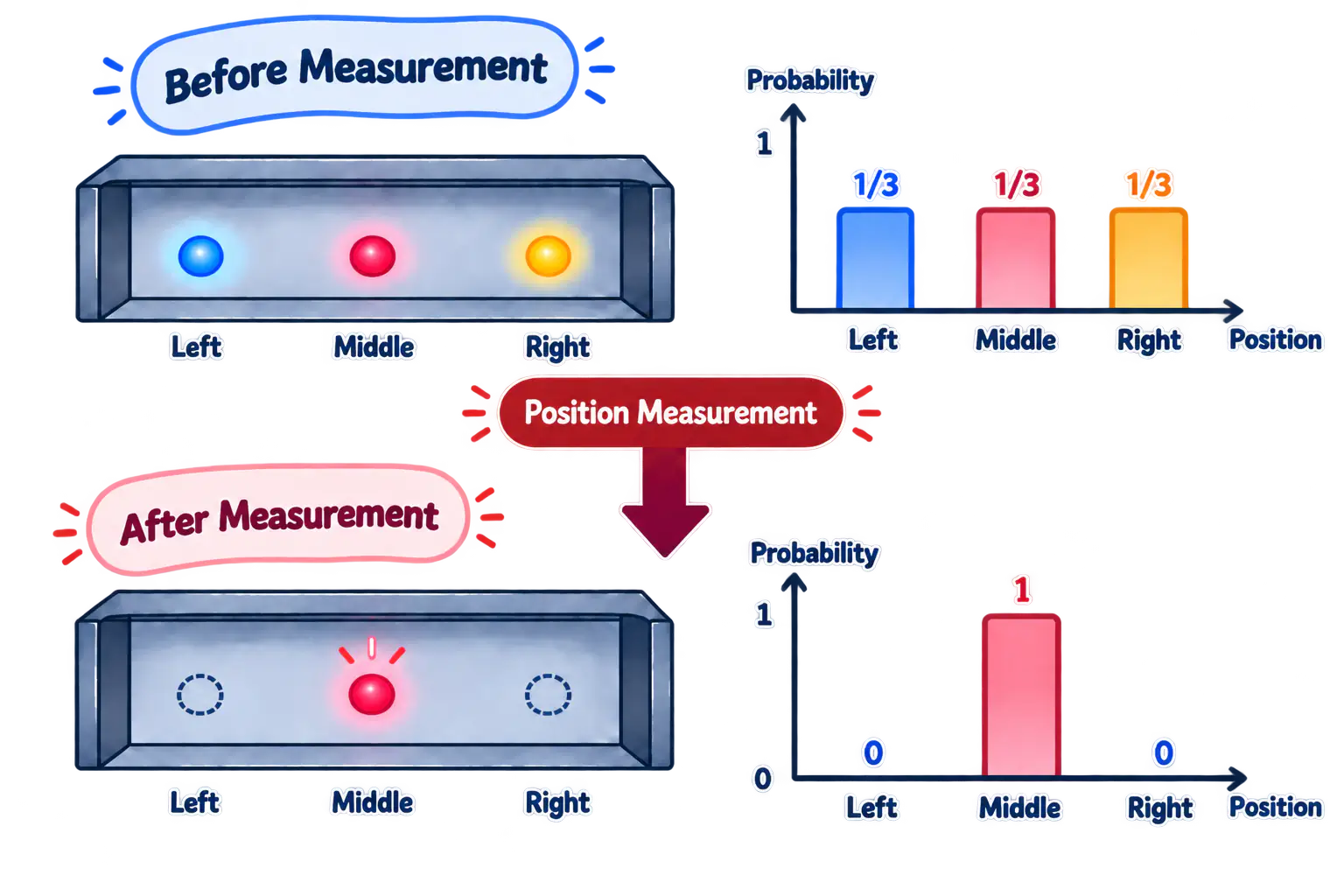
Figure 2: Illustration of the collapse of the wave function into a specific value after measurement.
Does the Wave Function Have Physical Reality?
There are experiments showing that the mathematical form of the wave function is in complete agreement with the behavior of quantum systems. However, there is still no consensus on whether the wave function is merely a mathematical function or whether it represents a physical reality.
Do observables have physical reality? There is no definitive answer to this question. However, the standard interpretation of quantum mechanics today is that observables do not possess physical reality by themselves and are created through measurement.
Where does the mathematics of quantum mechanics come from? Quantum mechanics is built upon several fundamental postulates. Although the mathematics of these initial principles has been inspired by classical physics, they are ultimately accepted assumptions that construct a purely mathematical framework whose results are in complete agreement with nature (even in cases where quantum mechanics itself cannot explain the underlying phenomena).
These ideas also lead to other phenomena in quantum mechanics that have no classical counterparts, such as quantum superposition and quantum entanglement. Each of these phenomena is more naturally compatible with some of the various answers proposed to the questions mentioned above.
The most precise statement that can be made about the nature of quantum mechanics is that it is a mathematical structure that is in complete agreement with experimental results in the domain of microscopic physical systems. The lack of definitive answers to these questions, along with many others, has led physicists and philosophers to develop multiple interpretations built upon the mathematical framework of quantum mechanics (such as the Copenhagen interpretation, hidden variables, the many-worlds interpretation, and others). However, there is still no single description of quantum mechanics upon which everyone agrees.
This uncertainty and ambiguity regarding the worldview underlying quantum mechanics can sometimes lead to the mistaken attribution of quantum mechanics to areas unrelated to its actual domain.
Understanding the physics of microscopic particles is a long journey that must continue. Although quantum mechanics successfully predicts processes and has enabled the development of many technologies, it is still far from its ultimate goal: understanding the universe as it truly is.