Have you ever wondered what we mean when we say that one event “causes” another? What makes the relationship between two events one of cause and effect in the first place?
In the simplest case, a causal relationship means that one event or action can affect the outcome of another event. For example, when we flip a light switch and the light comes on, flipping the switch is what causes the light to come on. Under ordinary conditions, if we leave the switch alone, the light stays off. So by changing what we do, we can affect the outcome.
Of course, just because one event happens earlier doesn’t mean it causes what happens next. That distinction matters in physics, too. When we say that event A comes before event B in the causal order, we mean that information or the effect of an operation can travel from A to B, while later choices at B cannot change the local outcomes already obtained at A. This tells us the direction in which influence can travel in the process. A doesn’t necessarily cause B itself to happen.
Getting a little philosophical, isn’t it?
Let me give you a simpler example. Suppose our phone rings just before it starts raining. Did the phone ringing actually make it rain? No! For two events to be causally related, there has to be a way for one to actually affect the other. Timing alone isn’t enough.
Okay, it all makes sense so far. But now imagine stepping into a world where even the order in which two operations exert their influence isn’t always definite! This is exactly the idea physicists study under the name indefinite causal order.
Here’s an example from everyday life. When we bake a cake, we mix the ingredients first and then put the batter in the oven. Or we enter our phone’s passcode first and then open an app. Even computers run instructions in a specific order to carry out calculations.
Interestingly, most circuits used in quantum computers follow the same pattern. For example, one quantum gate is applied to a qubit first, followed by a second gate. You might be wondering what a gate is in the first place. Put simply, quantum gates are operations that change the state in which quantum information is encoded. But quantum mechanics opens up an even stranger possibility. The order in which the operations are carried out can itself be controlled by a quantum state. (The quantum world really is strange!)
To see how this works, imagine a photon, a particle of light, that’s about to pass through two different devices. Let’s call them A and B.
In the first case, the photon goes through device A and then device B. In the second case, the order is reversed. The photon enters B first and then passes through A.
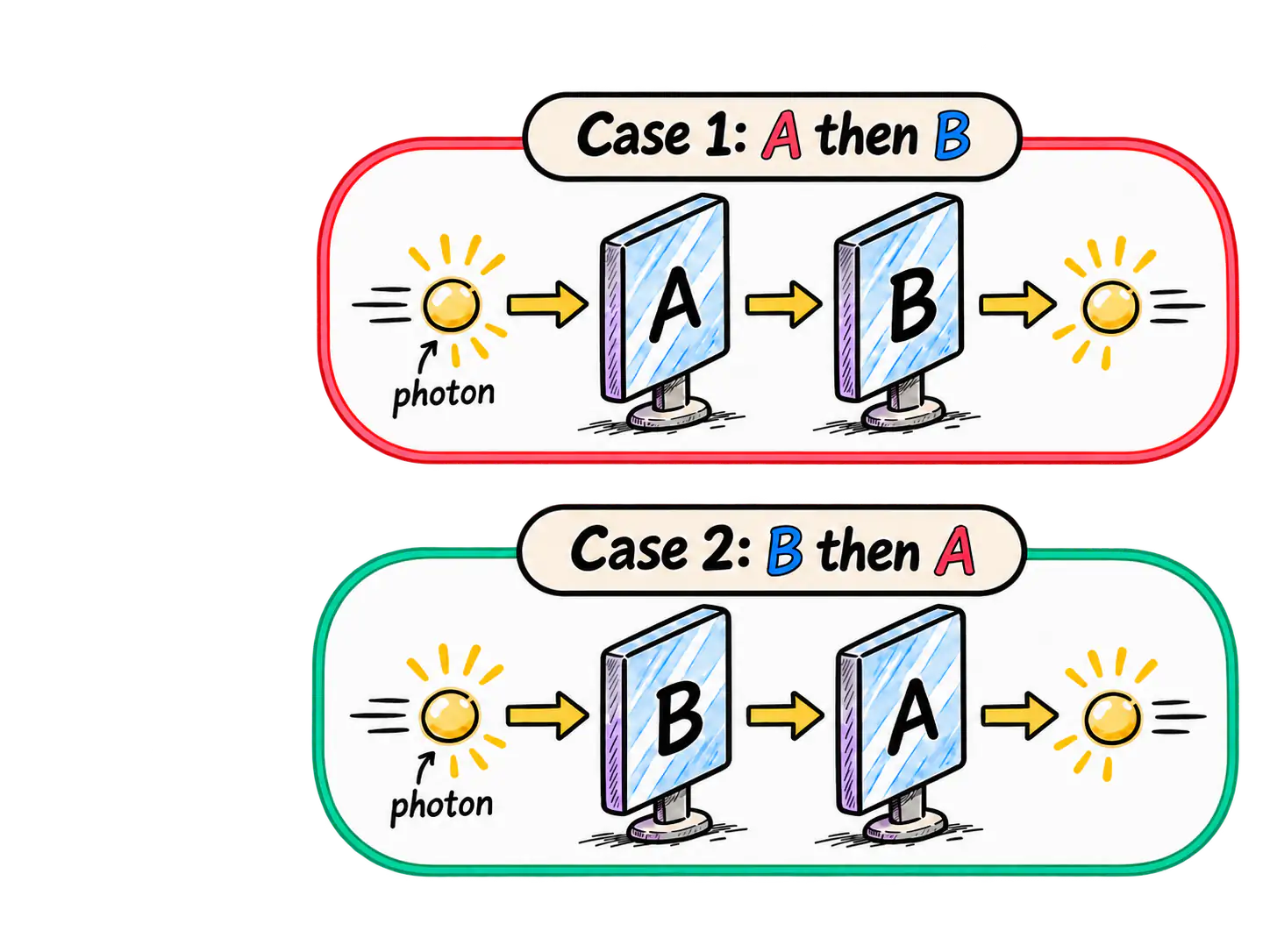
In the everyday world, we could flip a coin to decide which path the photon takes. Heads, we choose the first path. Tails, we choose the second. But, but, but… here’s the crucial part! Every time we run the experiment this way, one of the two orders is selected. Even if we don’t know which path the photon took, there’s still a definite order.
Now quantum mechanics enters the picture, and things get more interesting.
In quantum physics, a system can be in a state called a superposition. In such a state, none of the usual alternatives can describe the system on its own. Different states can contribute coherently to the process and can even interfere with one another.
This same property allows the order of two operations to be controlled by a quantum superposition. The two orders, A followed by B and B followed by A, can both contribute coherently to a single quantum process, with no need to pick just one for each run.
There’s more to this than a mathematical curiosity. We can look for the difference between a quantum superposition and a random choice in the experimental results. In the quantum case, information associated with the two orders can interfere, while a random mixture of the two orders lacks that coherence.
To study this phenomenon, scientists use a setup called a quantum switch.
A conventional switch chooses between two paths, while a quantum switch can use a quantum control system to determine the order in which two operations are carried out. If that control system is prepared in a suitable superposition, the order of the operations is under quantum control.
In many experiments, this is done with photons. How does that work? Researchers use mirrors, beam splitters, and other optical components to create different paths for the photon to follow. Along one path, the photon undergoes operation A and then B. Along the other, the order is reversed.
When the experiment is set up to preserve quantum coherence, researchers can examine how the contributions of both orders affect the device’s output. What scientists actually measure are specific statistical patterns that tell them about the structure of the quantum process.
This is where a misunderstanding can creep in. What kind of misunderstanding? Someone might take indefinite causal order to mean that time runs backward or that we can see the outcome of an event before it happens.
Nobody built a time machine in these experiments, and the usual rules of cause and effect aren’t suddenly going to stop applying. The point is that when we describe a quantum process, we can’t always assign a fixed causal order to the operations under study.
There’s even an important concept, causal nonseparability, that gets at this idea more precisely. The term applies when a quantum process can’t be reduced to a probabilistic mixture of processes with definite causal orders. Sound complicated?
Let me put it more simply. It’s as if nature were telling us that some quantum processes can’t be fully described by saying “first A, then B” or “first B, then A.”
The idea of the quantum switch has been around for a long time, and a range of experiments have investigated it over the years. One important paper in the field is a 2024 review in Nature Reviews Physics that examines the experiments, applications, and limitations of indefinite causal order.
The review makes an important point. Observing unusual behavior in an experiment isn’t enough on its own to establish a fundamental claim about causality. We have to be precise about how we define causality and what framework we’re using, what assumptions the experiment rests on, and whether there are alternative explanations for the results.
This matters because some quantum-switch experiments can also be analyzed in terms of finer-grained events in space and time. So observing causal nonseparability in a process doesn’t necessarily prove that the fundamental structure of spacetime is indefinite.
The story didn’t end there. In 2025, it got even more interesting.
In a paper published in Physical Review Letters, researchers implemented generalized versions of indefinite causal order using a programmable integrated photonic chip.
To see why this advance matters, consider how much simpler it is to control two operations with two possible orders than to control many operations and their different orderings.
For example, if we have just two operations, A and B, there are two possible orders. With three operations, A, B, and C, there are six. As the number of operations grows, the number of possible orders rises rapidly.
Meanwhile, maintaining quantum coherence across different paths is no easy task. Even the slightest disturbance from the environment or flaw in how the system is controlled can degrade the process. That’s why building a chip that can control more complex configurations with high precision is an important step forward.
The scientists went beyond building a new optical circuit. They also examined the device’s output and compared their results with bounds defined for processes with definite causal orders. The experimental results showed a violation of those bounds with high statistical significance.
Put more simply, the researchers found evidence that, within the frameworks they tested, a definite classical causal structure couldn’t explain the experimental data.
One of the study’s more interesting aspects was the implementation of a process for distilling causal nonseparability.
What does distillation mean? In quantum physics, distillation refers to methods that aim to extract or enhance a valuable quantum property using the resources at hand. In this study, the researchers implemented a single-copy distillation protocol for this quantum resource.
The significance of this work is that indefinite causal order can be studied as more than a conceptual or philosophical question. It can be treated as a resource in quantum information science, one that can be identified, measured, and used.
Now for what might be the most important question in the story. Does this strange feature have any practical use?
One promising area is quantum computing. For certain problems, using an indefinite order of operations can reduce the number of times particular gates need to be applied or operations need to be called. That could be useful in designing quantum algorithms.
Another area is quantum communication. Imagine that quantum information has to pass through noisy channels that corrupt some of the information. Some studies have shown that, under certain conditions, placing such channels in a quantum-controlled indefinite order can improve how well they transmit information.
Researchers are also exploring whether this idea can be used in high-precision measurements and even in quantum thermodynamic processes. For example, some proposals suggest that putting certain operations in an indefinite order could play a role in how quantum heating and cooling systems work.
Those are potential applications, and how well the quantum switch performs compared with conventional methods depends on the circumstances. Any advantage depends on the problem, the resources used, and the experimental conditions. There’s still a long way to go from demonstrating this phenomenon in the lab to using it widely in everyday technology.
Perhaps the most fascinating part of the story is what this phenomenon makes us ask about the nature of the world, beyond its technological applications.
We usually think of space and time as the setting in which events take place. In Einstein’s theory of general relativity, the structure of spacetime is directly linked to gravity. Quantum mechanics, meanwhile, tells us that some physical properties can be in superposition.
That brings us to one of the deepest questions in the search for a theory of quantum gravity. If the geometry of spacetime itself behaves quantum mechanically, what happens to the causal order of events?
Current experiments with the quantum switch haven’t answered that question definitively. They do, however, give us a framework for exploring ideas like this using more precise mathematics and experiments with measurable outcomes.
One of the most important lessons from this research is that some seemingly obvious ideas become much less straightforward once we enter the quantum world.
We used to assume that to explain a process, all we needed to know was what happened and in what order. We now know that, in some quantum processes, the order of the operations can itself be part of the system’s quantum structure.
Perhaps future quantum computers and networks will draw on properties like superposition and entanglement and also use superpositions of the order in which operations are carried out as a computational resource.
This research hasn’t produced a time machine or done away with the law of causality. What it has shown is that even something as simple and familiar as “first and then” can have a far more complex and fascinating meaning in the quantum world than we ever imagined.
Sources
- Experimental aspects of indefinite causal order in quantum mechanics
- Generalized Indefinite Causal Orders in an Integrated Quantum Switch