The Story of Quantum Error Correction: How to Build a Reliable Computer from Imperfect Components!
Remember the game of telephone? Someone whispers a sentence into the ear of the first player, and each player passes it on to the next. No one makes a mistake on purpose, yet by the time the sentence reaches the last player, “It’s sunny today” has turned into “It’s Sunday today!” Each transmission may introduce only a tiny error, but when tens or even billions of transmissions occur in succession, these small errors can change everything. Quantum computers face exactly this kind of challenge: every operation carries a small risk of error, and a substantial quantum computation may require billions of consecutive operations.
The good news is that physicists and computer scientists have discovered a way to deal with this problem. Even if we cannot prevent errors from occurring, we can encode information in such a way that errors can be detected and corrected before they ruin the entire computation. This approach is called quantum error correction.
The Qubit: A Coin That Has Yet to Land
A classical computer works with bits. A bit is like a light switch: it is either off (0) or on (1). A qubit, however, is more like a coin spinning on a table. While the coin is spinning, we cannot say whether it is heads or tails; it is in a state that, by analogy, combines both possibilities. In quantum mechanics, this property is called superposition.
The important point is that when we read the coin—that is, when we perform a measurement—the spinning stops, and the coin lands on either heads or tails. Similarly, measuring a qubit in the computational basis collapses its superposition into one of the two possible outcomes. The power of quantum computers comes from these superposition states, along with another property called entanglement. It is the fragility of these quantum states that makes working with qubits so challenging.
The World Is Not a Peaceful Place for Qubits
Qubits can be made from microscopic particles or tiny circuits, such as superconducting loops cooled to temperatures close to absolute zero or atoms held in place by lasers. Even the slightest disturbance can interfere with these delicate systems: a little heat, a vibration, stray electromagnetic fields, or even high-energy particles arriving from outer space! When the surrounding environment unintentionally takes a “peek” at a qubit, its quantum coherence can be lost. This phenomenon is known as decoherence, much like a spinning coin that suddenly hits an obstacle and stops spinning.
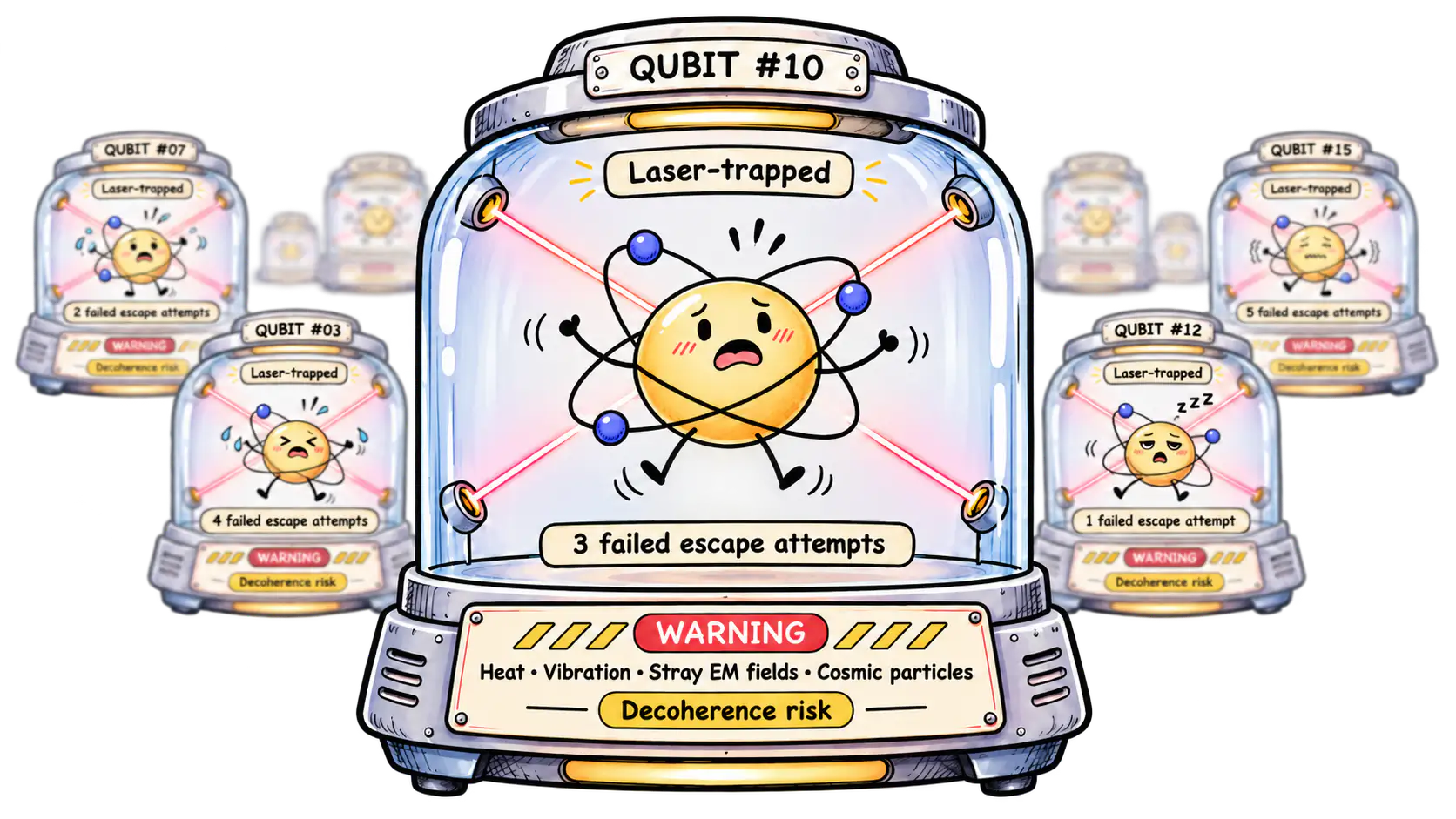
In some of today's best quantum hardware, roughly one error occurs for every thousand operations. You might think, “Just one in a thousand? That's hardly anything!” Yet large-scale quantum algorithms may require billions of operations. By comparison, the conventional chips in your smartphone are so reliable that you practically never notice their errors.
Why Doesn't the Simple Solution Work?
In the classical world, solving this problem is quite straightforward. Suppose we want to send the number 1 through a noisy communication channel. Instead of sending it once, we send it three times: 1, 1, 1. If the receiver gets 1, 0, 1, we can use majority voting to determine that the middle bit was probably corrupted. This method is called a repetition code, and the underlying principle of redundancy has long been used in various forms.
In the quantum world, however, three major obstacles stand in the way:
- No copying allowed! A fundamental principle of quantum physics, known as the no-cloning theorem, states that an unknown quantum state cannot be perfectly copied. Therefore, we cannot simply create three identical copies of an unknown qubit state.
- Looking means disturbing. If we directly measure a qubit to check whether an error has occurred, we may destroy its superposition and lose the very information we were trying to protect.
- Errors come in different forms. In a classical computer, a bit error occurs when a 0 changes into a 1 or a 1 changes into a 0. A qubit, however, can also experience a more subtle type of error known as a phase flip, which has no classical counterpart in ordinary bit-based computation. An error correction method must be able to detect and correct both types of errors, as well as combinations of them.
These obstacles led many researchers in the early 1990s to believe that quantum error correction might be practically impossible.
A Brilliant Idea!
Imagine three students in a classroom. Each student holds a card with either a 0 or a 1 written on it. Together, these three cards encode a secret answer. According to an initial agreement, only two configurations are valid:
Either all three cards display zeros (000), or all three display ones (111).
During the transmission of information, however, one of the students might accidentally change the number on their card. For example, if the original configuration was 000, the cards might now read 010.
The teacher wants to determine whether an error has occurred and, if so, which student's card contains the error. However, there is one important restriction: the teacher is not allowed to ask the students what numbers are written on their cards, because the answer is confidential and must not be revealed.
So how can the teacher identify the error?
The solution lies in a clever change in the type of question being asked. Instead of asking for the actual value of each card, the teacher asks the students to compare their cards and report only whether the numbers are the same or different.
To do this, two comparisons are made:
The first and second students check whether the numbers on their cards are the same or different.
The second and third students perform the same comparison.
No one needs to reveal the actual number on their card to the teacher. Each pair simply reports the result of its comparison: “same” or “different.”
Now, let's examine the four possible cases:
Comparison of Students 1 and 2 | Comparison of Students 2 and 3 | Result |
Same | Same | No single-bit error is detected. |
Different | Same | An error has occurred in the first student's card. |
Different | Different | An error has occurred in the second student's card. |
Same | Different | An error has occurred in the third student's card. |
For example, if the cards read 010, the comparison between the first and second students reveals that their numbers are different. The comparison between the second and third students produces the same result. The teacher therefore realizes that the second student's card differs from those of the other two. All the teacher needs to do now is ask the second student to correct the number on their card, restoring the entire set to the valid configuration of 000.
What is particularly interesting is that although the teacher has identified the location of the error, they still do not know whether the original secret answer was zero or one. Whether the cards were originally 000 or 111, the two comparisons would produce identical results in the absence of errors. The teacher has obtained information only about the relationships between the cards, not their actual values.
In this way, an error can be located and corrected without revealing the original information.
Something very similar happens inside a quantum computer. The difference is that instead of three students holding three cards, we have three physical qubits that collectively store the information of a single qubit. This information is encoded so that the logical zero corresponds to the state 000 and the logical one corresponds to the state 111. Even if the original information is a superposition of zero and one, this quantum superposition is distributed across the three qubits, forming a shared, entangled quantum state.
Now suppose that one of these qubits experiences an error due to noise. Just like the student who accidentally changed the number on their card, the state of one qubit becomes inconsistent with those of the other two. However, we cannot simply measure the individual qubits to read their values, because doing so could destroy the very quantum information we are trying to protect.
This is where ancilla qubits come into play. These auxiliary qubits interact with the data qubits and record the results of comparisons between them. Only the ancilla qubits are then measured, rather than the qubits that carry the original quantum information.
The results of these measurements reveal whether everything has gone as expected or which qubit has experienced an error. This collection of measurement outcomes is called the error syndrome. Once the location of the error has been identified, an appropriate corrective operation can be applied to restore the affected qubit to its correct state. For example, if an error has caused a zero to become a one or a one to become a zero, applying an X gate can reverse this change.
However, there is another important concept here. The three physical qubits that work together to protect the information collectively form a logical qubit. A physical qubit is an actual hardware component that is susceptible to errors, whereas a logical qubit represents quantum information that is encoded and protected using multiple physical qubits.
Therefore, when we talk in the future about a quantum computer with hundreds or thousands of logical qubits, we should not imagine that all these qubits exist directly and independently as individual hardware components. Each logical qubit may require a large number of physical qubits that protect its information through repeated cycles of error detection and correction.
Of course, this example illustrates only one of the simplest types of quantum errors: the bit flip. As mentioned earlier, qubits can also experience other types of errors, such as phase flips. More advanced encoding and measurement techniques are therefore required to provide more comprehensive protection.
When the Impossible Became Possible
In 1995, Peter Shor—the same scientist whose famous algorithm for breaking cryptographic systems had sparked widespread interest in quantum computing—introduced the first quantum error correction code, which used nine qubits. Shortly afterward, Andrew Steane and other research groups developed ingenious new codes. In 1997, Alexei Kitaev proposed an idea rooted in mathematics and condensed matter physics that later laid the foundations for the surface code. In a surface code, qubits are arranged like the squares of a chessboard, with each qubit interacting only with its neighbors. This local connectivity makes the code more practical to implement in the laboratory.
But perhaps the most remarkable breakthrough in this story is what is known as the threshold theorem. In simple terms, this theorem states that if the physical error rate is below a certain critical value, known as the threshold, increasing the number of physical qubits through appropriate quantum error correction can dramatically reduce the logical error rate, making it arbitrarily small. However, if the physical error rate is above the threshold, adding more qubits can make the situation worse, because every additional qubit introduces another potential source of error.
Imagine a damaged boat that is gradually filling with water. If you can scoop the water out with a bucket faster than it flows in, getting more people to help can save the boat. But if water flows in faster than it can be removed, adding more people will only make the boat heavier.
The Latest News from the Laboratory
For years, these ideas existed largely on paper, until experiments began to demonstrate their effectiveness. In late 2024, Google's quantum computing team reported results from its Willow quantum processor showing that as the surface-code lattice was scaled from a small size to a medium size and then to a larger one, the logical error rate was reduced by approximately half at each step. This provided a landmark experimental demonstration that adding more qubits could indeed improve reliability and that the system was operating below the error correction threshold. Other research groups have also demonstrated logical qubits using different physical platforms, including neutral atoms and trapped ions, and the field is advancing rapidly.
Of course, there is still a long way to go. According to current estimates, building a sufficiently reliable logical qubit may require hundreds or even thousands of physical qubits, while tackling large-scale problems, such as accurately simulating drug molecules, may require tens or hundreds of logical qubits. The engineering challenge of building such a machine therefore remains substantial.
To summarize, the following table presents a side-by-side comparison of these two worlds:
Feature | Classical Error Correction | Quantum Error Correction |
Information storage | Storing multiple copies of a bit | Distributing information across multiple entangled qubits |
Copying information | Fully possible | Impossible for unknown quantum states, according to the no-cloning theorem |
Error detection | Directly reading the individual copies | Measuring the error syndrome without revealing the encoded information |
Types of errors | Bit flips (0 to 1 or 1 to 0) | Bit flips, phase flips, and combinations of the two |
Quantum error correction is one of those fields where physics, mathematics, computer science, and engineering all come together. Almost any academic path, from physics and electrical engineering to mathematics and computer science, can lead those interested to this exciting field.
Further Reading
Chapter 10 of Quantum Computation and Quantum Information by Michael A. Nielsen and Isaac L. Chuang, for those who are ready to explore the mathematical foundations of quantum error correction.
The paper “Quantum error correction below the surface code threshold” by the Google Quantum AI team, published in Nature.
Search for the terms “surface code” and “logical qubit” on YouTube, where you can find many excellent educational videos with visual explanations.