1. In Depth Insights
Bell's inequality is not a consequence of quantum mechanics. Therefore, the first step we must take is to temporarily set aside our existing knowledge of quantum theory. To derive Bell's inequality, we formulate a thought experiment rooted entirely in common sense and our intuitive understanding of how the physical world operates, reflecting the very assumptions held by Albert Einstein and his colleagues regarding nature.
Once this common sense analysis is established, we carry out a quantum mechanical analysis demonstrating that quantum mechanics directly conflicts with these intuitive premises. Nature herself, through empirical experimentation, is left to adjudicate between our intuitive worldview and the predictions of quantum mechanics.
2. Mathematical Derivation
Consider the following thought experiment: Charlie prepares two particles. The precise preparation mechanism is irrelevant, provided he can reliably replicate the experimental procedure. Once prepared, Charlie sends one particle to Alice and the other to Bob.
Upon receiving her particle, Alice performs a measurement. Suppose she has two distinct measurement apparatuses available, allowing her to measure one of two physical properties, denoted respectively by and . Alice does not decide which property to measure in advance; instead, upon receiving the particle, she chooses between them randomly, such as by flipping a coin. For simplicity, each measurement yields one of two discrete outcomes: or.
Suppose Alice's particle possesses a predetermined value for property . The value is treated as an objective, intrinsic property of the particle that is merely revealed by the measurement, much like observing the position of a tennis ball illuminated by scattered light. Similarly, the value revealed by measuring property is denoted by .
Likewise, Bob is equipped to measure one of two physical properties, or , yielding the objective values or , respectively, each taking values of or . Bob does not predetermine his choice of measurement; he waits until his particle arrives and selects his setting randomly.
The experiment is timed such that Alice and Bob execute their measurements simultaneously in spacelike separation. Consequently, Alice's measurement choice cannot exert any physical influence on Bob's measurement outcome and vice versa, as causal physical influences cannot propagate faster than the speed of light.
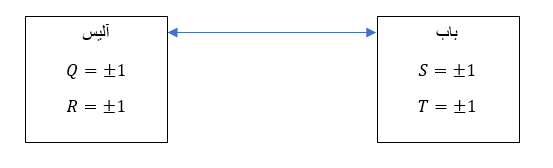
Figure 1: Schematic configuration of the Bell inequality test. Alice chooses to measure either quantity or , while Bob chooses to measure either or . Measurements are conducted concurrently at sufficient spatial separation such that measuring one subsystem exerts no causal influence on the outcome of the other.
Consider the following algebraic expression involving the measurement outcomes:
Because it follows that either or . In either case, one of the two terms vanishes while the other evaluates to , guaranteeing that:
Let denote the joint probability that the system is prepared with intrinsic properties , and prior to measurement. These probabilities depend on Charlie's preparation procedure and experimental noise. Defining as the mathematical expectation value, we obtain:
By the linearity of expectation values, this expands to:
Comparing the two equations yields Bell's inequality, specifically the CHSH inequality named after Clauser, Horne, Shimony, and Holt:
This inequality is part of a broader class of constraints established by John Stewart Bell. By repeating this experiment across a large statistical ensemble, Alice and Bob can empirically determine each expectation value on the left side. For instance, by aggregating all runs where Alice measured and Bob measured, multiplying their paired outcomes, and taking the statistical average, they estimate with precision bounded only by sample size.
Now, consider the corresponding quantum mechanical formulation. Suppose Charlie prepares a two qubit entangled system in the Bell state:
He sends the first qubit to Alice and the second to Bob. They measure the following quantum observables:
Evaluating the quantum expectation values for these operators yields:
Substituting these values into the CHSH correlator gives:
Under classical local realistic assumptions, this correlation sum cannot exceed ; however, quantum mechanics predicts a maximum value of.
Real world experiments utilizing entangled photons have decisively tested this contradiction. Empirical observations consistently violate Bell's inequality and align with quantum mechanical predictions: nature violates Bell's inequality.
This definitive violation implies that at least one foundational premise used in the derivation must be false. The proof relies on two core assumptions:
- Realism: The physical observables have definite, objective values independent of the act of observation.
- Locality: Alice's choice of measurement does not affect the physical reality or measurement outcome at Bob's spatially separated detector.
Collectively designated as local realism, these intuitive assumptions govern classical physics. The empirical violation of Bell's inequalities demonstrates that local realism cannot describe our universe. Most physicists conclude that realism must be abandoned in quantum theory, while others argue against locality; regardless, our classical intuition regarding nature's operation is fundamentally flawed.
From the standpoint of quantum computing and quantum information, Bell's theorem reveals that quantum entanglement is a fundamentally novel physical resource distinct from classical correlation. Harnessing entanglement enables protocols and computational tasks, such as device independent quantum key distribution and superdense coding, that are strictly impossible within classical information theory.
3. Historical Background
John Stewart Bell, born in Belfast, joined CERN in 1960 after completing his studies at Queen's University Belfast. On November 4, 1964, the journal Physics published his seminal paper, laying the theoretical foundation of modern quantum information science.
Bell's work was motivated by Albert Einstein's dissatisfaction with quantum mechanics in the 1930s, specifically Einstein's critique of spooky action at a distance, known as the EPR paradox, which suggested that quantum theory was incomplete and governed by underlying local hidden variables. Bell transformed this philosophical debate into an empirically testable mathematical theorem.
Beginning in the 1970s, pioneering experiments confirmed the violation of Bell's inequalities, verifying quantum non locality and laying the groundwork for contemporary quantum cryptography and quantum computing.
4. References
Nielsen, M. A., and Chuang, I. L. (2010). Quantum Computation and Quantum Information. Cambridge University Press.