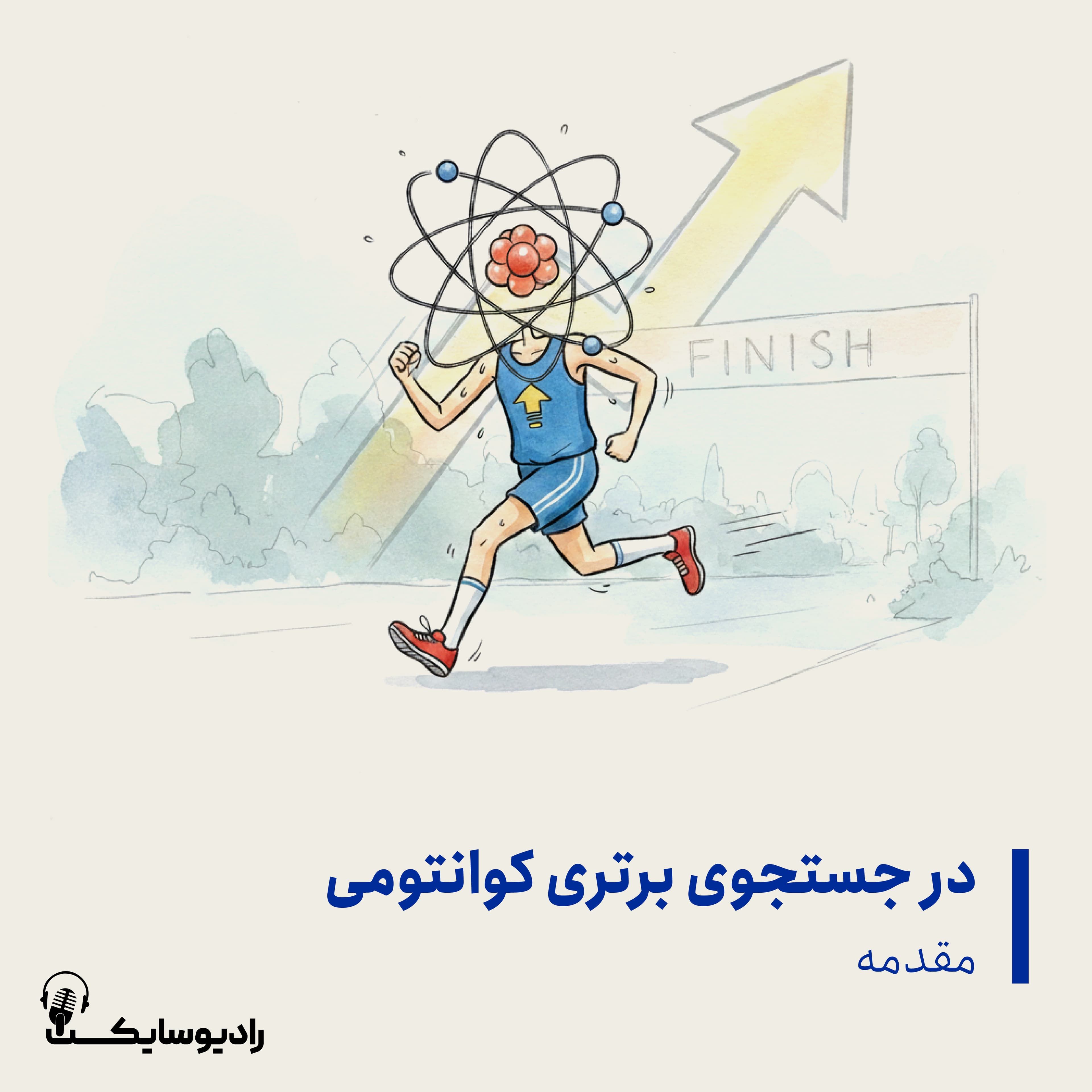
Introductory Episode of the Season: “In Search of Quantum Advantage”
Introductory Episode of the Season: “In Search of Quantum Advantage”
Since the sixth century BCE, humans have sought to understand motion, celestial bodies, and the nature of matter. Over the centuries, they gradually developed a structured framework for describing nature, and by the late nineteenth century, it was widely believed that physics was nearly complete; as Lord Kelvin remarked in 1900, nothing remained but more precise measurements. But with the problem of blackbody radiation and the “ultraviolet catastrophe,” everything changed: Max Planck introduced the idea of quantized energy, Albert Einstein proposed the photon, Niels Bohr presented his atomic model, and Werner Heisenberg and Erwin Schrödinger laid the foundations of quantum mechanics. A new world emerged; one built upon probability, the wave function, superposition, and entanglement. Today, quantum technologies promise computers capable of solving complex problems, discovering new materials and medicines, and even enabling quantum artificial intelligence. The question is: in which problems does true quantum advantage actually lie, and where is the boundary between reality and exaggeration? Join us in Season Four of Radio Psiket as we explore these questions and see whether quantum technologies can truly transform our future.
Since the sixth century BCE, humans have sought to understand motion, celestial bodies, and the nature of matter. Over the centuries, they gradually developed a structured framework for describing nature, and by the late nineteenth century, it was widely believed that physics was nearly complete; as Lord Kelvin remarked in 1900, nothing remained but more precise measurements. But with the problem of blackbody radiation and the “ultraviolet catastrophe,” everything changed: Max Planck introduced the idea of quantized energy, Albert Einstein proposed the photon, Niels Bohr presented his atomic model, and Werner Heisenberg and Erwin Schrödinger laid the foundations of quantum mechanics. A new world emerged; one built upon probability, the wave function, superposition, and entanglement. Today, quantum technologies promise computers capable of solving complex problems, discovering new materials and medicines, and even enabling quantum artificial intelligence. The question is: in which problems does true quantum advantage actually lie, and where is the boundary between reality and exaggeration? Join us in Season Four of Radio Psiket as we explore these questions and see whether quantum technologies can truly transform our future.