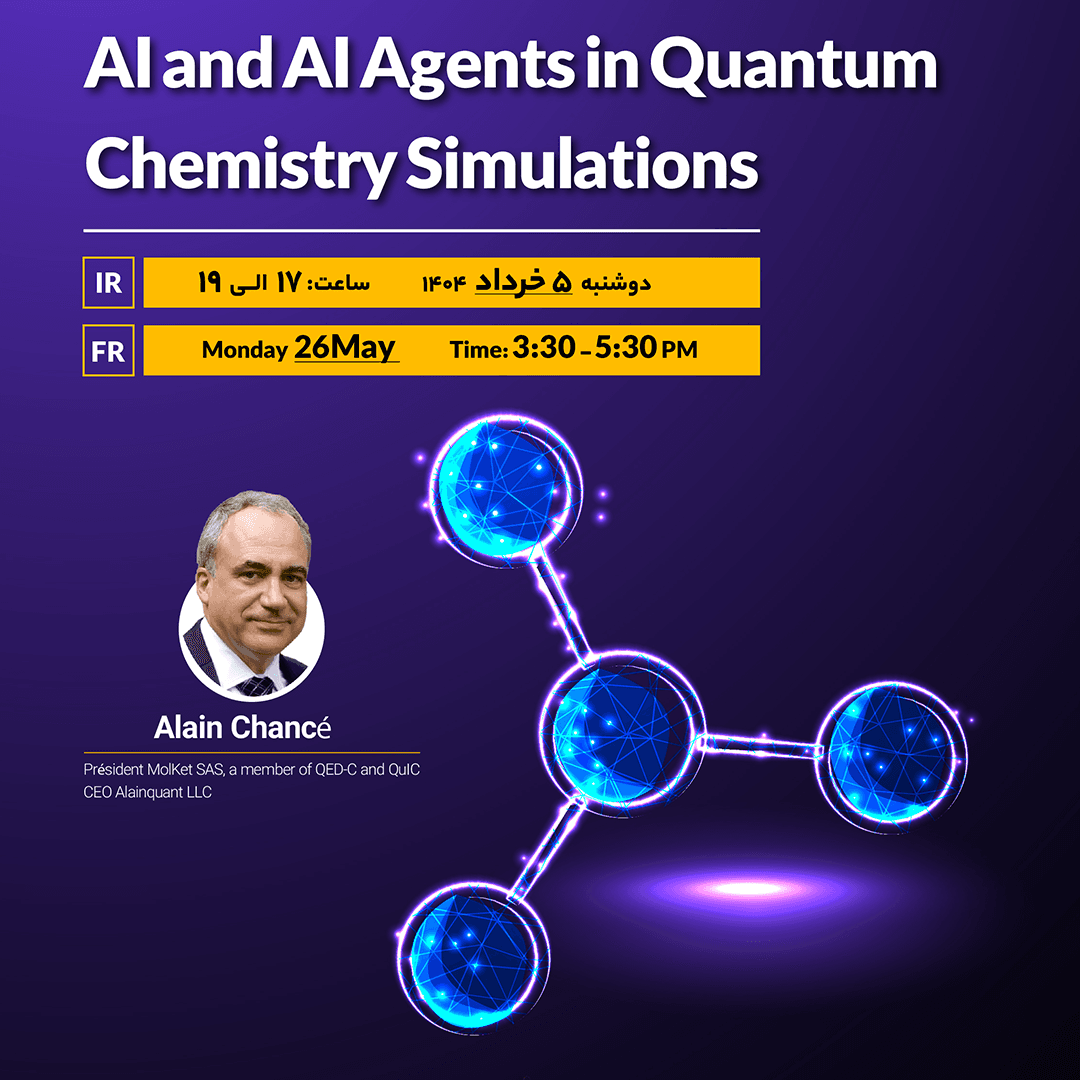
AI and AI Agents in Quantum Chemistry Simulations
محتویات وبینار
1
چکیده
برگزار شده
وبینار آموزشیسطح: مقدماتی
AI and AI Agents in Quantum Chemistry Simulations
Quantum dynamical simulations are computationally demanding, particularly for large systems and long-time evolutions. While quantum computing holds the potential to revolutionize this field, current quantum computers remain limited in scale, and algorithm development continues to present significant challenges. Artificial Intelligence (AI) has demonstrated remarkable success in diverse applications, including complex problem-solving and large-scale data analysis. Recent advances in AI, such as NVIDIA's universal function approximators, have enabled the development of AI applications capable of learning and replicating complex algorithmic behaviors. We propose leveraging AI to accelerate chemical design and quantum dynamical simulations. These AI applications can be trained on the inputs and outputs of quantum chemistry and dynamics algorithms, effectively replacing computationally expensive components. Furthermore, they can learn the scaling behavior of these algorithms, enabling extrapolation to larger systems. We present a proof-of-concept which demonstrates the potential of this approach. We successfully developed an AI application capable of generating vibrational wavefunctions for small molecules, such as CO₂, using only frequency and potential parameters as input. This method bypasses the need for computationally intensive variational algorithms. This work highlights the promising synergy between quantum computing and AI in advancing the field of quantum dynamical simulations.
2
معرفی استاد
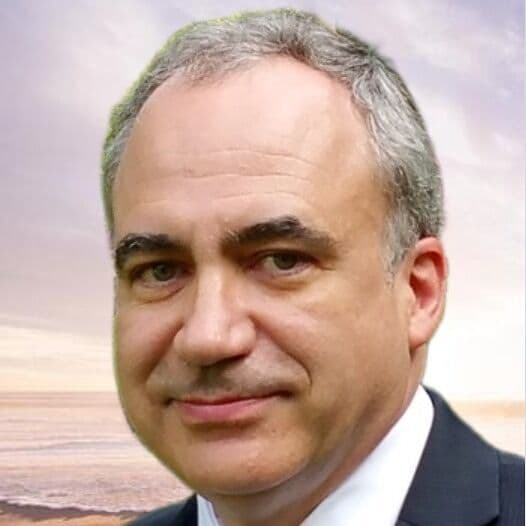
Alain Chancé
Président MolKet SAS, a member of QED-C and QuIC
CEO Alainquant LLC
Co-author: Quantum Chemistry and Computing for the Curious
Member APS, QSECDEF, Society Affiliate ACS
IEEE Senior member
Qiskit Advocate |
3
اطلاعات برگزاری
Time of holding: Monday 26 may; Timer 17-19 PM (IR)
Target Audience:
Students, graduates, faculty members, and other individuals interested in gaining knowledge in this field.
4