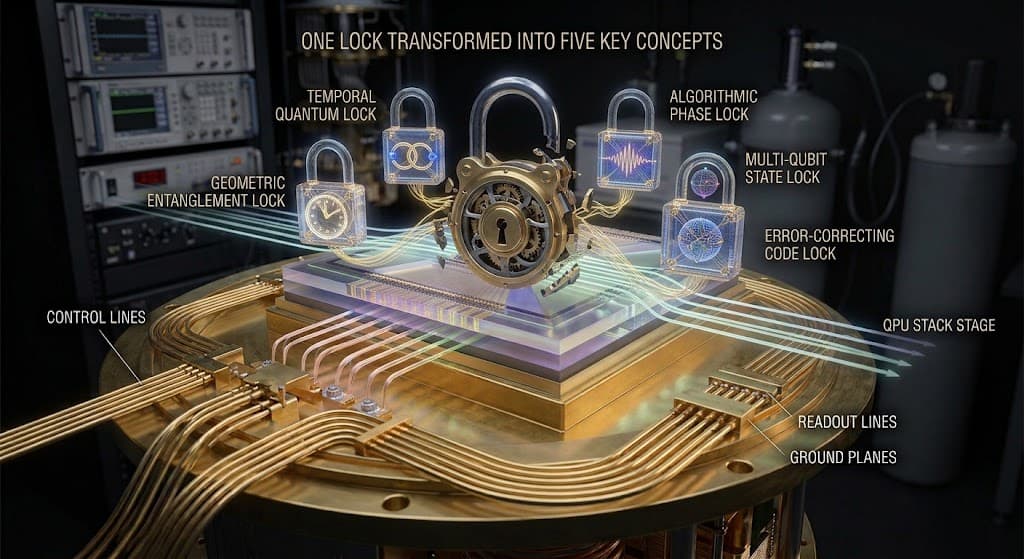
quantum cryptography
Quantum cryptography is a branch of cryptography that uses the principles of quantum mechanics to secure communications and protect information. Unlike classical cryptographic methods, whose security typically relies on the computational difficulty of certain mathematical problems, quantum cryptography exploits properties such as Heisenberg’s uncertainty principle and the quantum no-cloning theorem to help detect certain eavesdropping attempts. One of its most important applications is Quantum Key Distribution (QKD), which enables two parties to establish shared cryptographic keys and obtain security guarantees grounded in the principles of quantum physics. Well-known QKD protocols include BB84 and E91. These protocols use the properties of quantum states and their measurements to help detect potential eavesdropping. However, practical security also depends on implementation details, hardware characteristics, and the proper management of the communication process. Technologies such as Measurement-Device-Independent QKD (MDI-QKD) and Device-Independent QKD (DI-QKD) have been developed to address certain hardware-related vulnerabilities. Quantum cryptography does not mean that all data are directly encrypted using quantum computers; rather, it represents an innovative approach to strengthening communication security. Alongside classical cryptographic methods and post-quantum cryptography, it is expected to play an increasingly important role in the future of cybersecurity.