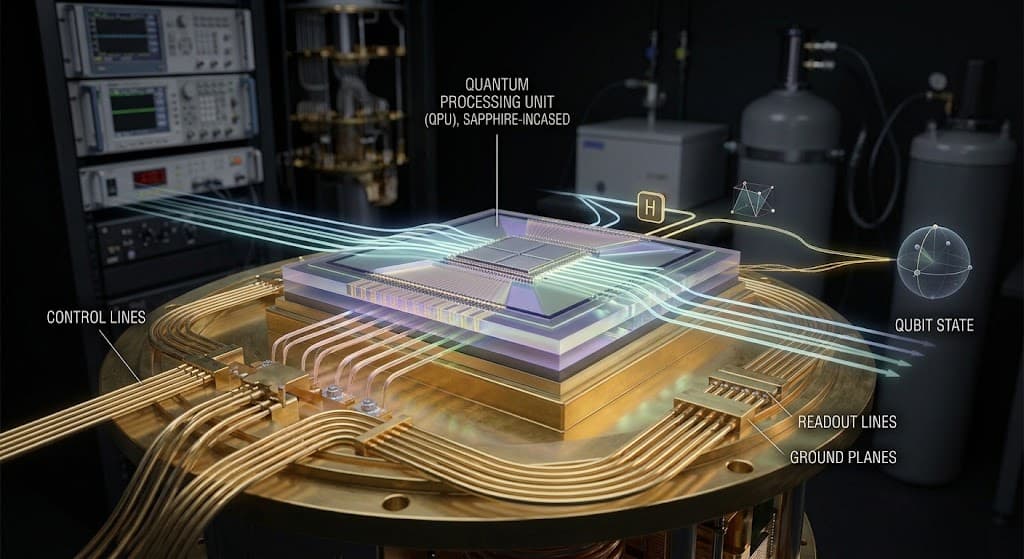
quantum computing
Quantum computing is an emerging generation of information-processing technology that harnesses the principles of quantum physics, including superposition, entanglement, and quantum interference, to offer a fundamentally different approach to solving computational problems. Unlike classical computers, which process information using bits represented by zeros and ones, quantum computers use units called *qubits*, whose quantum behavior enables the development of novel algorithms. This technology has the potential to solve certain complex problems beyond the practical capabilities of classical methods, although its advantages depend on the specific problem and computational conditions. Quantum computing has the potential to transform fields such as molecular and materials simulation, drug discovery, optimization, cryptography, and artificial intelligence. However, challenges such as the sensitivity of qubits to their environment, computational errors, and the difficulty of developing scalable systems remain major obstacles to its widespread adoption. Rather than replacing all existing computers, quantum computing represents an emerging complementary approach that could expand the boundaries of scientific and technological computation in the future.