Introduction to Classical and Quantum Computing
Author: Thomas G. Wong
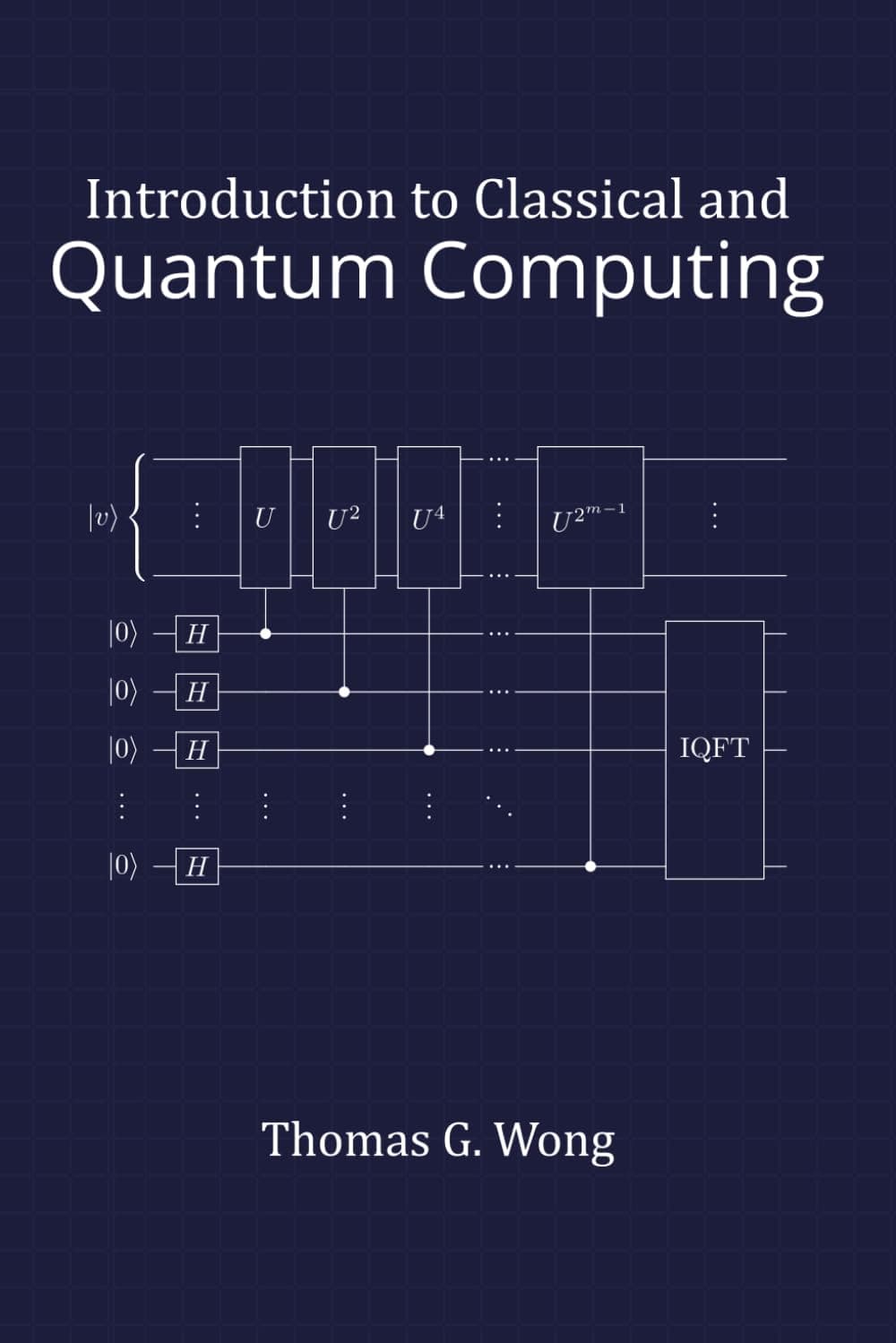
Introduction to Classical and Quantum Computing by Thomas G. Wong is an educational textbook that provides a systematic introduction to the foundations of classical and quantum computing. Its main objective is to teach quantum computing beyond the conceptual level while remaining accessible to readers without advanced mathematical preparation. The author gradually guides readers from the fundamentals of classical information processing to the principles and methods of quantum computation. The book is organized into eight chapters. It begins with classical information, bits, logic gates, computational circuits, Boolean algebra, reversible computation, error correction, and computational complexity. It then introduces qubits, superposition, measurement, the Bloch sphere, quantum gates and circuits, linear algebra, multi-qubit systems, entanglement, and quantum error correction. Later chapters cover quantum programming, quantum assembly language, Qiskit and other programming tools, quantum protocols, and algorithms such as Shor's algorithm and quantum search methods. A major strength of the book is its practical and pedagogical approach. Educational games, the Quirk quantum simulator, computational examples, and code for Mathematica and SageMath help readers connect theoretical concepts with quantum circuits and programs. The book is suitable for students in computer science, engineering, physics, and mathematics, as well as readers interested in entering the field of quantum computing. Its main prerequisite is trigonometry, while the necessary linear algebra is introduced within the text.
Read the introduction- Pages
- 400
- Language
- انگلیسی
- Reading level
- Beginner
About the book
Introduction to Classical and Quantum Computing by Thomas G. Wong is an educational textbook that provides a systematic introduction to the foundations of classical and quantum computing. Its main objective is to teach quantum computing beyond the conceptual level while remaining accessible to readers without advanced mathematical preparation. The author gradually guides readers from the fundamentals of classical information processing to the principles and methods of quantum computation.
The book is organized into eight chapters. It begins with classical information, bits, logic gates, computational circuits, Boolean algebra, reversible computation, error correction, and computational complexity. It then introduces qubits, superposition, measurement, the Bloch sphere, quantum gates and circuits, linear algebra, multi-qubit systems, entanglement, and quantum error correction. Later chapters cover quantum programming, quantum assembly language, Qiskit and other programming tools, quantum protocols, and algorithms such as Shor's algorithm and quantum search methods.
A major strength of the book is its practical and pedagogical approach. Educational games, the Quirk quantum simulator, computational examples, and code for Mathematica and SageMath help readers connect theoretical concepts with quantum circuits and programs. The book is suitable for students in computer science, engineering, physics, and mathematics, as well as readers interested in entering the field of quantum computing. Its main prerequisite is trigonometry, while the necessary linear algebra is introduced within the text.
How this book helps
Fundamentals of Quantum Computing: Learning the principles of quantum information processing, qubits, superposition, and measurement.
Quantum Circuit Design: Understanding quantum gates, single-qubit and multi-qubit circuits, and universal gate sets.
Quantum Programming: Gaining practical experience in programming quantum circuits using Qiskit and other software tools.
Quantum Computing Simulation: Using simulators such as Quirk to construct, execute, and analyze quantum circuits.
Quantum Algorithms: Studying and implementing introductory quantum search algorithms, the quantum Fourier transform, phase estimation, and Shor's algorithm.
Quantum Error Correction: Understanding the principles of quantum encoding and methods for mitigating errors in quantum computations.
Quantum Information Protocols: Studying entanglement, quantum teleportation, superdense coding, and quantum key distribution.
Classical and Quantum Computing Comparison: Examining computational differences, algorithmic complexity, and the limitations of both computational paradigms.
What you will learn
Explain the fundamentals of classical information processing, bits, logic gates, and computational circuits.
Understand the fundamental differences between classical bits and quantum bits.
Describe quantum states using mathematical representations and the Bloch sphere.
Analyze quantum gate operations and construct single-qubit and multi-qubit circuits.
Use linear algebra to represent and calculate quantum states.
Analyze superposition, measurement, and entanglement in multi-qubit systems.
Program and simulate quantum circuits using tools such as Qiskit.
Explain the principles and applications of quantum information protocols, including quantum teleportation and quantum key distribution.
Understand and implement introductory quantum algorithms, including Shor's algorithm and quantum search methods.
Evaluate computational complexity and the capabilities of classical and quantum computing.
Become familiar with the basic principles of quantum error correction and its importance in quantum information processing
Contributors
- Author
- Thomas G. Wong
Publication and reading details
- Publisher
- Rooted Grove
- Published
- 2022
- Language
- انگلیسی
- Pages
- 400
- Print run
- 1
- Format
- Text
- Reading level
- Beginner
- Category
- quantum computing
Book identifiers
- ISBN
- 979-8-9855931-1-2