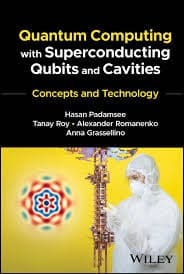
Quantum Computing with Superconducting Qubits and Cavities: Concepts and Technology
Author: Hasan Padamsee, Tanay Roy, Alexander Romanenko, Anna Grassellino
This book explores the physical principles, theoretical foundations, and engineering technologies underlying quantum computing based on superconducting qubits and microwave cavities. The authors introduce the fundamentals of quantum computation, covering concepts such as qubits, coherence and decoherence, quantum gates, entanglement, and measurement. Topics including quantum errors, error correction, and qudits are also discussed to familiarize readers with the principles of quantum information processing and the physical requirements for its implementation. A substantial part of the book is devoted to the design and operation of superconducting qubits, particularly transmon qubits, and their interaction with high-quality microwave cavities. The authors examine the physical principles of superconducting circuits, quantum oscillators, LC circuits, Josephson junctions, and cavity–transmon architectures. The book also addresses quantum computation using bosonic modes, Fock states, quantum memories, and bosonic encoding. Bosonic error-correcting codes, including cat, binomial, and Gottesman–Kitaev–Preskill (GKP) codes, are discussed in detail. Another major focus of the book is the role of materials science, fabrication techniques, and surface treatments in improving the coherence times of qubits and cavities. By analyzing energy-loss mechanisms, factors limiting quantum state lifetimes, and the requirements for scalable processor development, the authors clarify the relationship between material properties, hardware design, and computational performance. In addition to providing theoretical foundations, this work offers the technical knowledge required to understand and analyze advanced superconducting qubit technologies and cavity-based architectures, making it valuable for students, engineers, and researchers.
Read the introduction- Pages
- 320
- Language
- انگلیسی
- Reading level
- Advanced
About the book
This book explores the physical principles, theoretical foundations, and engineering technologies underlying quantum computing based on superconducting qubits and microwave cavities. The authors introduce the fundamentals of quantum computation, covering concepts such as qubits, coherence and decoherence, quantum gates, entanglement, and measurement. Topics including quantum errors, error correction, and qudits are also discussed to familiarize readers with the principles of quantum information processing and the physical requirements for its implementation.
A substantial part of the book is devoted to the design and operation of superconducting qubits, particularly transmon qubits, and their interaction with high-quality microwave cavities. The authors examine the physical principles of superconducting circuits, quantum oscillators, LC circuits, Josephson junctions, and cavity–transmon architectures. The book also addresses quantum computation using bosonic modes, Fock states, quantum memories, and bosonic encoding. Bosonic error-correcting codes, including cat, binomial, and Gottesman–Kitaev–Preskill (GKP) codes, are discussed in detail.
Another major focus of the book is the role of materials science, fabrication techniques, and surface treatments in improving the coherence times of qubits and cavities. By analyzing energy-loss mechanisms, factors limiting quantum state lifetimes, and the requirements for scalable processor development, the authors clarify the relationship between material properties, hardware design, and computational performance. In addition to providing theoretical foundations, this work offers the technical knowledge required to understand and analyze advanced superconducting qubit technologies and cavity-based architectures, making it valuable for students, engineers, and researchers.
How this book helps
- Design and analysis of quantum processors based on superconducting qubits and microwave cavities.
- Design, fabrication, and evaluation of transmon qubits and superconducting circuits.
- Development of cavity-based quantum computing architectures and qubit–cavity interactions.
- Design and analysis of quantum memories and bosonic-mode-based information processing systems.
- Development of quantum encoding and error correction methods based on cat, binomial, and GKP codes.
- Investigation and optimization of materials, fabrication techniques, and surface treatments to improve qubit and cavity coherence times.
- Analysis of energy-loss mechanisms, decoherence, and factors limiting quantum hardware performance.
- Design and evaluation of scalable architectures for developing quantum processors with larger numbers of qubits.
- Exploring quantum computing applications in integer factoring, database searching, quantum chemistry, and simulations of materials and condensed matter systems.
What you will learn
- Explain the physical and mathematical foundations of quantum computation and the operating principles of superconducting qubits.
- Analyze the structure, characteristics, and operating principles of transmon qubits and superconducting circuits.
- Understand qubit–microwave cavity interactions and their role in quantum processor architectures.
- Explain bosonic modes, Fock states, qudits, and quantum information encoding.
- Identify and analyze bosonic error correction methods, including cat, binomial, and GKP codes.
- Investigate energy-loss and decoherence mechanisms and evaluate the factors affecting qubit and cavity coherence times.
- Analyze the role of material properties, fabrication techniques, and surface treatments in improving quantum hardware performance.
- Evaluate the engineering requirements and challenges involved in developing and scaling superconducting quantum processors.
Contributors
- Author
- Hasan Padamsee, Tanay Roy, Alexander Romanenko, Anna Grassellino
Publication and reading details
- Publisher
- John Wiley & Sons (Wiley)
- Published
- 2026
- Language
- انگلیسی
- Pages
- 320
- Print run
- 1
- Format
- Text
- Reading level
- Advanced
- Category
- quantum hardware
Book identifiers
- ISBN
- 978-1-394-29458-9