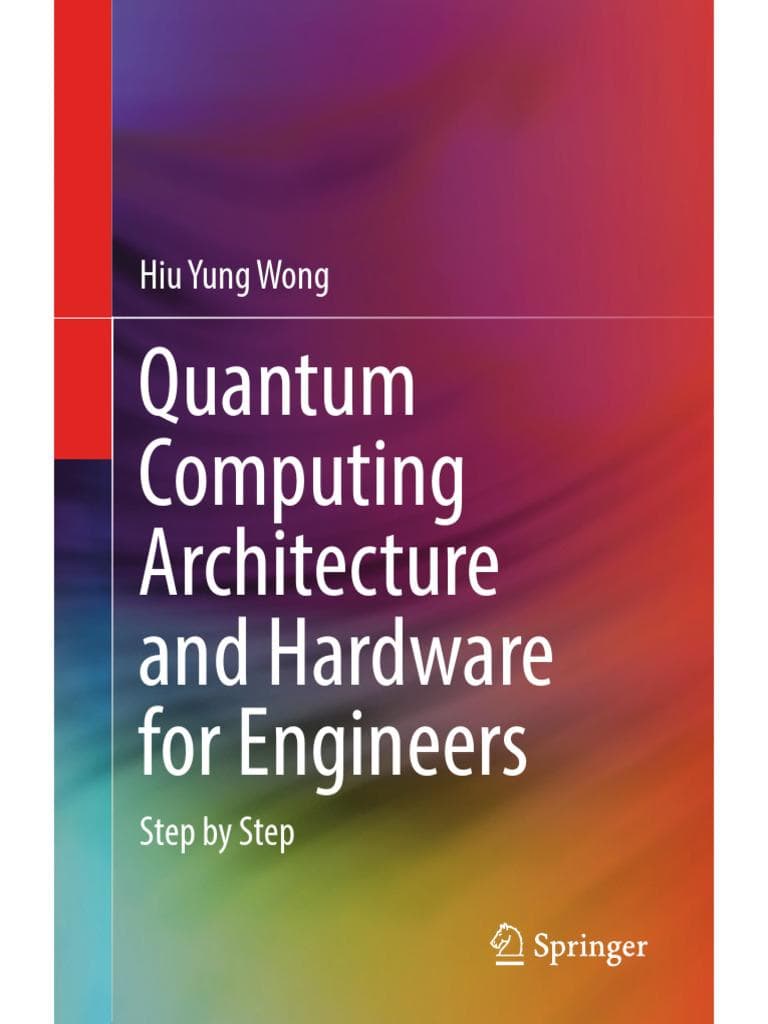
Quantum Computing Architecture and Hardware for Engineers
Author: Hiu Yung Wong
This book aims to provide an engineering-oriented understanding of quantum computer architecture and hardware. Recognizing that many electrical, electronics, and computer engineering students and professionals lack extensive backgrounds in quantum physics and mathematics, the author adopts a step-by-step approach to connect fundamental physical and mathematical concepts with the principles of quantum hardware design and implementation. The opening chapters introduce the essential linear algebra and quantum mechanics required to understand quantum states, operators, matrices, quantum gates, and measurement. The central part of the book focuses on two important technologies for building quantum processors: spin qubits and superconducting qubits. By explaining the physical principles underlying these systems, the author examines how their quantum properties are connected to hardware components and electronic circuits. Topics such as the quantum harmonic oscillator, LC circuits, superconductivity, Josephson junctions, and the principles of controlling and manipulating quantum states provide the foundation for a deeper understanding of the physical structure of quantum processors. A distinctive feature of this book is its continuous integration of physics, mathematics, and microwave engineering. The material is presented through step-by-step examples, simulation codes, and superconducting quantum chip design examples. The five DiVincenzo criteria are also used as a framework for examining the requirements of building a practical quantum computer. This approach enables readers to move beyond the theoretical understanding of qubits and become familiar with the technical requirements, limitations, and engineering considerations involved in designing and developing quantum computing hardware.
Read the introduction- Pages
- 371
- Language
- انگلیسی
- Reading level
- Intermediate
About the book
This book aims to provide an engineering-oriented understanding of quantum computer architecture and hardware. Recognizing that many electrical, electronics, and computer engineering students and professionals lack extensive backgrounds in quantum physics and mathematics, the author adopts a step-by-step approach to connect fundamental physical and mathematical concepts with the principles of quantum hardware design and implementation. The opening chapters introduce the essential linear algebra and quantum mechanics required to understand quantum states, operators, matrices, quantum gates, and measurement.
The central part of the book focuses on two important technologies for building quantum processors: spin qubits and superconducting qubits. By explaining the physical principles underlying these systems, the author examines how their quantum properties are connected to hardware components and electronic circuits. Topics such as the quantum harmonic oscillator, LC circuits, superconductivity, Josephson junctions, and the principles of controlling and manipulating quantum states provide the foundation for a deeper understanding of the physical structure of quantum processors.
A distinctive feature of this book is its continuous integration of physics, mathematics, and microwave engineering. The material is presented through step-by-step examples, simulation codes, and superconducting quantum chip design examples. The five DiVincenzo criteria are also used as a framework for examining the requirements of building a practical quantum computer. This approach enables readers to move beyond the theoretical understanding of qubits and become familiar with the technical requirements, limitations, and engineering considerations involved in designing and developing quantum computing hardware.
How this book helps
Understanding the architecture and physical structure of quantum processors.
Design and analysis of spin and superconducting qubits.
Analysis of quantum circuits based on Josephson junctions.
Design of microwave systems for qubit control.
Simulation and performance evaluation of quantum hardware.
Examination of the engineering requirements for quantum computer development.
What you will learn
Understanding the mathematical and physical foundations of quantum hardware.
Identifying and comparing different types of qubits.
Analyzing the physical principles of superconducting quantum circuits.
Understanding the relationship between quantum mechanics and electronic engineering.
Using simulation tools for quantum systems.
Evaluating the requirements for quantum computer design and implementation.
Contributors
- Author
- Hiu Yung Wong
Publication and reading details
- Publisher
- Springer Nature Switzerland
- Published
- 2025
- Language
- انگلیسی
- Pages
- 371
- Print run
- 1
- Format
- Text
- Reading level
- Intermediate
- Category
- quantum hardware
Book identifiers
- ISBN
- 978-3-031-78219-0