1. In-Depth Insights
To manipulate the state of a qubit, we utilize quantum logic gates represented by unitary matrices. Quantum gates are expressed as unitary matrices of dimension, where denotes the number of qubits upon which the gate acts. Prominent examples of two-qubit gates include the and gates. Quantum gates can be assembled within a quantum circuit alongside state preparation and measurement operations to execute arbitrary quantum computations.
We distinguish three primary groups of quantum gates of operational interest: Pauli gates, Clifford gates, and non-Clifford gates.
- Pauli Gates: A foundational set of single-qubit gates comprising the, and gates.
- Clifford Group: A finite group defined as the normalizer of the Pauli group. Specifically, for any Clifford element and any Pauli operator, there exists a Pauli operator such that . Canonical examples include the (Hadamard) and gates.
- Non-Clifford Gates: Quantum gates such as the and gates that lie outside the Clifford group.
Notably, achieving universal quantum computation strictly requires combining both Clifford and non-Clifford gate sets.
Prominent Quantum Gates and Their Representations
Pauli Gates (X, Y, Z)
The Pauli gates constitute fundamental single-qubit transformations:
Pauli-X Gate (X gate) — Matrix Representation:
Pauli-Y Gate (Y gate) — Matrix Representation:
Pauli-Z Gate (Z gate) — Matrix Representation
Hadamard Gate (H gate)
The Hadamard gate creates an equal superposition from a computational basis state. Acting on the basis state, it maps it to an equal superposition of and. Similarly, it maps to an orthogonal superposition state. Matrix representation:
For instance, applying the Hadamard gate to the state yields:
This gate is essential in numerous quantum algorithms to establish quantum superposition across all possible computational basis inputs.
Phase Shift Gates (S and T Gates)
Phase shift gates modify the phase of a qubit without altering measurement probabilities between basis states. The most common phase gates are and . Specifically, the gate applies a phase shift of to the state . Matrix representation:
CNOT Gate (Controlled-NOT Gate)
The gate is a two-qubit gate where one qubit serves as a control and the other as the target. If the control qubit is in the state , the gate flips the target qubit (applying an gate). If the control qubit is in the state , the target qubit remains unchanged. Matrix representation:
The gate is indispensable for generating quantum entanglement between qubits, serving as a cornerstone of quantum algorithmic protocols.
Broadly speaking, quantum gates constitute the building blocks and operational core of all quantum computations; every quantum algorithm is structured as a sequence of discrete quantum gates applied to a quantum register.
2. Key Principles
Quantum gates exhibit fundamental mathematical and physical properties that distinguish them from classical logic gates, ensuring rigorous compliance with quantum mechanics:
Unitarity
A defining property of every quantum gate is that its matrix representation must be unitary. This guarantees that every quantum transformation satisfies:
where denotes the conjugate transpose (Hermitian adjoint) of the matrix, and I is the identity matrix. Unitarity preserves the total probability norm of quantum states and ensures that quantum evolution is strictly reversible. For example, for the Hadamard gate :
It is straightforward to verify that, proving that the Hadamard gate is unitary.
Entangling Capability
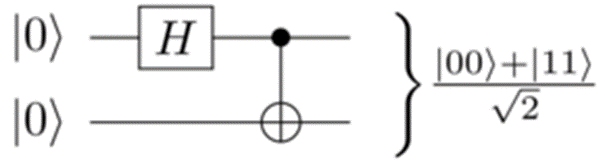
Quantum gates such as the gate are capable of creating entanglement between qubits. For instance, if the first qubit is prepared in an equal superposition while the second is initialized in , applying a gate yields a maximally entangled Bell state:
Reversibility
By virtue of their unitary nature, quantum gates are inherently reversible. This stands in sharp contrast to classical logic gates (such as AND, OR, and NAND), which are dissipative and irreversible because input states cannot be uniquely determined from outputs. Any quantum gate transformation can always be undone by applying its inverse (adjoint) operator. For example, for the Pauli-X gate:
The inverse of is itself ; applying Pauli-X twice to any qubit state restores the original quantum state exactly.
Universality
Specific sets of quantum gates are universal, meaning any arbitrary multi-qubit unitary operation can be approximated to arbitrary accuracy using a circuit composed exclusively of gates from that set. For instance, combining Hadamard, CNOT, and T gates forms a standard universal set. This is analogous to classical logic where NAND or {AND, OR, NOT} forms a universal computation basis.
3. Applications
Below, we outline key applications of quantum logic gates across prominent quantum computing domains:
Shor's Algorithm: Quantum gates such as Hadamard, Controlled-U, and Quantum Fourier Transform (QFT) gates are employed to construct superposition states and execute phase estimation. These gates enable quantum computers to factor large composite integers exponentially faster than classical algorithms, presenting a foundational challenge to classical public-key cryptography (e.g., RSA).
Grover's Algorithm: Leverages quantum gates such as the Hadamard gate and the Oracle gate to search unstructured databases with a quadratic speedup over classical search algorithms.
Quantum Key Distribution (QKD): Quantum gates including Pauli-X (bit flip) and Hadamard gates are deployed in protocols like BB84 to prepare superposition states and perform conjugate basis measurements, ensuring secure cryptographic key exchange.
Quantum Teleportation: CNOT and Hadamard gates are utilized in quantum teleportation protocols to transmit unknown quantum states across arbitrary spatial distances by establishing entangled Bell states and executing Bell-state measurements.
4. Historical Milestones
Foundations of Quantum Mechanics (1920s–1930s): The formulation of unitary time evolution in quantum mechanics by Erwin Schrödinger and contemporaries laid the conceptual groundwork for quantum gates; quantum gates manipulate quantum states through unitary transformations while preserving probability conservation.
Quantum Information Theory (1980s): Richard Feynman proposed in 1981 that classical computers face exponential barriers when simulating quantum systems. This insight motivated the concept of quantum computers and the subsequent development of quantum gates as primary computational operations.
Introduction of Quantum Gates (1985): David Deutsch formally introduced the concept of quantum logic gates in his seminal 1985 paper, defining the first universal quantum gate constructions and formalizing the quantum circuit model.
Development of Specific Quantum Gates (1990s): Foundational quantum gates including Hadamard and CNOT were systematically developed and analyzed throughout the 1990s, establishing the mechanisms required to generate quantum superposition and multi-qubit entanglement.
Quantum Algorithms and Universal Gate Sets (1994–1996): Shor's algorithm (1994) and Grover's algorithm (1996) demonstrated the practical computational superiority of quantum gates, highlighting their ability to deliver exponential and quadratic computational speedups.
5. Visual Representation
Figure 1: Generation of a maximally entangled Bell state using a Hadamard gate and a CNOT gate on a two-qubit quantum register initialized in the state . The resulting output state is:
6. References
Nielsen, M. A., & Chuang, I. L. (2010). Quantum Computation and Quantum Information. Cambridge University Press.