1. In-Depth Insights
The bit is the fundamental concept in classical computation and information theory. Quantum computation and quantum information are built upon an analogous concept: the quantum bit, or qubit for short. Much like a classical bit possesses a state of either or , a qubit can also be prepared in these states. The two possible computational states for a qubit are and , corresponding respectively to the classical bit states 0 and . This bra-ket notation, known as Dirac notation, is the standard convention for representing states in quantum mechanics.
The defining distinction between bits and qubits is that a qubit can exist in states other than or . In other words, linear combinations of these states can be formed, a phenomenon termed superposition:
where and are complex numbers. Geometrically, the state of a qubit is a unit vector in a two-dimensional complex Hilbert space. The states and are known as computational basis states and form an orthonormal basis for this vector space.
We can examine a classical bit to determine definitively whether it is in state or 1. In contrast, we cannot directly measure a qubit to determine its exact continuous quantum state—that is, the amplitudes and . Quantum mechanics dictates that measurement yields far more restricted information: when we measure a qubit in the computational basis, we obtain outcome with probability , and outcome with probability .
A classical bit is akin to a coin displaying heads or tails. While real coins might transiently balance on their edge, such states are neglected in idealized models. In stark contrast, a qubit can reside in a continuous spectrum of states between and until a measurement is performed. For example, a qubit can be prepared in the state:
Upon measurement, this state yields outcome with a 50% probability and outcome with a 50% probability. This state is conventionally designated as
To gain physical intuition regarding how qubits are realized, several physical quantum systems serve as paradigms:
Two orthogonal polarization modes of a single photon;
The spin alignment of an atomic nucleus in a uniform magnetic field;
Two energy levels of an electron orbiting a single atom (the ground state and an excited state ). By shining laser pulses of calibrated frequency, intensity, and duration, the electron can be transitioned between and, or placed into arbitrary coherent superpositions.
2. Mathematical Representation
A qubit is described mathematically by a state vector in a two-dimensional complex Hilbert space:
where α and β are complex numbers satisfying the normalization condition:
Because an overall global phase has no observable physical consequence, the state vector of a qubit can be parameterized on the unit sphere in terms of real angles and :
where and are real parameters.
3. Key Principles
Superposition: The capacity of a qubit to exist simultaneously in a coherent linear combination of basis states and .
Entanglement: When two or more qubits become entangled, measuring the state of one instantaneously determines the state of the other, regardless of spatial separation.
Wavefunction Collapse: The act of measurement perturbs the qubit from its superposition state, projecting it onto a definite eigenstate consistent with the measurement outcome. For instance, if state is measured and outcome is observed, the post-measurement state collapses deterministically to . This behavior constitutes an axiomatic postulate of quantum mechanics.
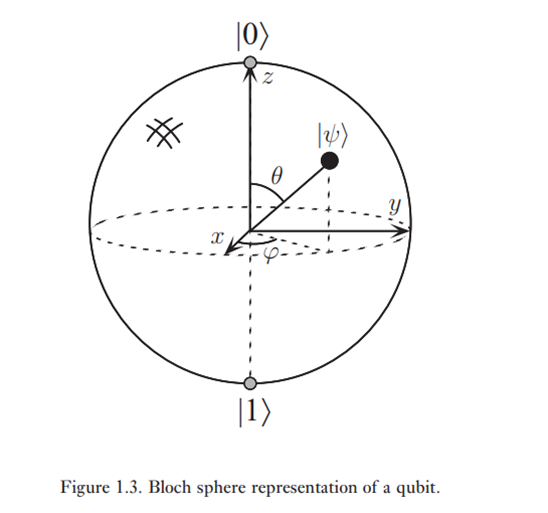
Bloch Sphere: In the parametric representation:
the angles define a point on the surface of a three-dimensional unit sphere known as the Bloch sphere. The Bloch sphere provides an indispensable geometric visualization for single-qubit states and unitary operations, serving as a standard testbed for quantum information concepts.
4. Applications
Qubits serve as the fundamental resource for quantum information processing and quantum computers, holding revolutionary potential across diverse domains such as quantum cryptography, molecular simulations, materials discovery, and quantum-enhanced machine learning.
5. Historical Milestones
In 1995, theoretical physicist Benjamin Schumacher extended Claude Shannon's noiseless coding theorem to the quantum regime, coining the term "qubit" and formalizing it as an elementary physical resource for quantum information transmission.
6. Visual Representation
Figure 1.3: Geometric visualization of a single qubit on the Bloch sphere:
The North Pole represents the basis state;
The South Pole represents the basis state ;
The polar angle and azimuthal angle uniquely determine the orientation of the state vectoron the sphere:
7. References
Nielsen, M. A., & Chuang, I. L. (2000). Quantum Computation and Quantum Information. Cambridge University Press.