Join Psiket webinars to hear from experts and explore the latest ideas and breakthroughs in quantum science—live, clear, and practical.

Reducing the number of assumptions in an axiomatic theory is a natural route toward constructing more general frameworks. Historically, the discovery of non-Euclidean geometries provides a well-known example of this approach. Recently, we have applied this strategy to quantum mechanics by abandoning the assumption that the position of a particle must be described by a strictly self-adjoint operator. The remaining principles of quantum theory, together with Galilean symmetry, lead to a generalized quantum framework characterized by a single free parameter with the dimension of length. This mathematical structure preserves Galilean invariance and gives rise to a generalized uncertainty relation that guarantees the existence of a minimal length—an expectation shared by several approaches to quantum gravity. Remarkably, this non-Heisenberg quantum theory yields, without assuming any *a priori* commutation relations, a modified Heisenberg-type uncertainty relation of the form [ \Delta x , \Delta p \geq \sqrt{\frac{\hbar^2}{4} + l_0^2 (\Delta p)^2}, ] which explicitly implies a minimum position uncertainty equal to ( l_0 ). In the limit ( l_0 \to 0 ), the theory smoothly reduces to standard quantum mechanics. By comparing the predictions of this framework with observational data—including the first longitudinal normal modes of the resonant-bar gravitational wave detector **AURIGA** and the (1S!-!2S) transition in hydrogen—we derive upper bounds on the value of the length parameter ( l_0 ).


In this talk, we begin by introducing a general framework for quantifying the intrinsic quantum randomness. This framework allows us to compute the maximum guessing power of an eavesdropper, while fully accounting for the possibility that they may share classical or quantum correlations with the input state or even with the measurement itself. We then compute the intrinsic randomness of a mixed state and identify the measurements that optimize this quantity. Next, we derive the randomness generated by noisy measurements, along with the corresponding optimal states. Finally, we show that the simultaneous presence of noise in both the state and the measurement can significantly enhance the eavesdropper’s ability to guess the outcomes.

The wave–particle duality is a concept in quantum mechanics that states that the fundamental entities of the universe, such as photons and electrons, exhibit either particle-like or wave-like properties depending on experimental conditions. In the early twentieth century, it was discovered that light behaves as a wave, and later it was found to display particle-like behavior. Meanwhile, electrons, which initially appeared to act as particles in early experiments, were later shown to exhibit wave-like properties. What single identity can be conceived for matter?

One of the issues that was difficult to understand and confusing from the very beginning of quantum mechanics was that we attributed particle properties to entities we knew as waves, and we also attributed wave properties to entities we knew as particles. For example, we considered light to be photon particles and we performed the double-slit experiment for electrons. But what is the story? After all, is the electron a particle or a wave? In this seminar, I want to unpack these experiments a little and relate the wave-particle duality to another duality in quantum mechanics that goes back to the dynamics we have created.

In this lecture, we will discuss several phenomena in solid-state physics that classical physics was unable to describe and were explained with the birth of quantum mechanics.

In this talk, we will have an overview of the main issues facing high energy physics, both theoretically and experimentally. This field of physics deals with the world in distances Very small, from about the inside of the nucleus to the power of 10 minus 15 meters to the Planck dimensions of 10 to the power of minus 35 meters, where gravity and quantum merge and connect us with the universe. They face differently. On the other hand, our understanding of this field of physics also strongly affects the cosmology of the early universe. The problem of dark matter and dark energy A fundamental and unanswered question is at the center of attention in both high energy physics and cosmology. The entropy problem of the black hole and its radiation and the problem with it The loss of information in this process has been keeping us busy for years. Maybe the answer to all of this is in string theory. Surely the answer to these questions is the opinion It will drastically change us from the structure of space-time in Planckian dimensions. At the other end of this range, we have problems of a different kind, such as the problem of color limitation. And measuring the mass of neutrino and the number of Higgs particles and... we don't know if their answers will also surprise us. Do these two sets of pain and treatment affect each other do they put

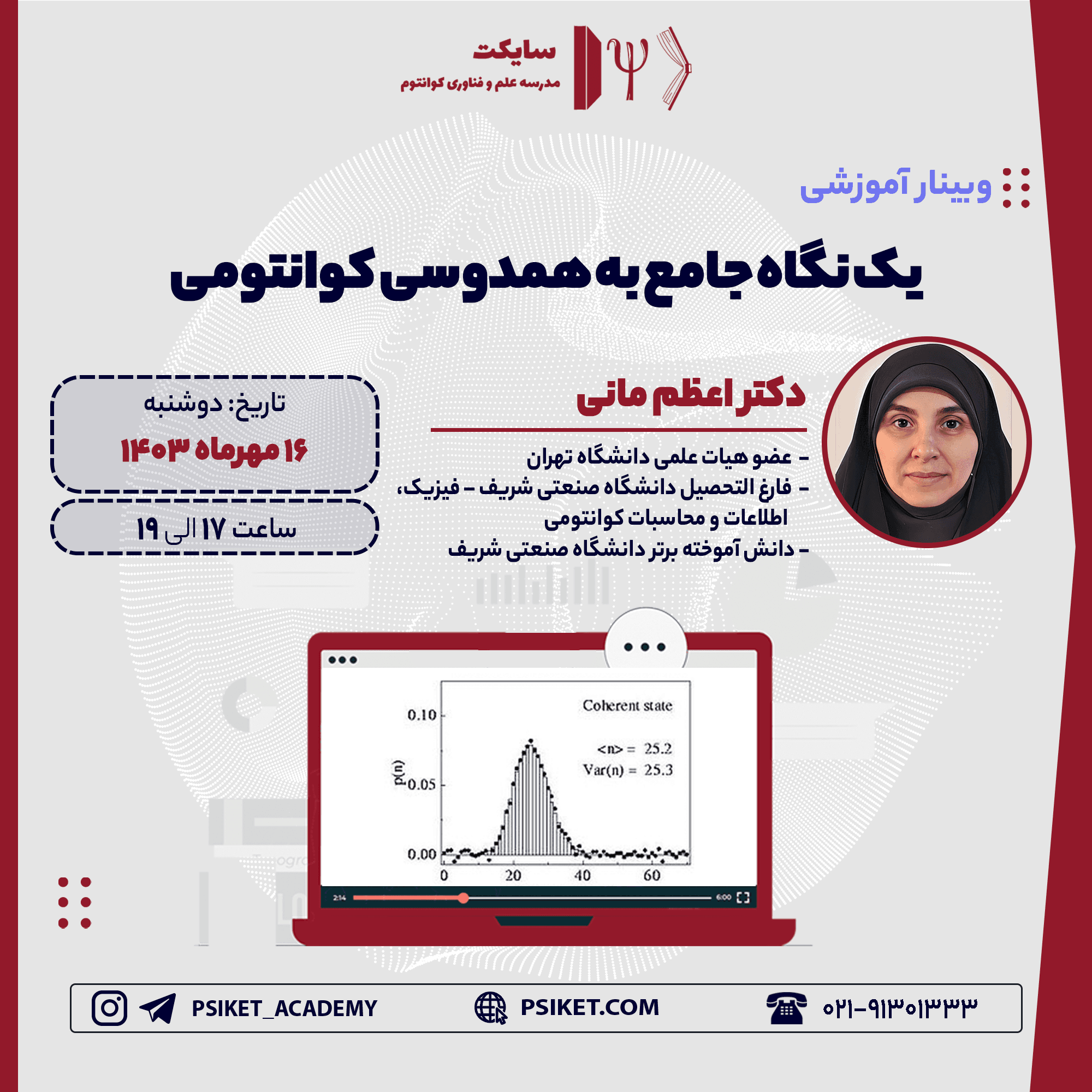
Quantum coherence is one of the unique features of quantum systems, and the existence of this feature is the reason for the theoretical superiority of classical algorithms over their classical counterparts. In simple terms, quantum coherence means that the quantum state of the system is placed in the superposition of its allowed levels. In this presentation, we will state the exact definition of quantum coherence and discuss the principles of its quantification methods, especially the resource theory of quantum coherence. In the following, we introduce hypercoherent states that are considered a quantum resource and discuss why these states are considered quantum resources. Finally, we talk about the fact that the concept of coherence is inevitably tied to the concept of quantum measurement, and on this basis we define and quantify quantum coherence based on available measurements.

The development of quantum technology has so far raised many hopes for different target markets. Sometimes the approach and driving engine of this technology is evaluated for its special functions and sometimes for its money-making future. This presentation evaluates the role and impact of quantum technology in the country's technology development by proposing a hybrid ecosystem.

The attempt to discover a quantum theory of gravity is motivated by reconciling the inconsistencies between quantum theory and general relativity. In this webinar, we present an alternative approach developed by Jonathan Oppenheim by building a consistent theory of classical gravity with quantum theory. The dynamics of this theory is linear, completely positive and Tris-preserving in relation to the density matrices that affect them, and reduces to Einstein's theory of general relativity in the classical limit. As a result, this dynamics does not suffer from the problems of the semiclassical theory of quantum gravity based on expectation values. Also, having this theory, the principle of measurement in quantum mechanics will not be necessary; The interaction of quantum degrees of freedom with classical space-time necessarily causes chaos in the quantum system.