Join Psiket webinars to hear from experts and explore the latest ideas and breakthroughs in quantum science—live, clear, and practical.

A quantum computer serves as a platform for executing quantum algorithms that exhibit significant advantages over classical computational methods in solving certain problems. Among the various proposed physical implementations, photonic technology has emerged as a strategic pathway toward achieving universal quantum processors, thanks to its inherent compatibility with quantum communication and sensing systems. In the field of photonic quantum computing, two promising approaches have attracted particular attention: the continuous-variable (CV) approach, which operates based on the measurement-based computational model, and the single-photon approach, which utilizes the fusion-based computational model. This talk will explore the physical and computational principles underlying each of these approaches, highlighting their strengths, implementation challenges, and scalability potential within photonic platforms. The goal of this presentation is to provide a comprehensive overview of the diverse development pathways for photonic quantum computing systems and to outline the future prospects of this transformative technology.

استاد این وبینار توسط جناب آقای دکتر ابوالحسن واعظی، دکتری فیزیک دانشگاه امآیتی و برنده جایزه تحصیلی وایتمن، استاد و عضو هیئت علمی دانشکده فیزیک دانشگاه صنعتی شریف و پژوهشگر در دانشگاه استنفورد آمریکا، برنده جایزه پژوهشی دانشگاه کورنل و استنفورد آمریکا و پژوهشگر برتر کشور سال ۱۴۰۰ارائه میشود. با ما همراه باشید و این وبینار جذاب را از دست ندهید.

Quantum thermodynamics deals with the study of the fundamental laws of thermodynamics at quantum scales, where quantum effects play a decisive role in energy flow and its conversion. In this field, quantum refrigerators replace classical systems, and heat exchange processes between different components occur through the flow of quasiparticles such as electrons, photons, and phonons, without the need for macroscopic mechanical parts. Recent advances in solid-state quantum technologies have increased interest in designing and controlling thermal currents in these systems, particularly at ultra-low temperatures. In this talk, we will first present a brief overview of the laws of thermodynamics in quantum systems. Then, we will introduce some implementations of quantum refrigerators in hybrid superconducting systems. Finally, as a practical application, we will discuss the potential use of these methods for cooling topological superconducting 0−π qubits.

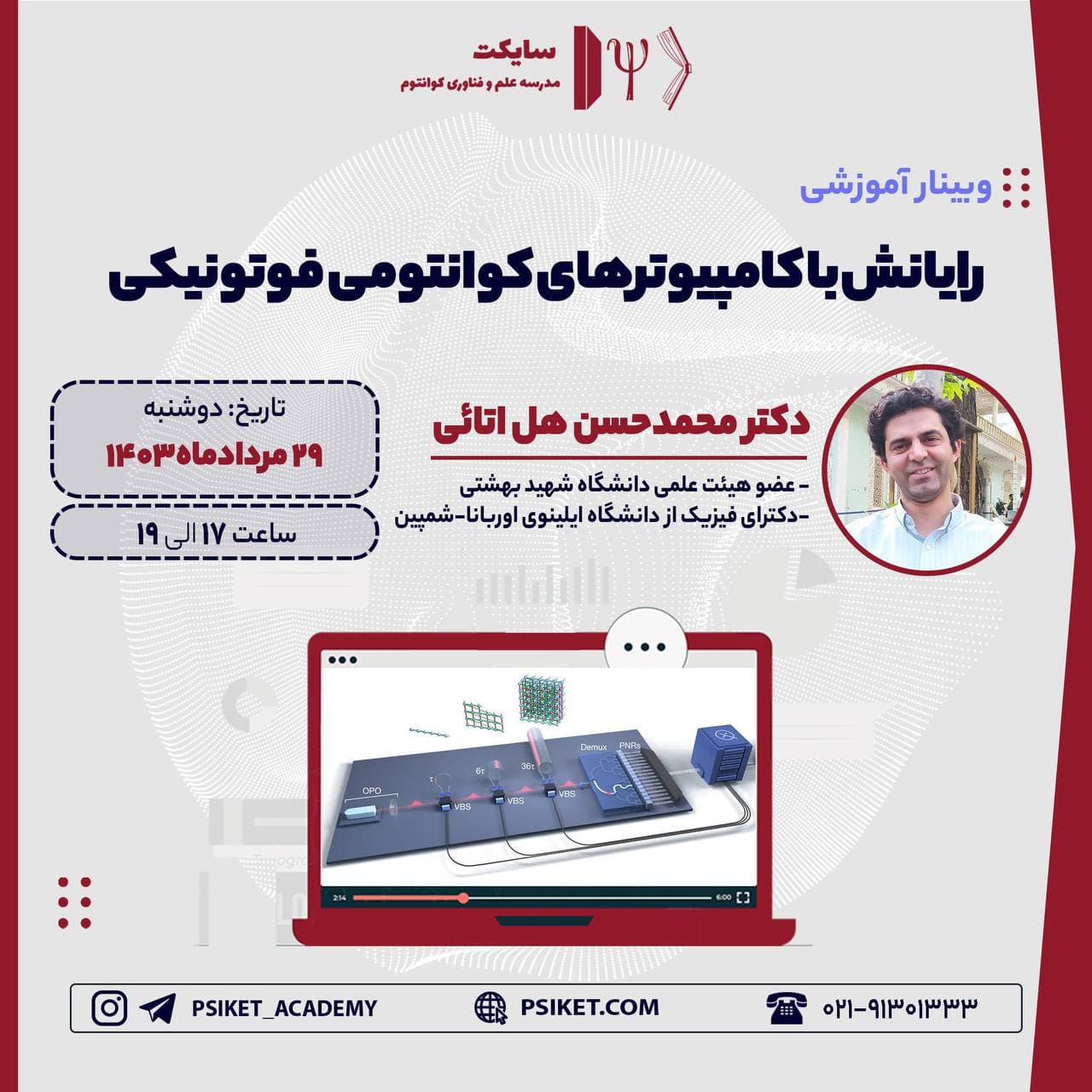
Photonic quantum computers are single-purpose quantum computers that have recently attracted the attention of some start-up companies in the world. These computers are able to solve a very difficult problem, which researchers generally believe is beyond the reach of classical computers. Computing with such computers is different from computing with all-purpose, programmable quantum computers. In this presentation, we will first discuss in detail the basis of computing with photonic quantum computers, and then we will briefly mention the state of existing hardware of photonic quantum computers in the world. At the end, we examine the value of investing in such quantum computers for the country of Iran.

In this presentation, after explaining the basics of quantum computers, we will focus on superconducting quantum computers. First, we introduce the principles and main elements of circuit quantum electrodynamics (cQED) as a basis for understanding superconducting quantum computer technology. Then, we discuss the concept of resonant waveguides and artificial atoms, which are the cornerstones of cQED, and show how these structures can exhibit quantum behavior and revolutionize quantum computing and information processing. Also, we compare cQED with quantum cavity electrodynamics (CQED) and highlight its advantages. Next, we will examine superconducting quantum computers. This platform provides the possibility of engineering qubits by changing the geometry and topology of superconducting circuits and ease of control, reading and adjustability. After introducing the basics of gate-based quantum computing, we will examine the quantum layer and confirm the DiVincenzo criteria in the context of superconducting quantum computers, and we will introduce the types of superconducting qubits, the methods of applying single and double qubit gates and their reading. By following this presentation, you will gain a comprehensive understanding of superconducting qubits and the main ideas in their control and readout.

Based on the laws of quantum mechanics, future quantum computers will perform dramatically better than their conventional classical counterparts. However, large-scale universal quantum computers have yet to be built. Boson sampling, which is designed based on a linear optical network, has been considered as a fast way to demonstrate quantum superiority. While it is difficult to efficiently simulate boson sampling without noise using a classical computer, current boson sampling experiments are accompanied by loss and noise. Classical algorithms are presented for simulating Gaussian boson sampling experiments, where the sampling complexity can be significantly reduced by increasing the photon loss rate, and by simulating the true-basis distribution, they challenge claims of experimental quantum superiority.

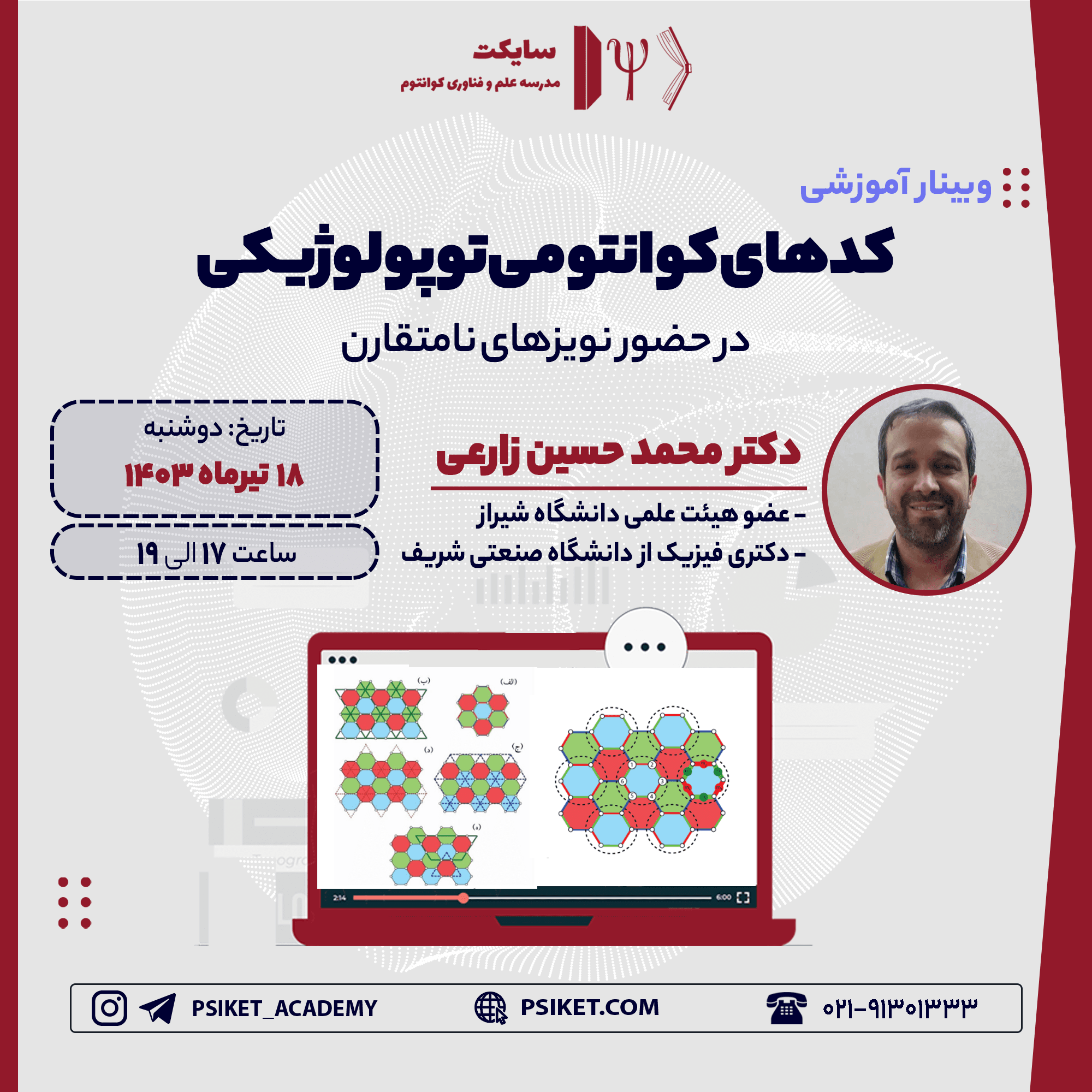
Topographical quantum codes are of special importance in quantum computing due to their inherent robustness to local disturbances, and numerous researches are underway on the robustness of these codes as well as the error tolerance threshold of such codes. On the other hand, recently and based on the studies conducted on current quantum computers, it has been shown that the noises in the laboratory are asymmetric, contrary to expectations. Fortunately, recent research shows that with a simple change in topological codes, this asymmetry can be used to increase fault tolerance. In this lecture, we will briefly introduce this idea.

The development of quantum technology has so far raised many hopes for different target markets. Sometimes the approach and driving engine of this technology is evaluated for its special functions and sometimes for its money-making future. This presentation evaluates the role and impact of quantum technology in the country's technology development by proposing a hybrid ecosystem.

Superconducting qubits with lithographic scalability are among the most promising platforms for building quantum computers. The possibility of engineering these qubits by changing the geometry and topology of superconducting circuits brings ease of control, reading and adjustability by electric currents and voltages. In this presentation, after the necessary preparations, we will introduce the basics of superconducting quantum computer architecture, including the introduction of the qubit load, the methods of applying single-qubit and double-qubit gates and its reading. Then we will discuss the most important challenges and opportunities facing this technology to build scalable quantum computers.