Join Psiket webinars to hear from experts and explore the latest ideas and breakthroughs in quantum science—live, clear, and practical.

This talk explores the major frontiers of the Second Quantum Revolution from a quantum hardware perspective, focusing on how the future of quantum technologies will be shaped. I present a forward-looking view of how the three foundational pillars—quantum computation, quantum communication, and quantum sensing—are co-evolving toward scalable and practically deployable quantum infrastructures. Within this framework, I highlight selected examples from my own work, including spin–photon interfaces in silicon for scalable quantum computing architectures and quantum networking, erbium-doped nanoparticle single-photon sources for telecom-band quantum communication, and a levitated superconducting particle coupled to a superconducting qubit as a platform for macroscopic quantum control and ultra-sensitive quantum sensing.

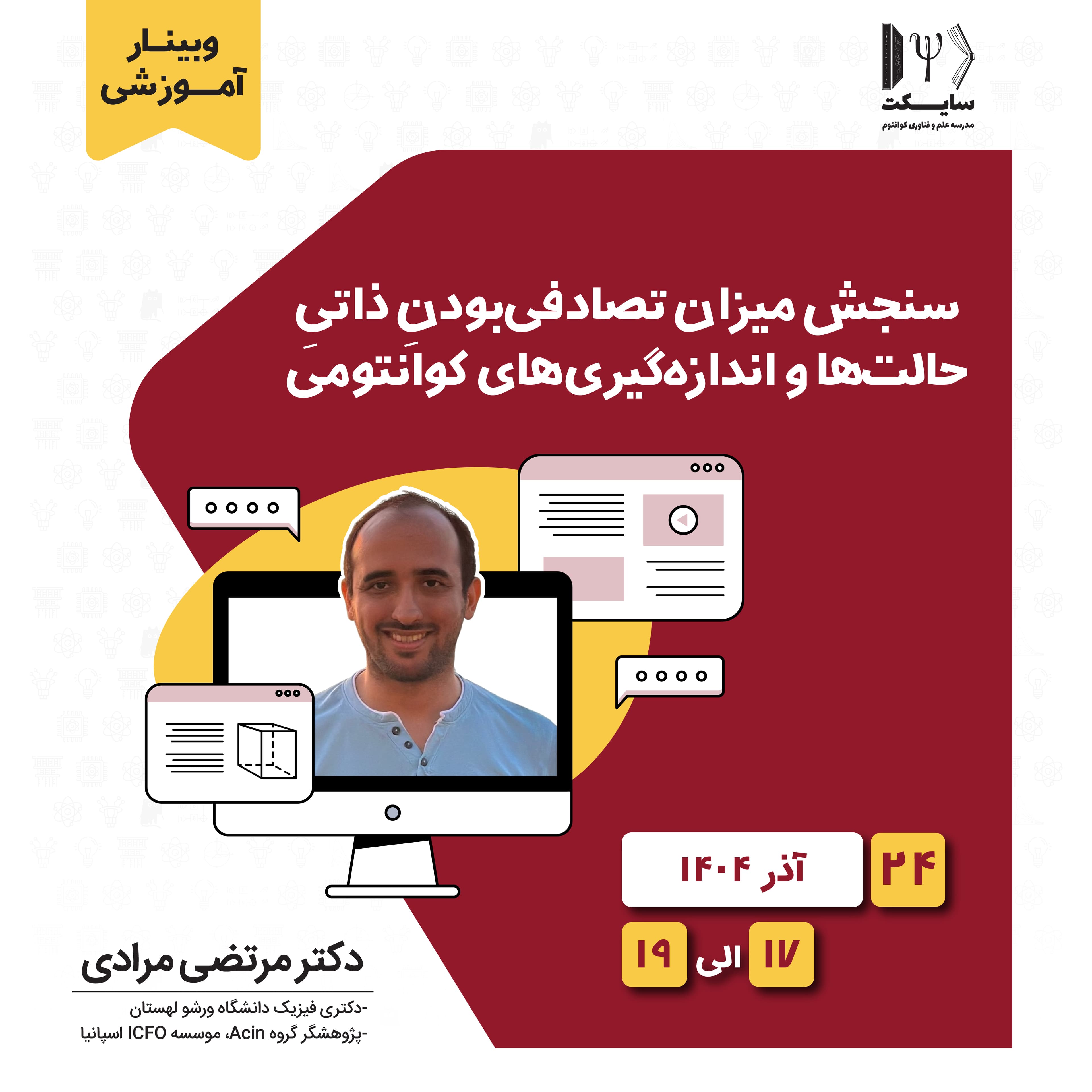
In this talk, we begin by introducing a general framework for quantifying the intrinsic quantum randomness. This framework allows us to compute the maximum guessing power of an eavesdropper, while fully accounting for the possibility that they may share classical or quantum correlations with the input state or even with the measurement itself. We then compute the intrinsic randomness of a mixed state and identify the measurements that optimize this quantity. Next, we derive the randomness generated by noisy measurements, along with the corresponding optimal states. Finally, we show that the simultaneous presence of noise in both the state and the measurement can significantly enhance the eavesdropper’s ability to guess the outcomes.

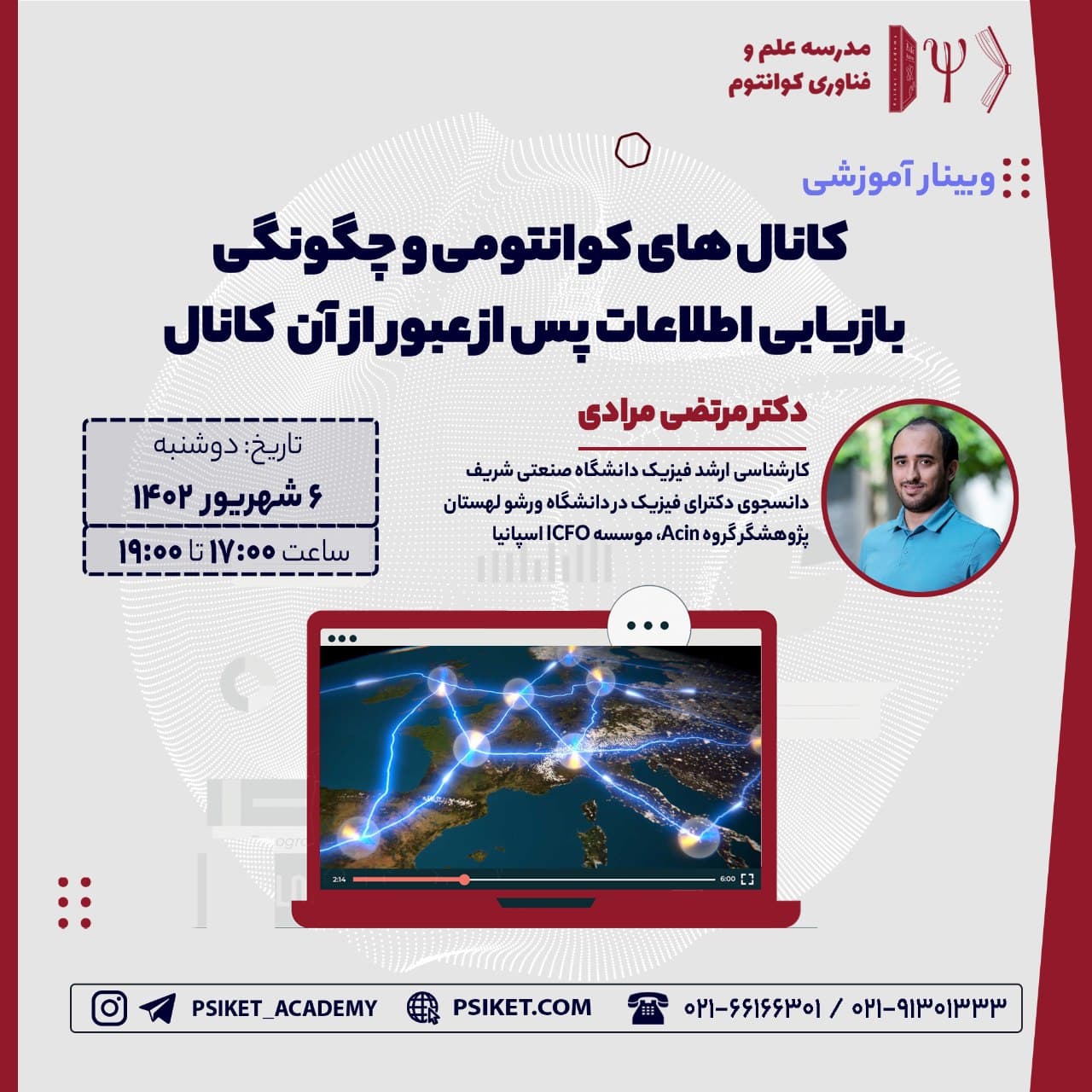
In this webinar, Dr. Morteza Moradi discusses the topic “Quantum Channels and How to Retrieve Information After Passing Through Them.” The subject of the webinar is related to quantum communications, providing a general introduction to quantum channels. If you are interested in quantum communication and quantum cryptography, this webinar is for you.

Although quantum cryptography offers extremely high security, it still faces two major challenges: transmission distance and quantum key rate. To improve this technology, we must employ powerful theoretical and computational tools—one of which is tensor networks, particularly the Multi-scale Entanglement Renormalization Ansatz (MERA) architecture. MERA provides an efficient structure for the optimal encoding of quantum states of matter, especially in critical states. In this seminar, we will demonstrate how MERA can serve as a novel mathematical and algorithmic language, opening new horizons in quantum cryptography. Finally, we will discuss the role of trapped-ion systems as one of the leading experimental platforms for implementing such networks.

For the design and engineering of efficient quantum systems, accurate estimation of the key parameters of quantum channels is of paramount importance. In this presentation, we employ the method of adaptive quantum estimation to achieve the maximum possible precision in estimating these parameters. By leveraging adaptive mechanisms, this approach progressively improves the accuracy of the estimates, bringing them closer to the ultimate precision bounds set by quantum mechanics. To this end, we utilize an adaptive protocol with local operations and two-way classical communication, in combination with the teleportation-stretching technique and quantum estimation theory. Furthermore, a mathematical simulation of the quantum channel is performed to validate and analyze the effectiveness of the proposed method.

Device-independent scenarios represent a fundamental shift in quantum information theory that enables the implementation of secure and verifiable quantum protocols without relying on the internal details of devices. This approach is based on Bell nonlocality, whereby violation of Bell inequality is used to ensure properties such as entanglement, randomness, and cryptographic security. This concept has wide applications in quantum cryptography, quantum random number generation, self-testing, quantum computation, and quantum networks. In device-independent quantum cryptography, the security of exchanged keys is guaranteed solely based on the violation of the inequality, without the need to know the internal workings of the sender and receiver. In the field of random numbers, this method allows for the generation of verifiable quantum random numbers that remain unpredictable even in the presence of a spy controlling the devices. Another key aspect of device-independent scenarios is self-testing, which allows us to verify quantum states and measurements based solely on observed data. This feature facilitates the verification of entanglement sources in quantum networks and plays an important role in the development of quantum-secure hardware. Despite the theoretical and practical importance of device-independent scenarios, the experimental implementation of these protocols faces challenges, including detection limitations, noise, and experimental holes that can weaken non-local correlations. However, recent advances have brought these applications closer to reality. In this presentation, a comprehensive picture of device-independent scenarios from theoretical foundations to advanced applications in quantum cryptography, random number generation, and quantum networks is presented.

In this presentation, after reviewing the basics and common methods of quantum cryptography, the weaknesses of these systems will be addressed and some of the known attacks on these systems will be reviewed. Next, a measurement device-independent cryptography method will be introduced that will eliminate the aforementioned attacks. Finally, recent advances in this field will be discussed.

The development of quantum technology has so far raised many hopes for different target markets. Sometimes the approach and driving engine of this technology is evaluated for its special functions and sometimes for its money-making future. This presentation evaluates the role and impact of quantum technology in the country's technology development by proposing a hybrid ecosystem.

Quantum mechanics began in 1900 with the introduction of the particle properties of electromagnetic radiation by the German scientist Max Planck. In 1924, Louis Dubroy stated that there is symmetry in nature and that if radiation can behave as both a particle and a wave, then matter must also have wave properties. Diffraction of particles, uncertainty principle, quantum tunneling, discretization of energy levels and some other phenomena of quantum mechanics are the direct result of wave property of particles. In this introductory presentation, some of the basic concepts of quantum mechanics will be briefly explained in comparison with the wave properties of electromagnetic radiation. Laboratory construction, field tests and practical use are introduced.